Review
. 2014 Sep;78(3):487-509.
doi: 10.1128/MMBR.00050-13.

Systems biology perspectives on minimal and simpler cells

Affiliations
Review

Systems biology perspectives on minimal and simpler cells

Joana C Xavier et al. Microbiol Mol Biol Rev. 2014 Sep.

Abstract

The concept of the minimal cell has fascinated scientists for a long time, from both fundamental and applied points of view. This broad concept encompasses extreme reductions of genomes, the last universal common ancestor (LUCA), the creation of semiartificial cells, and the design of protocells and chassis cells. Here we review these different areas of research and identify common and complementary aspects of each one. We focus on systems biology, a discipline that is greatly facilitating the classical top-down and bottom-up approaches toward minimal cells. In addition, we also review the so-called middle-out approach and its contributions to the field with mathematical and computational models. Owing to the advances in genomics technologies, much of the work in this area has been centered on minimal genomes, or rather minimal gene sets, required to sustain life. Nevertheless, a fundamental expansion has been taking place in the last few years wherein the minimal gene set is viewed as a backbone of a more complex system. Complementing genomics, progress is being made in understanding the system-wide properties at the levels of the transcriptome, proteome, and metabolome. Network modeling approaches are enabling the integration of these different omics data sets toward an understanding of the complex molecular pathways connecting genotype to phenotype. We review key concepts central to the mapping and modeling of this complexity, which is at the heart of research on minimal cells. Finally, we discuss the distinction between minimizing the number of cellular components and minimizing cellular complexity, toward an improved understanding and utilization of minimal and simpler cells.


Figures

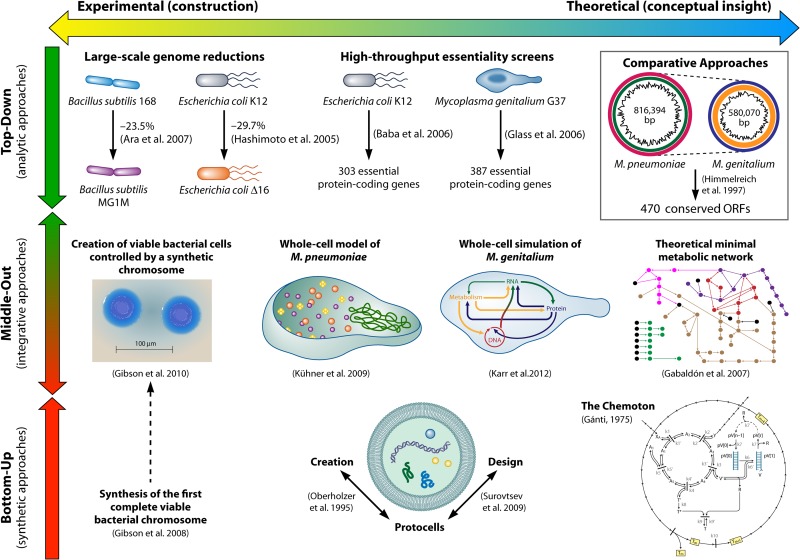
FIG 1
FIG 1
Systems approaches and relevant results toward understanding and designing minimal or simpler cells (8, 27, 45, 46, 101, 125, 140, 145, 156, 164, 170, 203, 204).
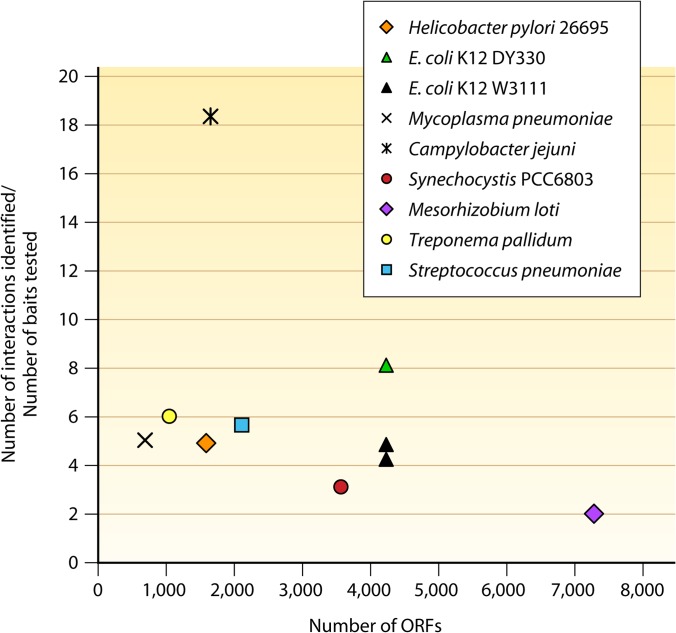
FIG 2
FIG 2
Results from high-throughput interactome studies of different prokaryotic species (16).
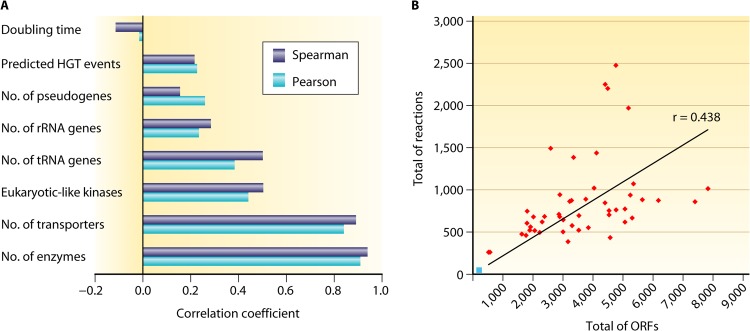
FIG 3
FIG 3
Correlations between genome sizes of prokaryotes and some genomic and phenotypic features. (A) Correlation coefficients for annotation data and doubling times. (Data for eukaryote-like kinases are from reference , data for doubling times are from reference , and the remaining data are from the IMG database [180].) All P values were <0.001, with the exception of the correlations for doubling times (nonsignificant P values). (B) Pearson's correlation between the number of reactions and the number of ORFs for 49 manually curated metabolic network reconstructions (P value of 0.001637) (for the full list and references, see Data Set S1 in the supplemental material). The blue square represents a theoretical minimal metabolic network (46).
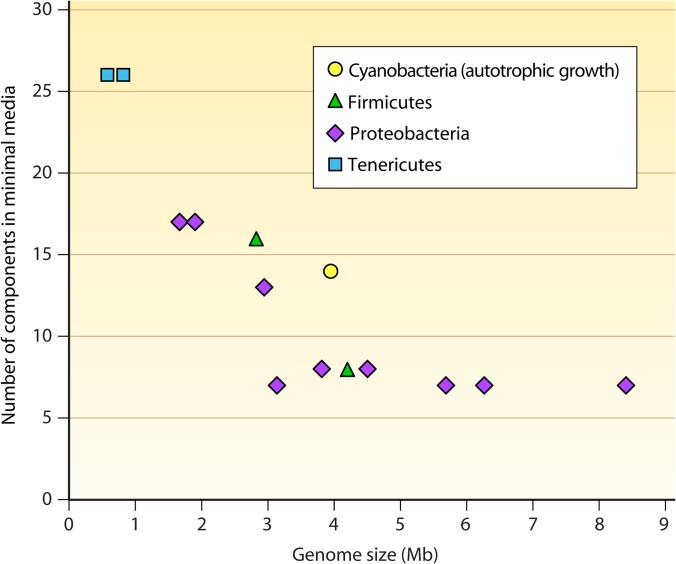
FIG 4
FIG 4
Relationship between the number of components of minimal medium and genome size for different prokaryotes of different phyla (see Data Set S2 in the supplemental material for medium composition and references).
FIG 5
FIG 5
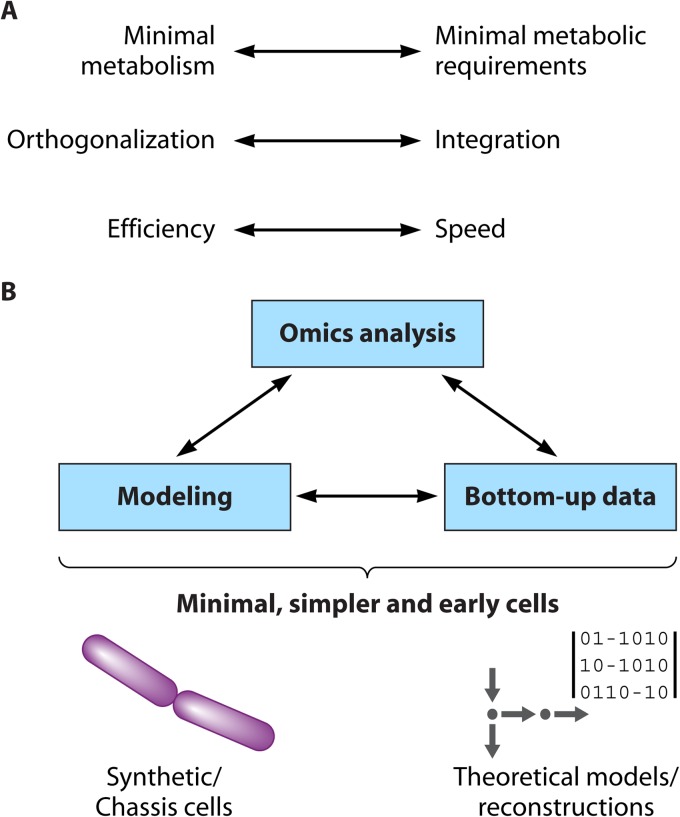
Open questions (A) and practical objectives (B) in systems biology toward the design and creation of minimal or simpler cells.

References

    1. Szostak JW, Bartel DP, Luisi PL. 2001. Synthesizing life. Nature 409:387–390. 10.1038/35053176 - DOI - PubMed
    1. Fehér T, Papp B, Pal C, Pósfai G. 2007. Systematic genome reductions: theoretical and experimental approaches. Chem. Rev. 107:3498–3513. 10.1021/cr0683111 - DOI - PubMed
    1. Henry C, Overbeek R, Stevens RL. 2010. Building the blueprint of life. Biotechnol. J. 5:695–704. 10.1002/biot.201000076 - DOI - PubMed
    1. Umenhoffer K, Fehér T, Balikó G, Ayaydin F, Pósfai J, Blattner FR, Pósfai G. 2010. Reduced evolvability of Escherichia coli MDS42, an IS-less cellular chassis for molecular and synthetic biology applications. Microb. Cell Fact. 9:38. 10.1186/1475-2859-9-38 - DOI - PMC - PubMed
    1. Rasmussen S, Chen L, Deamer D, Krakauer DC, Packard NH, Stadler PF, Bedau MA. 2004. Evolution. Transitions from nonliving to living matter. Science 303:963–965. 10.1126/science.1093669 - DOI - PubMed

Publication types