The Use of Refundable Tax Credits to Increase Low-Income Children's After-School Physical Activity Level
- PMID: 25184738
- PMCID: PMC4348362
- DOI: 10.1123/jpah.2014-0058
The Use of Refundable Tax Credits to Increase Low-Income Children's After-School Physical Activity Level
Abstract
Objective: The current study investigates the extent to which a refundable tax credit could be used to increase low-income children's after-school physical activity levels.
Methods: An experimental study was conducted evaluating the effectiveness of an intervention offering a simulated refundable tax credit to parents of elementary-school-age children (n = 130) for enrollment in after-school physical activity programs. A randomized controlled design was used, with data collected at baseline, immediately following the 4-month intervention (postintervention), and 6 weeks after the end of the intervention (follow-up). Evaluation measures included (1) enrollment rate, time spent, weekly participation frequency, duration of enrollment, and long-term enrollment patterns in after-school physical activity programs and (2) moderate to vigorous physical activity.
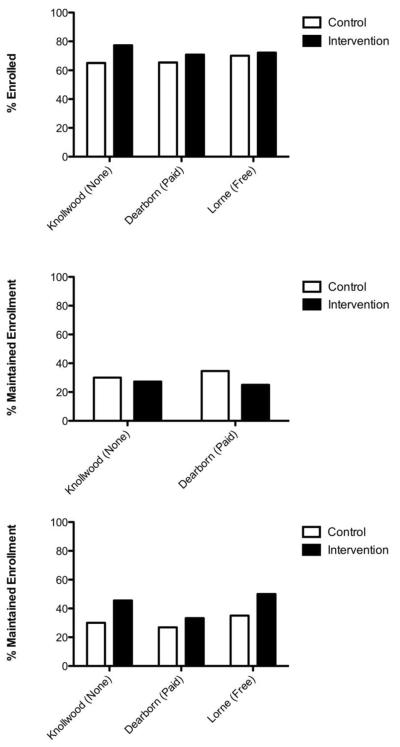
Results: The simulated tax credits did not significantly influence low-income children's rates of enrollment in after-school physical activity programs, frequency of participation, time spent in after-school physical activity programs, and overall moderate-to-vigorous intensity physical activity at postintervention or follow-up.
Conclusions: The use of refundable tax credits as incentives to increase participation in after-school physical activity programs in low-income families may have limited effectiveness. Lawmakers might consider other methods of fiscal policy to promote physical activity such as direct payment to after-school physical activity program providers for enrolling and serving a low-income child in a qualified program, or improvements to programming and infrastructure.
Figures

References
-
- Levy J, Vinter S, Richardson L, Laurent R, Segal LM. F As in fat: how obesity policies are failing in America. Trust for America's Health; Washington D.C.: 2009.
-
- Polhamus B, Dalenius K, Mackintosh H, Smith B, Grummer-Strawn L. Pediatric Nutrition Surveillance 2008 Report. U.S. Department of Health and Human Services, Centers for Disease Control and Prevention; Atlanta: 2009.
-
- Hanson MD, Chen E. Socioeconomic status and health behaviors in adolescence: a review of the literature. J Behav Med. 2007;30(3):263–85. - PubMed
-
- Janssen I, Boyce WF, Simpson K, Pickett W. Influence of individual-and-are-level measures of socioeconomic status on obesity, unhealthy eating, and physical inactivity in Canadian adolescents. Am J Clin Nutr. 2006;83:139–145. - PubMed
-
- Centers for Disease Control and Prevention Physical activity levels among children aged 9–13 years- United States, 2002. MMWR CDC Surveillance Summaries. 2003;52:785–788. - PubMed
Publication types
MeSH terms
Grants and funding
LinkOut - more resources
Full Text Sources
Other Literature Sources
Medical