Clinical Trial
. 2014 Nov;21(11):1490-9.
doi: 10.1128/CVI.00406-14. Epub 2014 Sep 3.

A Novel multivalent OspA vaccine against Lyme borreliosis is safe and immunogenic in an adult population previously infected with Borrelia burgdorferi sensu lato

Affiliations
Clinical Trial

A Novel multivalent OspA vaccine against Lyme borreliosis is safe and immunogenic in an adult population previously infected with Borrelia burgdorferi sensu lato

Nina Wressnigg et al. Clin Vaccine Immunol. 2014 Nov.

Abstract

Lyme borreliosis (LB) patients who recover, as well as previously infected asymptomatic individuals, remain vulnerable to reinfection with Borrelia burgdorferi sensu lato. There is limited information available about the use of OspA vaccines in this population. In this study, a randomized double-blind phase I/II trial was performed to investigate the safety and immunogenicity of a novel multivalent OspA vaccine in healthy adults who were either seronegative or seropositive for previous B. burgdorferi sensu lato infection. The participants received three monthly priming immunizations with either 30 μg or 60 μg alum-adjuvanted OspA antigen and a booster vaccination either 6 months or 9 to 12 months after the first immunization. The antibody responses to the six OspA serotypes included in the vaccine were evaluated. Adverse events were predominantly mild and transient and were similar in the seronegative and seropositive populations. Substantial enzyme-linked immunosorbent assay (ELISA) and surface-binding antibody responses against all six OspA antigens were induced after the primary immunization schedule in both populations, and they were substantially increased with both booster schedules. The antibody responses induced by the two doses were similar in the seronegative population, but there was a significant dose response in the seropositive population. These data indicate that the novel multivalent OspA vaccine is well tolerated and immunogenic in individuals previously infected with B. burgdorferi sensu lato. (This study is registered at ClinicalTrials.gov under registration no. NCT01504347.).


Figures

FIG 1
FIG 1
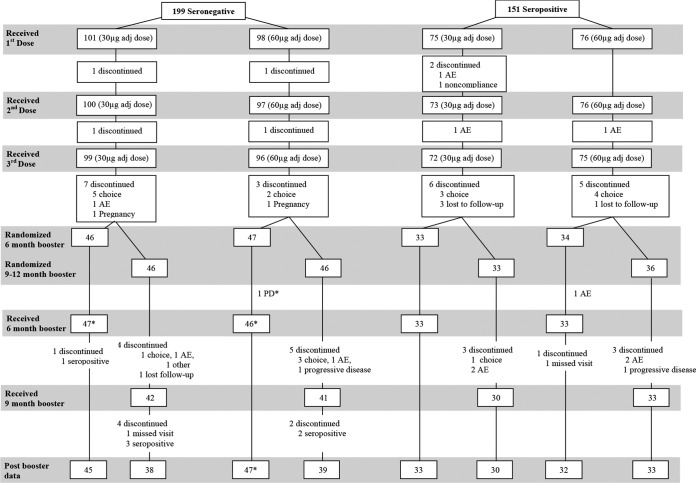
Trial profile. Asterisks (*) indicate a protocol deviation (PD), in which the subject was randomized to receive the 60-μg dose but was mistakenly administered the 30-μg dose (the subject was included in the immunogenicity data set for the 60-μg dose). Discontinuation by choice denotes discontinuation at the request of the patient, unrelated to adverse events. Of the 10 participants who discontinued due to an AE, three were judged to be related or possibly related to the vaccination: one reported fatigue, one arthralgia, headache, fatigue, and myalgia, and one alopecia areata (also reported in the medical history) and moderate arthritis (acute arthritis of the proximal interphalangeal finger joints of two fingers of the right hand; an X-ray examination gave no indication of arthritis or arthrosis). Of the two participants who discontinued due to progressive disease, one discontinued due to symptoms of hypothyroidism and the other one due to symptoms associated with type 2 diabetes. Of six participants who discontinued between the primary and booster immunizations due to being assessed as seropositive by C6-ELISA, 1 was subsequently confirmed by line blot, and five were seronegative by line blot. adj, adjuvanted.
FIG 2
FIG 2
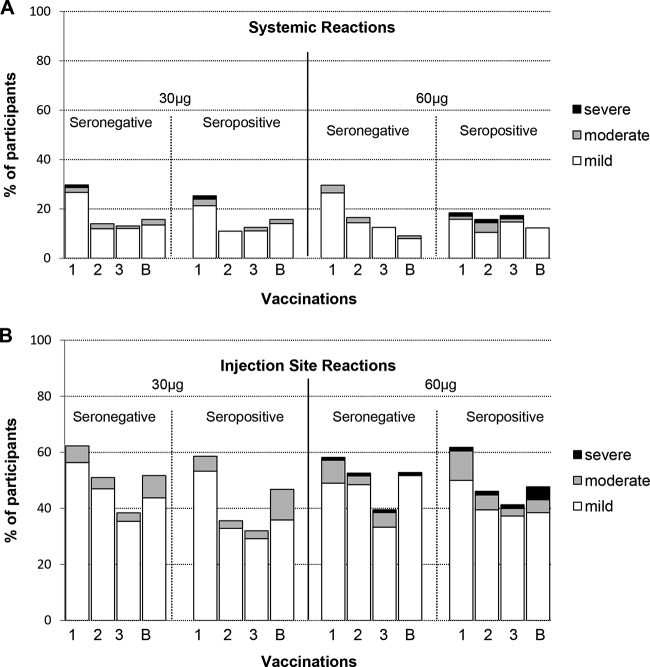
Tolerability profile. Shown are solicited systemic (A) and injection site (B) reactions within 7 days of first (1), second (2), third (3), and booster (B) vaccination with the 30-μg and 60-μg doses in seronegative and seropositive participants. The data are the % participants with mild (white), moderate (gray), and severe (black) reactions. The data for the 6-month and 9- to 12-month booster immunizations are combined.
FIG 3
FIG 3
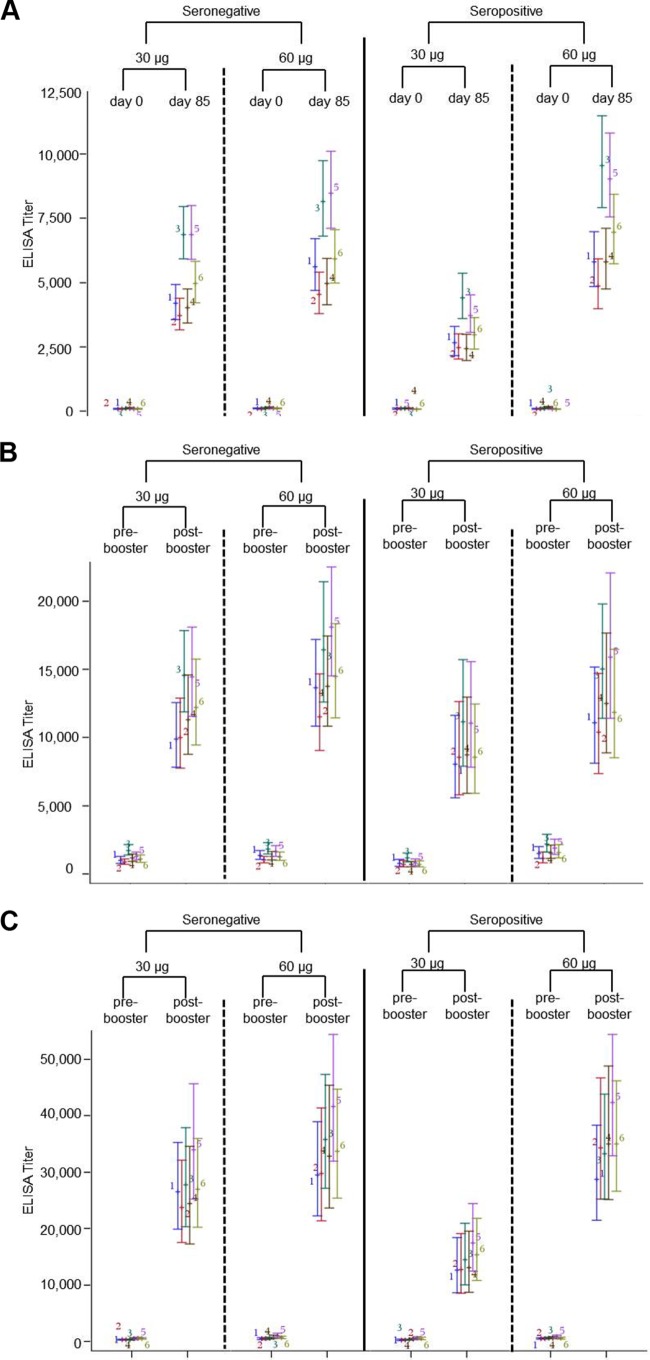
ELISA titers induced against OspA serotypes 1 to 6 (marked by different color bars and labeled by number) in seronegative and seropositive participants receiving the 30-μg and 60-μg doses at baseline and 28 days after the third priming immunization (day 85) (A), before the 6-month booster (prebooster) and 28 days after the 6-month booster (postbooster) (B), and before the 9- to 12-month booster (prebooster) and 28 days after the 9- to 12-month booster (postbooster) (C). The data are the GMTs and 95% CIs.
FIG 4
FIG 4
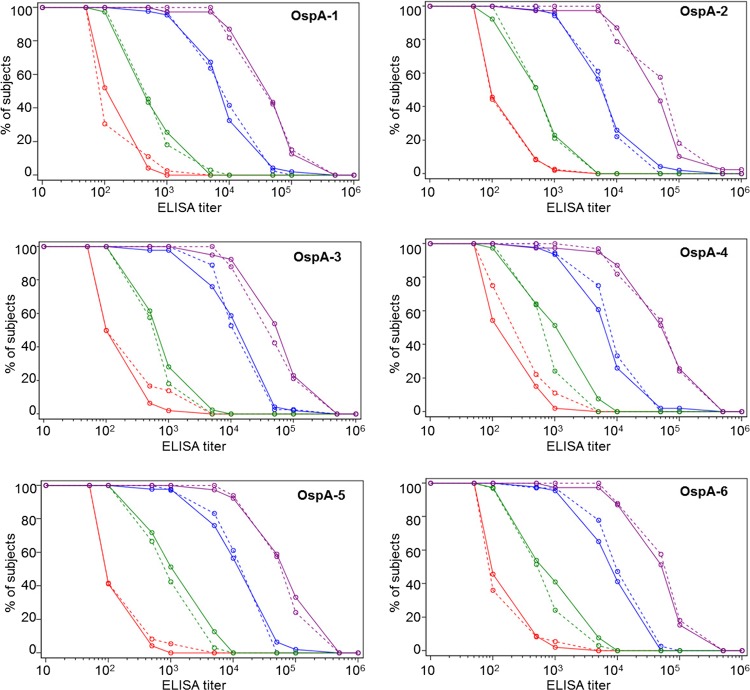
Reverse cumulative distribution of ELISA antibody titers against OspA serotypes 1 to 6 (marked by different color bars and labeled by number) in seronegative and seropositive participants receiving three priming immunizations with the 60-μg dose and a booster at 9 to 12 months after the first immunization. The seronegative participants are represented by solid lines, and the seropositive participants are represented by dashed lines. The data are at baseline (red lines), 28 days after the third priming immunization (blue lines), before the 9- to 12-month booster (green lines), and 28 days after the 9- to 12-month booster (purple lines).
FIG 5
FIG 5
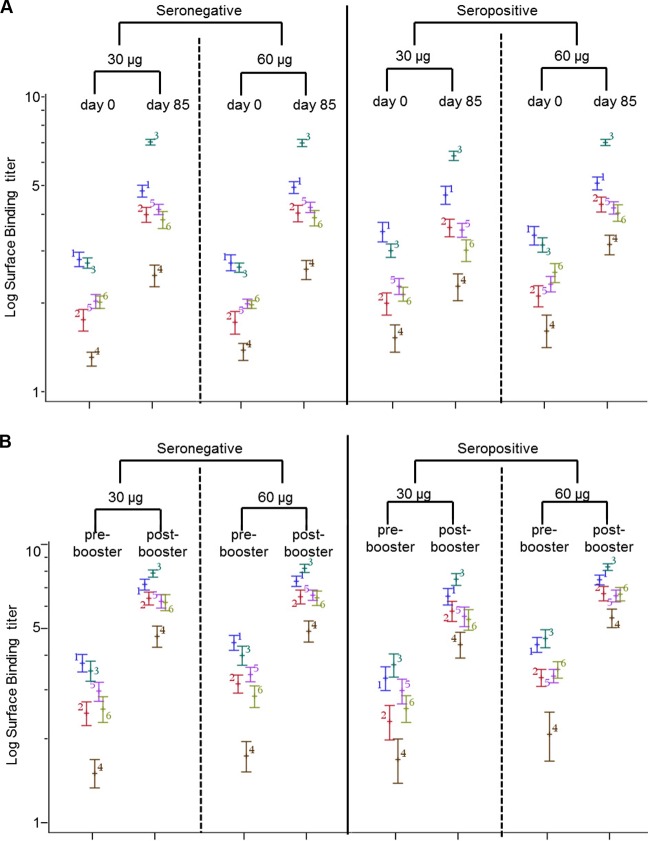
Surface-binding antibody titers induced against OspA serotypes 1 to 6 in seronegative and seropositive participants receiving three priming immunizations with the 60-μg dose and a booster at 9 to 12 months after the first immunization at baseline and 28 days after the third priming immunization (day 85) (A) and before the 9- to 12-month booster (prebooster) and 28 days after the 9 to 12 month booster (postbooster) (B). The data are the GMTs and 95% CIs.

References

    1. Stanek G, Wormser GP, Gray J, Strle F. 2012. Lyme borreliosis. Lancet 379:461–473. 10.1016/S0140-6736(11)60103-7. - DOI - PubMed
    1. Steere AC, Livey I. 2012. Lyme disease vaccines, p 1122–1132 In Plotkin SA, Orenstein WA, Offit PA. (ed), Vaccines, 6th ed, Elsevier, Philadelphia, PA.
    1. Centers for Disease Control and Prevention (CDC). 2013. Notice to readers: final 2012 reports of nationally notifiable infectious diseases. MMWR Morb. Mortal. Wkly. Rep. 62:669–682. - PMC - PubMed
    1. Kuehn BM. 2013. CDC estimates 300,000 U.S. cases of Lyme disease annually. JAMA 310:1110. 10.1001/jama.2013.278331. - DOI - PubMed
    1. Lindgren E, Jaenson TGT. 2006. Lyme borreliosis in Europe: influences of climate and climate change, epidemiology, ecology and adaptation measures. World Health Organization Regional Office for Europe, Copenhagen, Denmark: http://www.euro.who.int/document/E89522.pdf.

Publication types

MeSH terms

Associated data