Review
. 2014 Aug 29;13 Suppl 1(Suppl 1):S3.
doi: 10.1186/1475-2859-13-S1-S3. Epub 2014 Aug 29.

Novel bacteriocins from lactic acid bacteria (LAB): various structures and applications

Review

Novel bacteriocins from lactic acid bacteria (LAB): various structures and applications

Rodney H Perez et al. Microb Cell Fact. .

Abstract

Bacteriocins are heat-stable ribosomally synthesized antimicrobial peptides produced by various bacteria, including food-grade lactic acid bacteria (LAB). These antimicrobial peptides have huge potential as both food preservatives, and as next-generation antibiotics targeting the multiple-drug resistant pathogens. The increasing number of reports of new bacteriocins with unique properties indicates that there is still a lot to learn about this family of peptide antibiotics. In this review, we highlight our system of fast tracking the discovery of novel bacteriocins, belonging to different classes, and isolated from various sources. This system employs molecular mass analysis of supernatant from the candidate strain, coupled with a statistical analysis of their antimicrobial spectra that can even discriminate novel variants of known bacteriocins. This review also discusses current updates regarding the structural characterization, mode of antimicrobial action, and biosynthetic mechanisms of various novel bacteriocins. Future perspectives and potential applications of these novel bacteriocins are also discussed.


Figures
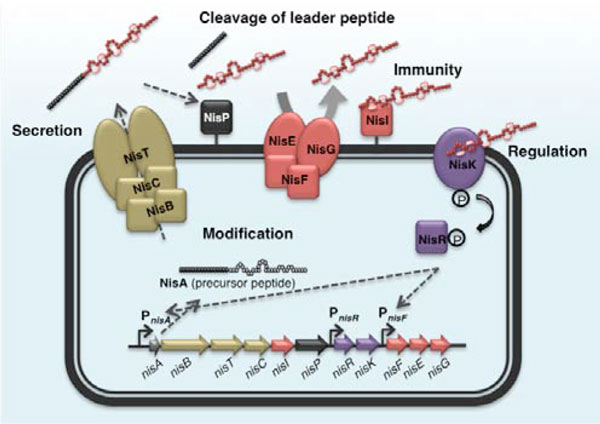
Figure 1
Figure 1
A schematic diagram of the biosynthesis of nisin A. Nisin A is ribosomally synthesized as an inactive prepeptide, NisA, consisting of an N-terminal leader sequence attached to a propeptide moiety. Modification enzymes, NisB and NisC, dehydrate and cyclize the propeptide respectively, and subsequently the ABC transporter, NisT, translocates the modified prepeptide into the extracellular space. The protease, NisP, then cleaves off the leader peptide, releasing the mature (active form) nisin A. The lipoprotein NisI that can bind to nisin A, and the multi-protein ABC transporter complex NisFEG, which expels nisin A from the cell, comprise the self-immunity system for nisin A. Two-component regulation system that is responsible for the up-regulation of the nisin gene cluster is composed of a histidine kinase, NisK, and a response regulator, NisR. Nisin A serves as the signal peptide that activates this regulation system.
Figure 2
Figure 2
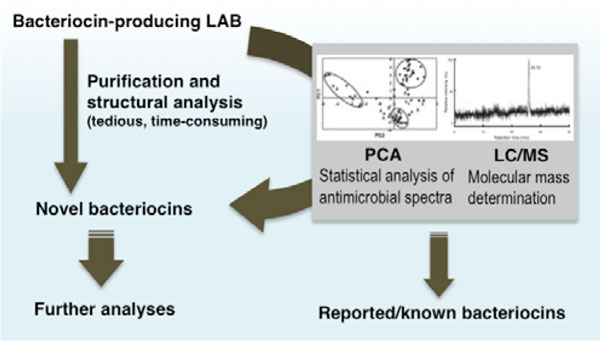
Rapid screening system for novel LAB bacteriocins. Bacteriocins from various LAB strains are evaluated for novelty at the early stage of screening. The process of bacteriocin purification and structural analysis are tedious and time-consuming, and in most cases would lead to the isolation of known bacteriocins. Hence, it is necessary to evaluate the novelty as early as possible during the screening process. In this system ESI-LC/MS analyses of the culture supernatant, combined with principal component analysis (PCA) of their activity spectra, are employed. Potential novel bacteriocins are then selected for purification and further analyses.
Figure 3
Figure 3
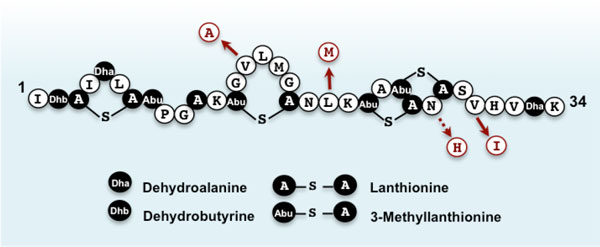
Primary structures of nisin Q and its replacement amino acid residues relative to the other nisin variants, nisin A and Z. Solid arrows indicate replacement residues for both nisin A and Z whereas broken arrow indicate nisin A. Unusual post-translationally modified amino acids such as dehydroalanine, dehydrobutyrine, lanthionine, and 3-methyllanthionine are indicated in black.
Figure 4
Figure 4
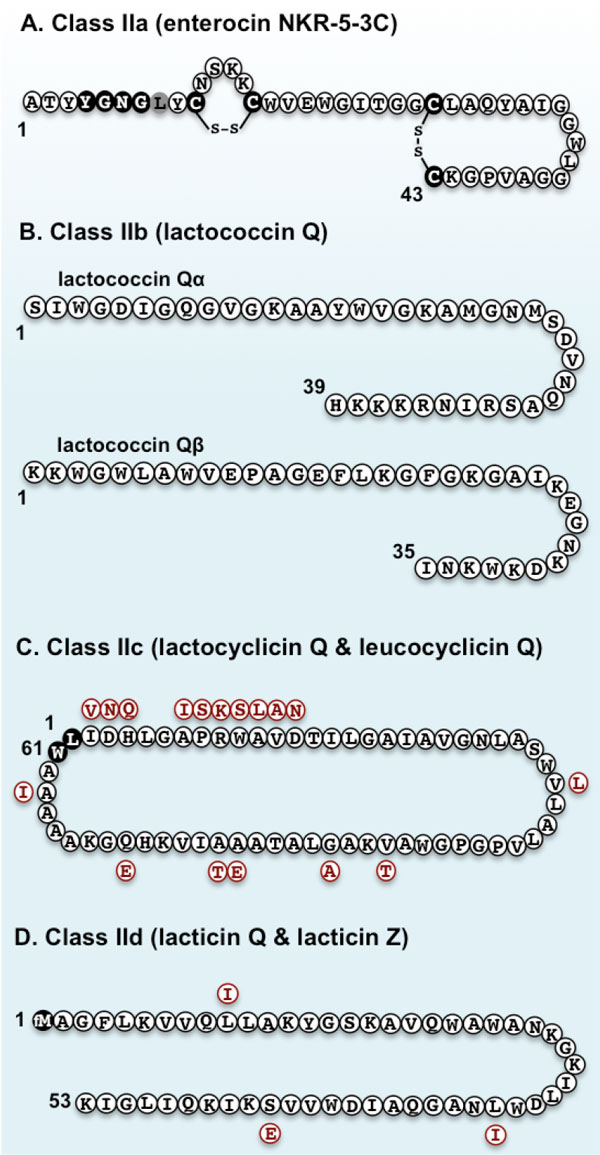
Primary structures of representative class II bacteriocins isolated/studied in our laboratory. Enterocin NKR-5-3C (Ent53C) is a novel class IIa (pediocin-like) bacteriocin. The conserved YGNGV (but in the case of Ent53C, V is replaced with L, shown in gray residue) and cysteine residues involved in disulfide bridges are highlighted in black (A). Lactococcin Q is a novel class IIb (two-peptide) bacteriocin, which is comprised of two peptides (Qα and Qβ) that show synergistic activity with each other (B). Lactocyclicin Q (LycQ) and leucocyclicin Q (LcyQ) are novel class IIc (circular) bacteriocins. Residues in red represent the replaced residues to constitute for LcyQ. N- and C- terminal residues involved in the head-to-tail cyclization are shown in dark residues (C). Lacticin Q and lacticin Z are leaderless (class IId) bacteriocins with a formylated methionine residue (fM) at the first N-terminal residue. Residues in red represent the replaced residues to constitute for lacticin Z (D).
Figure 5
Figure 5
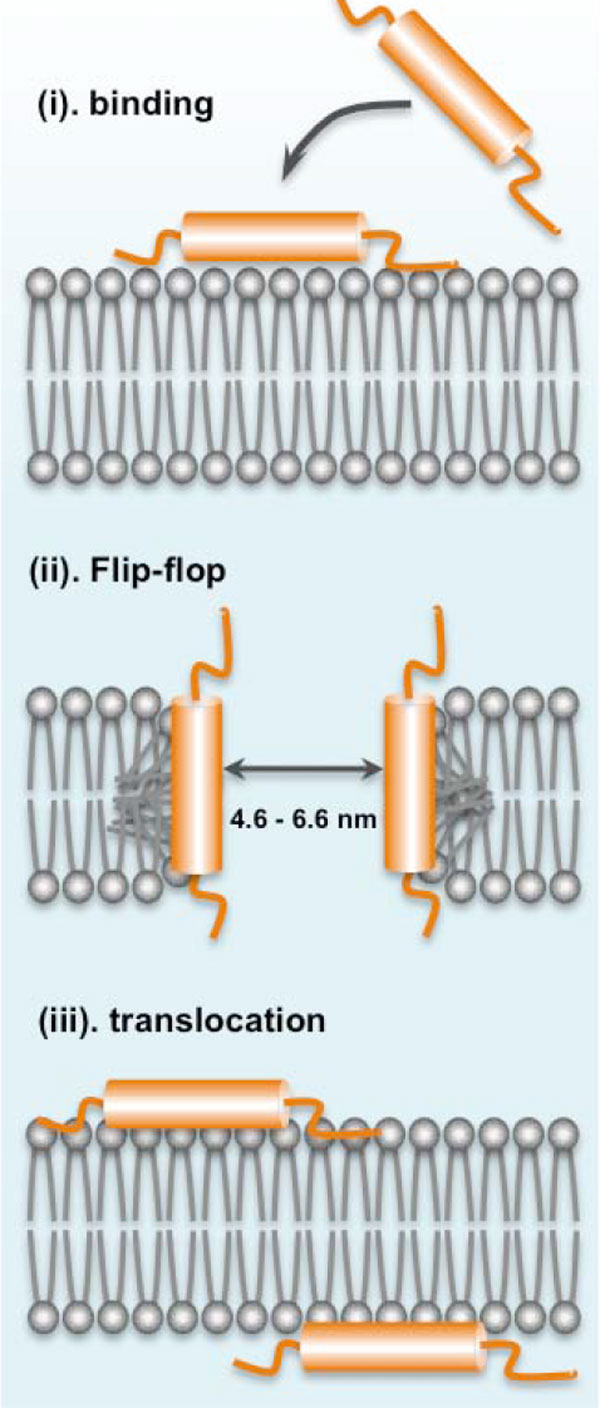
Huge toroidal pore (HTP) model of the antimicrobial action of lacticin Q. The highly cationic lacticin Q rapidly binds to the negatively charged phospholipid bilayer membrane (i) that would result in the formation of HTPs, coupled with membrane lipid flip-flop that would cause the leakage of intracellular components, including ions, ATP, and small proteins (ii), after which, the lacticin Q molecules translocate into the membrane as the pore closes (iii).

References

    1. De Vuyst L, Leroy F. Bacteriocins from lactic acid bacteria: production, purification, and food applications. J Mol Microbiol Biotechnol. 2007;13:194–199. doi: 10.1159/000104752. - DOI - PubMed
    1. Cleveland J, Montville TJ, Nes IF, Chikindas ML. Bacteriocins: safe, natural antimicrobials for food preservation. Int J Food Microbiol. 2001;71:1–20. doi: 10.1016/S0168-1605(01)00560-8. - DOI - PubMed
    1. Kemperman R, Kuipers A, Karsens H, Nauta A, Kuipers O, Kok J. Identification and characterization of two novel clostridial bacteriocins, circularin A and closticin 574. Appl Environ Microbiol. 2003;69:1589–1597. doi: 10.1128/AEM.69.3.1589-1597.2003. - DOI - PMC - PubMed
    1. Kemperman R, Jonker M, Nauta A, Kuipers OP, Kok J. Functional analysis of the gene cluster involved in production of the bacteriocin circularin A by Clostridium beijerinckii ATCC 25752. Appl Environ Microbiol. 2003;69:5839–5848. doi: 10.1128/AEM.69.10.5839-5848.2003. - DOI - PMC - PubMed
    1. Chen H, Hoover DG. Bacteriocins and their food applications. Compr Rev Food Sci F. 2003;2:82–100. doi: 10.1111/j.1541-4337.2003.tb00016.x. - DOI - PubMed

Publication types

MeSH terms