


Current practices of screening for incident hepatitis C virus (HCV) infection among HIV-infected, HCV-uninfected individuals in primary care
- PMID: 25186591
- PMCID: PMC4311177
- DOI: 10.1093/cid/ciu698
Current practices of screening for incident hepatitis C virus (HCV) infection among HIV-infected, HCV-uninfected individuals in primary care
Abstract
Background: Human immunodeficiency virus (HIV)-infected, hepatitis C virus (HCV)-uninfected patients are at risk for incident HCV infection, but little is known about screening practices for incident HCV among HIV-infected individuals in HIV primary care clinics.
Methods: We used data from the Center for AIDS Research Network of Integrated Clinical Systems (CNICS) to investigate historical trends in screening for incident HCV infection among HIV-infected patients who were HCV-uninfected at enrollment in care. We used descriptive measures and Poisson regression to identify factors associated with screening for HCV infection (using HCV antibody or RNA), performed temporal analyses to assess changes in screening over time, and investigated the frequency with which elevated alanine aminotransferase (ALT) levels were followed by diagnostic HCV testing.
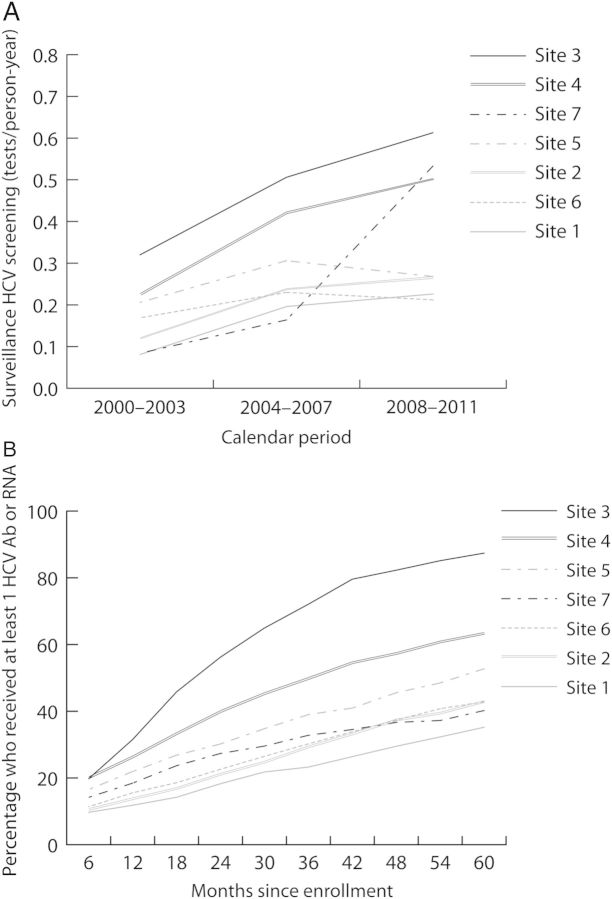
Results: Among 17 090 patients registered at CNICS sites between 2000 and 2011, 14 534 (85%) received HCV antibody screening within 3 months of enrolling in care, and 9077 met all of the inclusion criteria. Only 55.6% ever received additional HCV screening. HCV screening increased over time, but not uniformly at all sites. Only 26.7% of first-time ALT elevations to >100 IU/L were followed up within 12 months by HCV antibody or RNA testing.
Conclusions: Although most HIV-infected patients were screened for prevalent HCV infection at enrollment in care, only half who were HCV uninfected were screened again. Screening varied between sites, even when controlling for demographics and risk behaviors. Patients with new ALT elevations to >100 IU/L were seldom assessed for incident HCV infection. Guidelines are needed to help HIV providers know whom to screen, how frequently to screen, and which screening test to use.
Keywords: HIV; hepatitis C; incidence; men who have sex with men; screening.
© The Author 2014. Published by Oxford University Press on behalf of the Infectious Diseases Society of America. All rights reserved. For Permissions, please e-mail: journals.permissions@oup.com.
Figures
References
-
- Soriano V, Puoti M, Sulkowski M, et al. Care of patients coinfected with HIV and hepatitis C virus: 2007 updated recommendations from the HCV-HIV International Panel. AIDS. 2007;21:1073–89. - PubMed
-
- Rockstroh JK, Mocroft A, Soriano V, et al. Influence of hepatitis C virus infection on HIV-1 disease progression and response to highly active antiretroviral therapy. J Infect Dis. 2005;192:992–1002. - PubMed
-
- Gebo KA, Diener-West M, Moore RD. Hospitalization rates differ by hepatitis C status in an urban HIV cohort. J Acquir Immune Defic Syndr. 2003;34:165–73. - PubMed
-
- Te HS, Jensen DM. Epidemiology of hepatitis B and C viruses: a global overview. Clin Liver Dis. 2010;14:1–21. - PubMed
-
- McHutchison JG, Bacon BR. Chronic hepatitis C: an age wave of disease burden. Am J Manag Care. 2005;11(10 suppl):S286–95. quiz S307–11. - PubMed
Publication types
MeSH terms
Substances
Grants and funding
LinkOut - more resources
Full Text Sources
Other Literature Sources
Medical
Miscellaneous
