Review
. 2015 Jan;22(1):22-33.
doi: 10.1038/cdd.2014.112. Epub 2014 Sep 5.

The complexity of miRNA-mediated repression

Affiliations
Review

The complexity of miRNA-mediated repression

A Wilczynska et al. Cell Death Differ. 2015 Jan.

Abstract

Since their discovery 20 years ago, miRNAs have attracted much attention from all areas of biology. These short (∼22 nt) non-coding RNA molecules are highly conserved in evolution and are present in nearly all eukaryotes. They have critical roles in virtually every cellular process, particularly determination of cell fate in development and regulation of the cell cycle. Although it has long been known that miRNAs bind to mRNAs to trigger translational repression and degradation, there had been much debate regarding their precise mode of action. It is now believed that translational control is the primary event, only later followed by mRNA destabilisation. This review will discuss the most recent advances in our understanding of the molecular underpinnings of miRNA-mediated repression. Moreover, we highlight the multitude of regulatory mechanisms that modulate miRNA function.


Figures
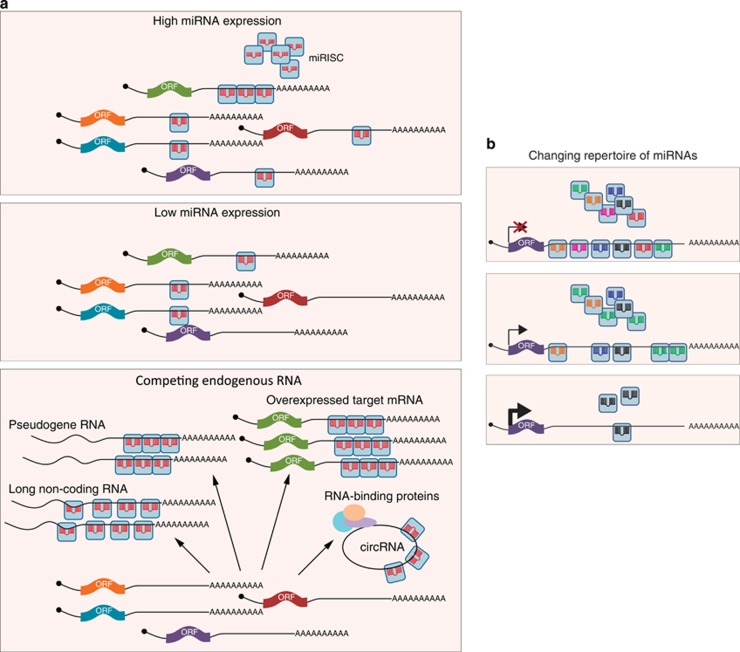
Figure 1
Figure 1
(a) A single mRNA can target hundreds of mRNAs and coordinately regulate them. The extent of regulation of a particular mRNA will depend on the expression levels of the miRNA that targets it as well as competing RNA. (b) One mRNA can have target sites for multiple miRNA. The repertoire of miRNAs in a given cell type, or under certain cellular conditions may result in differential regulation of the same target mRNA
Figure 2
Figure 2
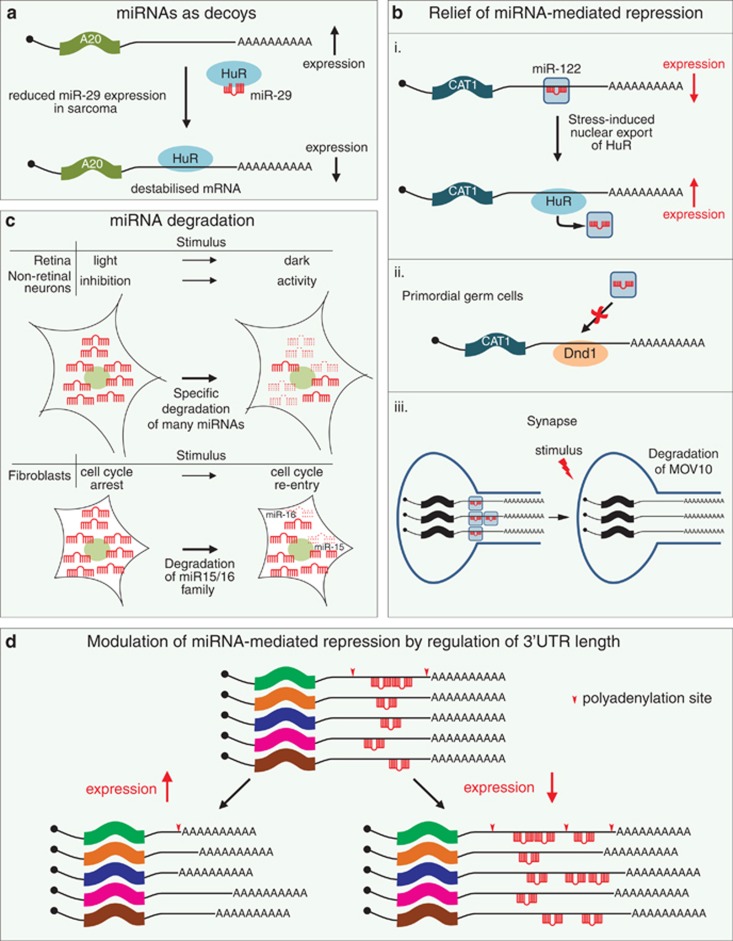
miRNA-mediated control of gene expression may be regulated in many ways. (a) miRNAs may act as decoys, competing for an RNA-binding protein with an mRNA, an activity beyond the scope of their predominant role in guiding the repressive RISC complex to a target mRNA. For example, miR-29 acts as a decoy for the RNA-binding protein HuR. (b) miRNA-mediated translational repression of an mRNA may be relieved by the preferential binding of a positive-regulator RNA-binding protein. (i) Cellular stress can cause the relief of repression of CAT-1 mRNA by miR-122, which is mediated by the HuR. (ii) Binding of Dnd1 to mRNA in primordial germ cells prevents their association with miRISC, ensuring continued translation. (iii) In the synapse, the stimulus-dependent degradation of a RISC component (MOV10) results in the relief of repression of localised mRNAs. (c) Particular miRNAs may be degraded in upon exposure to specific stimuli, which will lead to the reactivation of mRNAs involved in the cellular response to the stimulus. Selective miRNA degradation has been observed in the retina. Members of the miR-15/16 family are rapidly degraded upon re-entry into the cell cycle. (d) Alternative poly(A) site selection may influence protein expression by removal of miRNA target sites (use of proximal poly(A) site) or increase in their number (use of more distal poly(A) site)
Figure 3
Figure 3
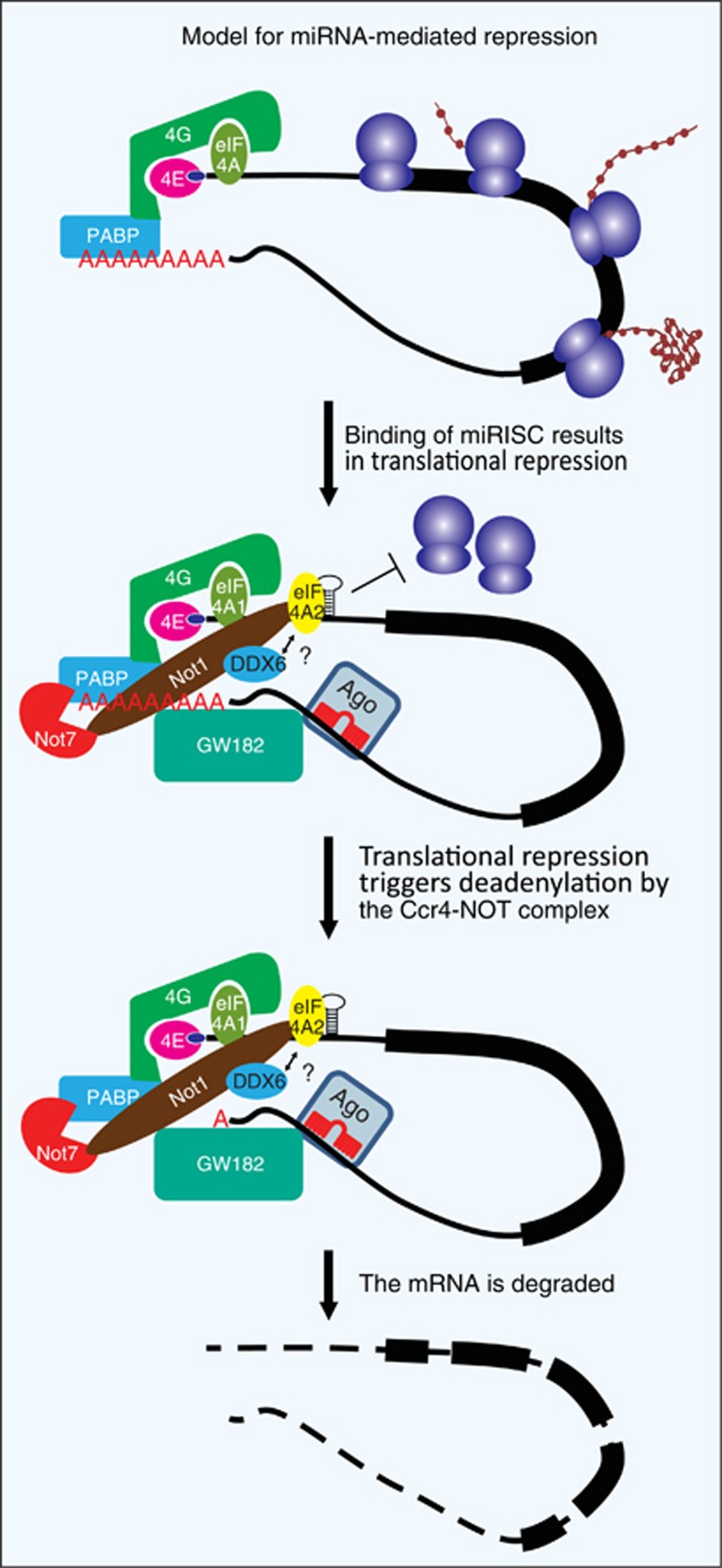
Working model of miRNA-mediated control of gene expression. The recruitment of RISC-bound miRNA to an mRNA results in translational repression. This is mediated by the DEAD-box helicase eIF4A2, which might be clamping on to the 5′UTR and inhibiting 40S scanning. Another RNA helicase, DDX6, is likely also be involved in this process. Translational repression is followed by deadenylation of the mRNA by Ccr4–NOT deadenylases and subsequent decapping and degradation. The relative contribution of the two DEAD-box RNA helicases to the translational repression, degradation and decapping remains to be determined

References

    1. Croce CM. Causes and consequences of microRNA dysregulation in cancer. Nat Rev Genet. 2009;10:704–714. - PMC - PubMed
    1. Mayr C, Bartel DP. Widespread shortening of 3′UTRs by alternative cleavage and polyadenylation activates oncogenes in cancer cells. Cell. 2009;138:673–684. - PMC - PubMed
    1. Lembo A, Di Cunto F, Provero P. Shortening of 3′UTRs correlates with poor prognosis in breast and lung cancer. PLoS One. 2012;7:e31129. - PMC - PubMed
    1. Ji Z, Lee JY, Pan Z, Jiang B, Tian B. Progressive lengthening of 3′ untranslated regions of mRNAs by alternative polyadenylation during mouse embryonic development. Proc Natl Acad Sci USA. 2009;106:7028–7033. - PMC - PubMed
    1. Bartel DP. MicroRNAs: target recognition and regulatory functions. Cell. 2009;136:215–233. - PMC - PubMed