


The mitochondrial genome of Parascaris univalens--implications for a "forgotten" parasite
- PMID: 25190631
- PMCID: PMC4262126
- DOI: 10.1186/1756-3305-7-428
The mitochondrial genome of Parascaris univalens--implications for a "forgotten" parasite
Abstract
Background: Parascaris univalens is an ascaridoid nematode of equids. Little is known about its epidemiology and population genetics in domestic and wild horse populations. PCR-based methods are suited to support studies in these areas, provided that reliable genetic markers are used. Recent studies have shown that mitochondrial (mt) genomic markers are applicable in such methods, but no such markers have been defined for P. univalens.
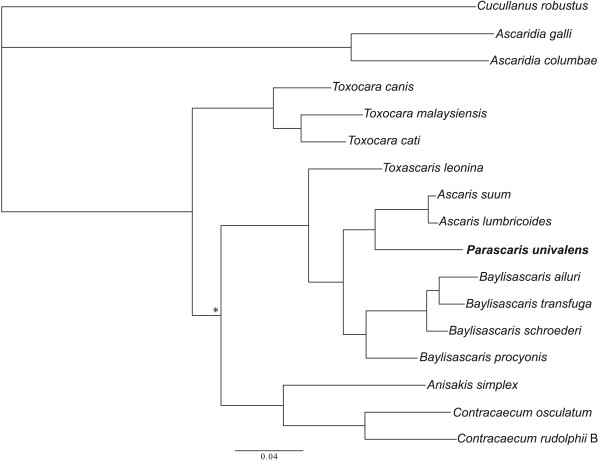
Methods: Mt genome regions were amplified from total genomic DNA isolated from P. univalens eggs by long-PCR and sequenced using Illumina technology. The mt genome was assembled and annotated using an established bioinformatic pipeline. Amino acid sequences inferred from all protein-encoding genes of the mt genomes were compared with those from other ascaridoid nematodes, and concatenated sequences were subjected to phylogenetic analysis by Bayesian inference.
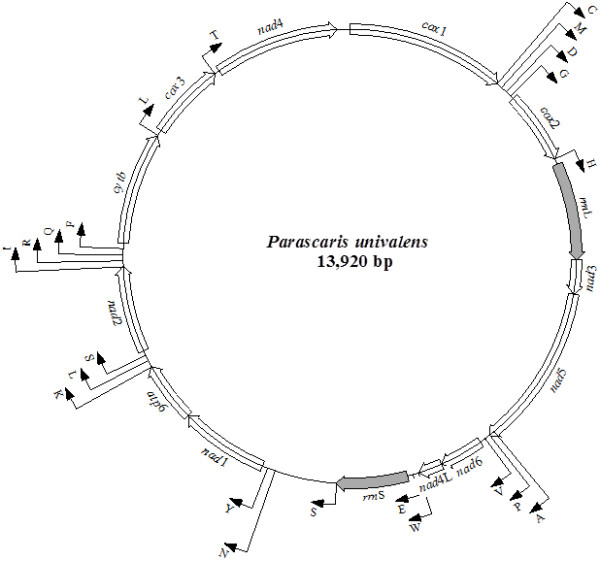
Results: The circular mt genome was 13,920 bp in length and contained two ribosomal RNA, 12 protein-coding and 22 transfer RNA genes, consistent with those of other ascaridoids. Phylogenetic analysis of the concatenated amino acid sequence data for the 12 mt proteins showed that P. univalens was most closely related to Ascaris lumbricoides and A. suum, to the exclusion of other ascaridoids.
Conclusions: This mt genome representing P. univalens now provides a rich source of genetic markers for future studies of the genetics and epidemiology of this parasite and its congener, P. equorum. This focus is significant, given that there is no published information on the specific prevalence and distribution of P. univalens infection in domestic and wild horse populations.
Figures
References
-
- Clayton HM. Ascarids: recent advances. Vet Clin North Am Equine Pract. 1986;2:313–328. - PubMed
Publication types
MeSH terms
Substances
Grants and funding
LinkOut - more resources
Full Text Sources
Other Literature Sources
