


Impact of reconstruction and reoperation on long-term patient-reported satisfaction after contralateral prophylactic mastectomy
- PMID: 25192678
- PMCID: PMC4498460
- DOI: 10.1245/s10434-014-4053-3
Impact of reconstruction and reoperation on long-term patient-reported satisfaction after contralateral prophylactic mastectomy
Abstract
Background: Contralateral prophylactic mastectomy (CPM) is increasingly chosen by breast cancer patients and may be related to increased use of immediate reconstruction. This study examines long-term patient satisfaction with CPM and reconstruction in a historical cohort.
Methods: 621 unilateral breast cancer patients with a family history of breast cancer who underwent CPM between 1960 and 1993 were surveyed regarding quality of life (QOL) and satisfaction with CPM at two time points (approximately 10 and 20 years after CPM).
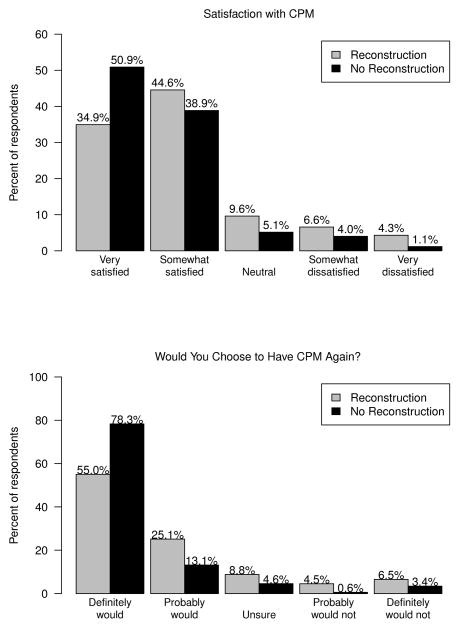
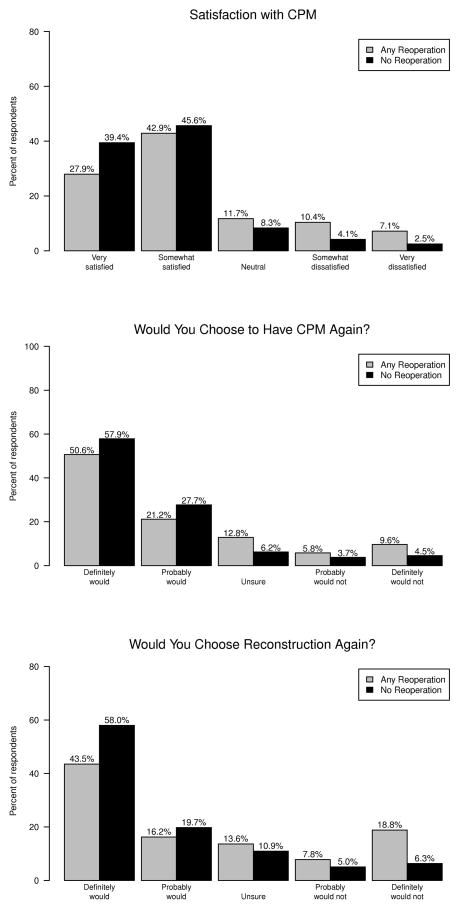
Results: 583 women responded to the first follow-up questionnaire (median 10.7 years; mean 11.9 years) after CPM. There were 403 (69 %) patients who underwent reconstruction and 180 (31 %) patients who did not. Women electing reconstruction were younger [mean age 47 versus (vs.) 53 years; p = 0.01] and more likely to be married (85 vs. 78 %; p = 0.048). Most women reported satisfaction with CPM (83 %), and they would choose CPM again (84 %) and make the same choice regarding reconstruction (73 %). However, reconstruction patients demonstrated significantly lower satisfaction (p = 0.0001) and were less likely to choose CPM again (p < 0.0001). Within the reconstruction group, 39 % needed 1 + unplanned reoperation, which was strongly associated with lower satisfaction (p = 0.0001), lower likelihood of choosing CPM again (p = 0.006), and lower likelihood of choosing reconstruction again (p < 0.0001). There were 269 women who responded to the second questionnaire (median 18.4 years; mean 20.2 years after CPM). Satisfaction with CPM remained high, with 92 % of the women stating they would choose CPM again.
Conclusions: Most women report stable long-term satisfaction with CPM. Women who had reconstruction and required reoperations in this historical cohort reported lower satisfaction.
Conflict of interest statement
Disclaimer: There are no financial disclosures or potential conflicts of interest
Figures
References
-
- McDonnell SK, Schaid DJ, Myers JL, Grant CS, Donohue JH, Woods JE, et al. Efficacy of contralateral prophylactic mastectomy in women with a personal and family history of breast cancer. J Clin Oncol. 2001;19:3938–43. - PubMed
-
- Rebbeck TR, Friebel T, Lynch HT, Neuhausen SL, van’t Veer L, Garber JE, et al. Bilateral prophylactic mastectomy reduces breast cancer risk in BRCA1 and BRCA2 mutation carriers: the PROSE Study Group. J Clin Oncol. 2004;22:1055–62. - PubMed
-
- Peralta EA, Ellenhorn JD, Wagman LD, Dagis A, Andersen JS, Chu DZ. Contralateral prophylactic mastectomy improves the outcome of selected patients undergoing mastectomy for breast cancer. Am J Surg. 2000;180:439–45. - PubMed
-
- Herrinton LJ, Barlow WE, Yu O, Greiger AM, Elmore JG, Barton MB, et al. Efficacy of prophylactic mastectomy in women with unilateral breast cancer: a cancer research network project. J Clin Oncol. 2005;23:4275–86. - PubMed
MeSH terms
Grants and funding
LinkOut - more resources
Full Text Sources
Other Literature Sources
Medical
