Review
. 2014:48:269-94.
doi: 10.1146/annurev-genet-111212-133531. Epub 2014 Sep 5.

From egg to gastrula: how the cell cycle is remodeled during the Drosophila mid-blastula transition

Affiliations
Review

From egg to gastrula: how the cell cycle is remodeled during the Drosophila mid-blastula transition

Jeffrey A Farrell et al. Annu Rev Genet. 2014.

Abstract

Many, if not most, embryos begin development with extremely short cell cycles that exhibit unusually rapid DNA replication and no gap phases. The commitment to the cell cycle in the early embryo appears to preclude many other cellular processes that only emerge as the cell cycle slows just prior to gastrulation at a major embryonic transition known as the mid-blastula transition (MBT). As reviewed here, genetic and molecular studies in Drosophila have identified changes that extend S phase and introduce a post-replicative gap phase, G2, to slow the cell cycle. Although many mysteries remain about the upstream regulators of these changes, we review the core mechanisms of the change in cell cycle regulation and discuss advances in our understanding of how these might be timed and triggered. Finally, we consider how the elements of this program may be conserved or changed in other organisms.

Keywords: Drosophila; G2; MBT; cell cycle; maternal-zygotic transition; replication.


Figures
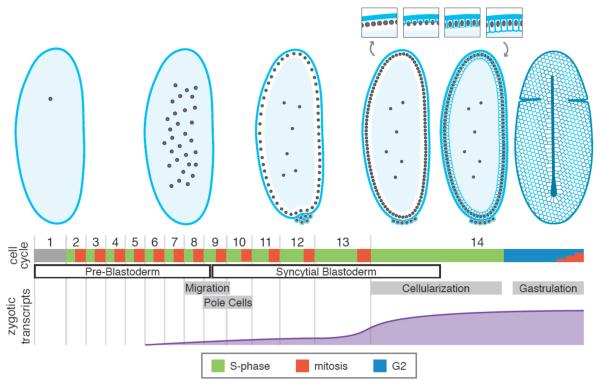
Figure 1
Figure 1. Early Development in Drosophila
A diagram of the first 14 cycles of Drosophila development with notable morphological stages illustrated at the top. Note that while most embryos are displayed as sections through the middle of the embryo with the ventral side to the right, the final illustration is a surface view, with the ventral side up. The process of cellularization is diagrammed in more detail in the insets. The duration of each phase of the cell cycle is below: S phase (green), mitosis (red), and G2 (blue). Mitosis 14 is represented as a series of small bars because the embryo is no longer synchronous at this time and individual groups of cells enter mitosis at different times according to a developmentally programmed schedule. The timing of notable morphological events are demarcated in grey boxes: the migration of the nuclei to the blastoderm, the insulation of the germline by cellularization of the pole cells, the cellularization of the blastoderm nuclei, and the onset of the first gastrulation movement—ventral furrow formation. Below this is diagrammed the approximate number of genes for which zygotic transcripts have been detected over time.
Figure 2
Figure 2. Regulation of Cdk1
Cyclin-dependent kinase 1 has diverse inputs that can regulate its function, which are diagrammed here. First, it requires a cyclin partner. Second, it requires activating phosphorylation in order to be functional. Third, it must be free of inhibitory phosphorylation, which blocks the ATP-binding pocket. This inhibitory phosphorylation is added by Wee and Myt1 kinases (which are thus inhibitors of Cdk1) and removed by String and Twine (Cdc25) phosphatases (which are thus activators of Cdk1)
Figure 3
Figure 3. Model for MBT cell cycle slowing
(a) Cartoon approximations across developmental time (marked at the top), showing replication timing of early and late replicating sequences (92), protein levels of Cyclin (29) and Cdc25 (31), and Cdk1 activity (29). Also listed are the approximate number of genomes and the transcriptional onset of genes discussed extensively in the text. (b) A cartoon of the model espoused in this review for how the cell cycle changes mechanistically during Drosophila early development. Note that cycles 10–12 are omitted and cycle 14 is separated into 3 sections.

References

    1. Ali-Murthy Z, Lott SE, Eisen MB, Kornberg TB. An essential role for zygotic expression in the pre-cellular Drosophila embryo. PLoS Genet. 2013;9(4):e1003428. - PMC - PubMed
    1. Alphey L, Jimenez J, White-Cooper H, Dawson I, Nurse P, Glover DM. Twine, a cdc25 homolog that functions in the male and female germline of Drosophila. Cell. 1992;69(6):977–88. - PubMed
    1. Benoit B, He CH, Zhang F, Votruba SM, Tadros W, et al. An essential role for the RNA-binding protein Smaug during the Drosophila maternal-to-zygotic transition. Development. 2009;136(6):923–32. - PMC - PubMed
    1. Bissen ST, Weisblat DA. Early differences between alternate n blast cells in leech embryo. J. Neurobiol. 1987;18(3):251–69. - PubMed
    1. Bissen ST, Weisblat DA. The durations and compositions of cell cycles in embryos of the leech, Helobdella triserialis. Development. 1989;106(1):105–18. - PubMed

Publication types