


Evaluation of matched control algorithms in EHR-based phenotyping studies: a case study of inflammatory bowel disease comorbidities
- PMID: 25196084
- PMCID: PMC4261034
- DOI: 10.1016/j.jbi.2014.08.012
Evaluation of matched control algorithms in EHR-based phenotyping studies: a case study of inflammatory bowel disease comorbidities
Abstract
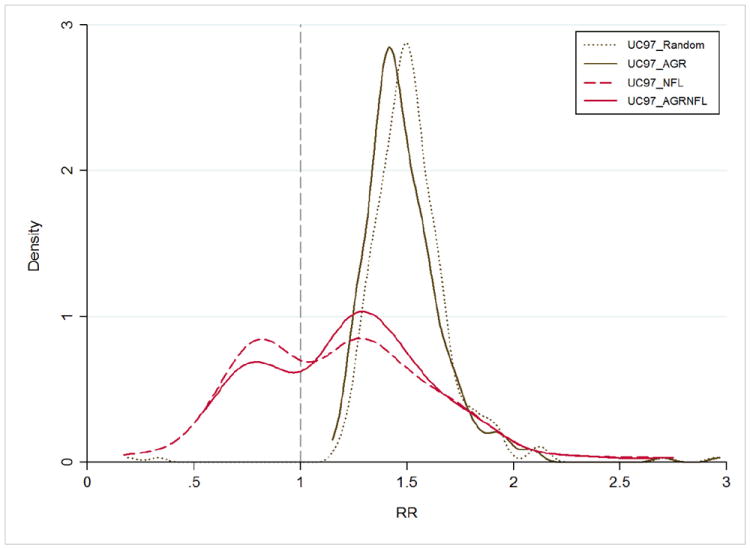
The success of many population studies is determined by proper matching of cases to controls. Some of the confounding and bias that afflict electronic health record (EHR)-based observational studies may be reduced by creating effective methods for finding adequate controls. We implemented a method to match case and control populations to compensate for sparse and unequal data collection practices common in EHR data. We did this by matching the healthcare utilization of patients after observing that more complete data was collected on high healthcare utilization patients vs. low healthcare utilization patients. In our results, we show that many of the anomalous differences in population comparisons are mitigated using this matching method compared to other traditional age and gender-based matching. As an example, the comparison of the disease associations of ulcerative colitis and Crohn's disease show differences that are not present when the controls are chosen in a random or even a matched age/gender/race algorithm. In conclusion, the use of healthcare utilization-based matching algorithms to find adequate controls greatly enhanced the accuracy of results in EHR studies. Full source code and documentation of the control matching methods is available at https://community.i2b2.org/wiki/display/conmat/.
Keywords: Comorbidity; Controls; EHR; Inflammatory bowel disease; Matching.
Copyright © 2014 Elsevier Inc. All rights reserved.
Figures


References
-
- DesRoches CM, Charles D, Furukawa MF, Joshi MS, Kralovec P, Mostashari F, et al. Adoption Of Electronic Health Records Grows Rapidly, But Fewer Than Half Of US Hospitals Had At Least A Basic System In 2012. Health Affairs. 2013 - PubMed
-
- Jha AK, DesRoches CM, Campbell EG, Donelan K, Rao SR, Ferris TG, et al. Use of electronic health records in US hospitals. New England Journal of Medicine. 2009;360:1628–38. - PubMed
-
- Jha AK. The Promise of Electronic Records. JAMA: The Journal of the American Medical Association. 2011;306:880–1. - PubMed
-
- Ryan PB, Madigan D, Stang PE, Marc Overhage J, Racoosin JA, Hartzema AG. Empirical assessment of methods for risk identification in healthcare data: results from the experiments of the Observational Medical Outcomes Partnership. Statistics in Medicine. 2012;31:4401–15. - PubMed
Publication types
MeSH terms
Grants and funding
LinkOut - more resources
Full Text Sources
Other Literature Sources
Research Materials
