


Folate, vitamin B-6, and vitamin B-12 intake and mild cognitive impairment and probable dementia in the Women's Health Initiative Memory Study
- PMID: 25201007
- PMCID: PMC4312724
- DOI: 10.1016/j.jand.2014.07.006
Folate, vitamin B-6, and vitamin B-12 intake and mild cognitive impairment and probable dementia in the Women's Health Initiative Memory Study
Abstract
Background: Whether higher B vitamin intake (ie, B-6, B-12, and folate) is protective against cognitive decline in later life remains uncertain. Several prospective, observational studies find higher B vitamin intake to be associated with lower risk of dementia; other studies, including most trials of B vitamin supplementation, have observed no effect on cognition. We examined this question in a large population of older women carefully monitored for development of mild cognitive impairment (MCI) and probable dementia.
Objective: To determine whether baseline folate, vitamin B-6, and/or vitamin B-12 intake, alone or in combination, are associated with incident MCI/probable dementia among older women.
Design: Prospective, longitudinal cohort study. Participants were enrolled between 1993 and 1998, and B vitamin intake was self-reported using a food frequency questionnaire administered at baseline.
Participants/setting: Postmenopausal women (N=7,030) free of MCI/probable dementia at baseline in the Women's Health Initiative Memory Study.
Main outcome measures: Over a mean follow-up of 5.0 years, 238 cases of incident MCI and 69 cases of probable dementia were identified through rigorous screening and expert adjudication.
Statistical analyses: Cox proportional hazard models adjusting for sociodemographic and lifestyle factors examined the association of B vitamin intake above and below the Recommended Daily Allowance and incident MCI/probable dementia.
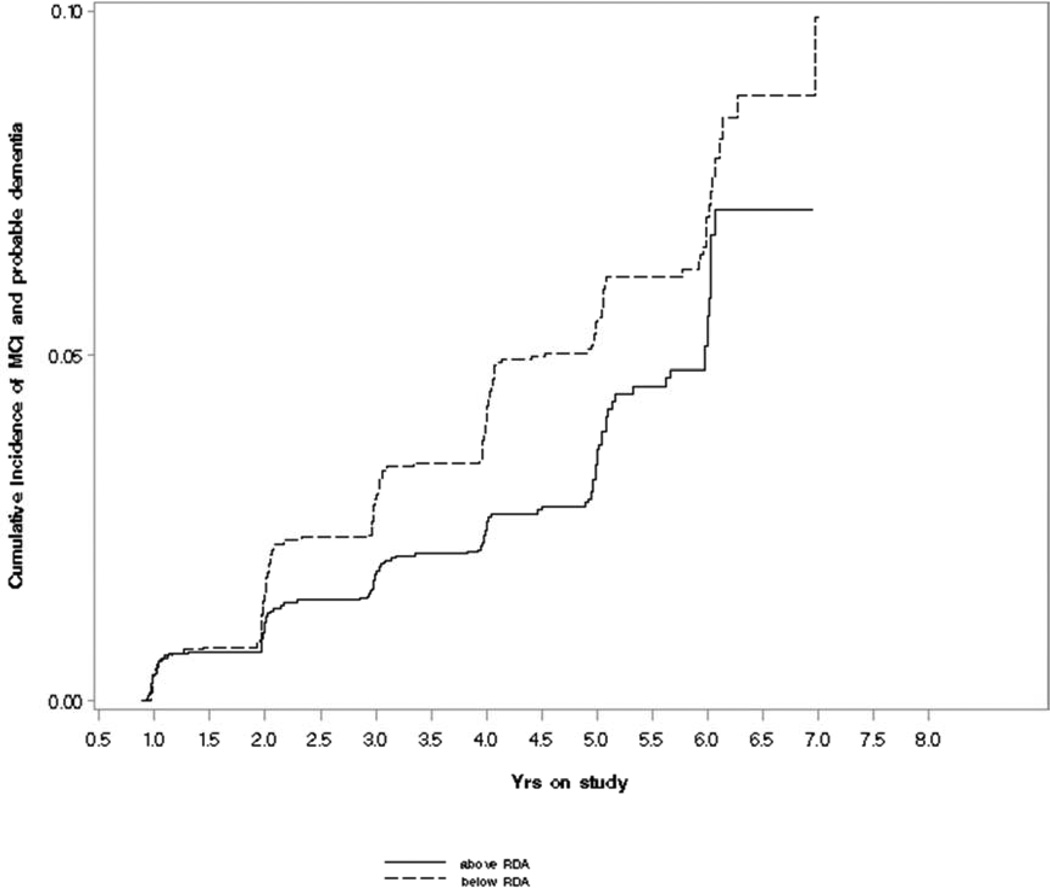
Results: Folate intake below the Recommended Daily Allowance at study baseline was associated with increased risk of incident MCI/probable dementia (hazard ratio 2.0, 95% CI 1.3 to 2.9), after controlling for multiple confounders. There were no significant associations between vitamins B-6 or B-12 and MCI/probable dementia, nor any evidence of an interaction between these vitamins and folate intake.
Conclusions: Folate intake below the Recommended Daily Allowance may increase risk for MCI/probable dementia in later life. Future research should include long-term trials of folic acid supplementation to examine whether folate may impart a protective effect on cognition in later life.
Keywords: Cognitive impairment; Dementia; Folic acid; Vitamin B-12; Vitamin B-6.
Copyright © 2015 Academy of Nutrition and Dietetics. Published by Elsevier Inc. All rights reserved.
Conflict of interest statement
No authors have any financial or personal conflicts of interest.
Figures
References
-
- Morris M. Vitamins and cognitive development and performance: Nutritional determinants of cognitive aging and dementia. Proc Nutr Soc. 2012;71(1):1–13. - PubMed
-
- Luchsinger JA, Tang MX, Miller J, Green R, Mayeux R. Relation of higher folate intake to lower risk of Alzheimer Disease in the elderly. Arch Neurol. 2007;64(1):86–92. - PubMed
Publication types
MeSH terms
Substances
Grants and funding
LinkOut - more resources
Full Text Sources
Other Literature Sources
Medical
