


Gout, urate-lowering therapy, and uric acid levels among adults in the United States
- PMID: 25201123
- PMCID: PMC4362996
- DOI: 10.1002/acr.22469
Gout, urate-lowering therapy, and uric acid levels among adults in the United States
Abstract
Objective: Evidence strongly suggests that delivery of gout care is suboptimal. The 2012 American College of Rheumatology (ACR) guidelines emphasize a serum uric acid (SUA) target of <6 mg/dl when utilizing urate-lowering therapy (ULT). However, the proportion and characteristics of Americans with gout receiving ULT, or with a ULT indication, who are achieving this target is unknown.
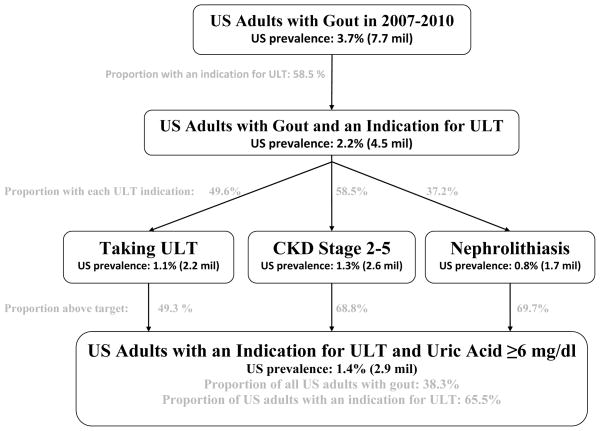
Methods: We identified US adults with gout receiving ULT, and those with an indication for ULT, using the National Health and Nutrition Examination Surveys from 2007-2010. Using the ACR guidelines, a ULT indication comprised chronic kidney disease (CKD) stage 2-5, a history of nephrolithiasis, or current ULT use. Demographic and clinical factors associated with an SUA ≥6 mg/dl were determined using Poisson regression.
Results: In 2007-2010, an estimated 4.5 million US adults with gout had an indication for ULT; two-thirds had an SUA ≥6 mg/dl. In adjusted analyses among those with gout and CKD or nephrolithiasis, those age ≥70 years were less likely (prevalence ratio [PR] 0.77, 95% confidence interval [95% CI] 0.61-0.97) to have an SUA ≥6 mg/dl. Regarding those taking ULT, hypertension was related to a reduced prevalence (PR 0.51, 95% CI 0.30-0.87), whereas diabetes mellitus (PR 1.42, 95% CI 1.06-1.90) and obesity (PR 1.74, 95% CI 1.19-2.56) were each associated with a higher prevalence of an SUA value ≥6 mg/dl.
Conclusion: Half of all Americans with gout receiving ULT, and two-thirds with an indication for ULT, have an SUA above target. This study furnishes a meaningful baseline for assessing the effectiveness of the ACR guidelines in future years.
Copyright © 2015 by the American College of Rheumatology.
Conflict of interest statement
The authors have no competing interests to report.
Figures
References
Publication types
MeSH terms
Substances
Grants and funding
LinkOut - more resources
Full Text Sources
Other Literature Sources
Medical
Research Materials
