


Oxidative stress markers in hypertensive states of pregnancy: preterm and term disease
- PMID: 25202276
- PMCID: PMC4142431
- DOI: 10.3389/fphys.2014.00310
Oxidative stress markers in hypertensive states of pregnancy: preterm and term disease
Abstract
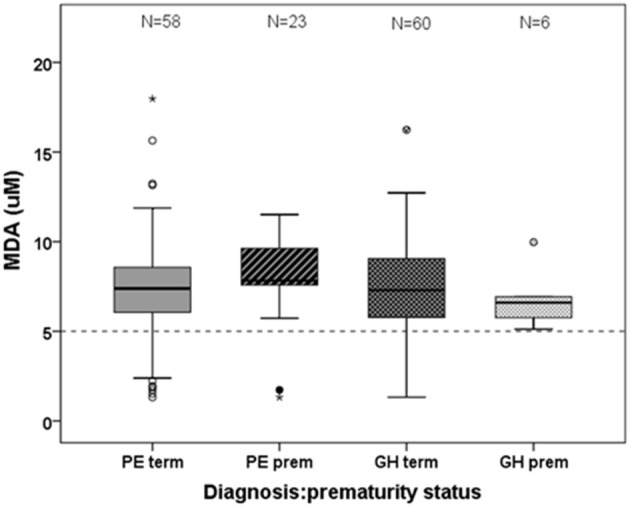
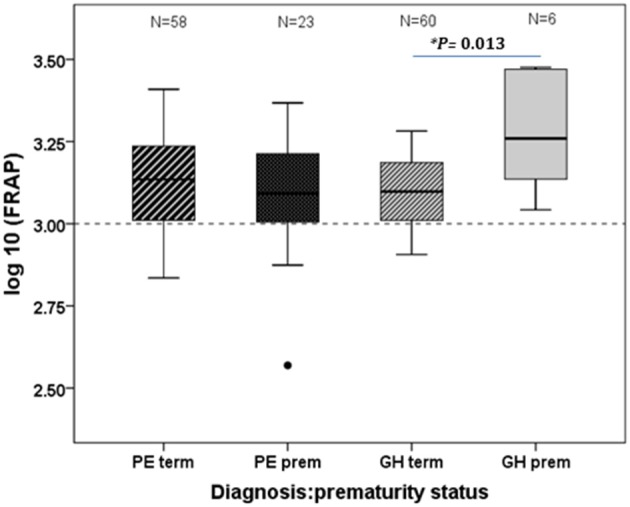
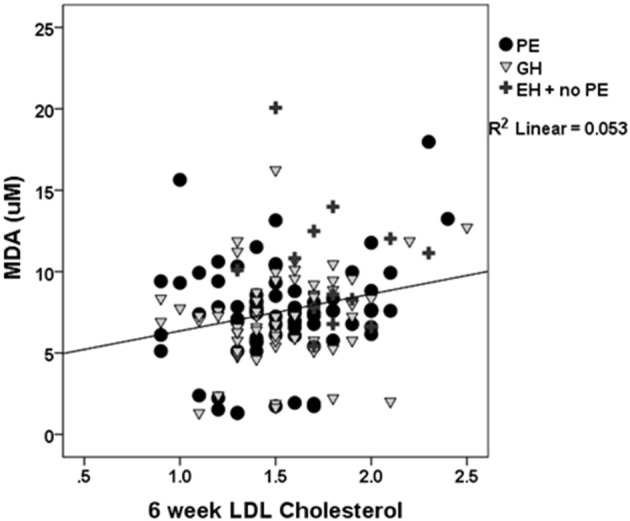
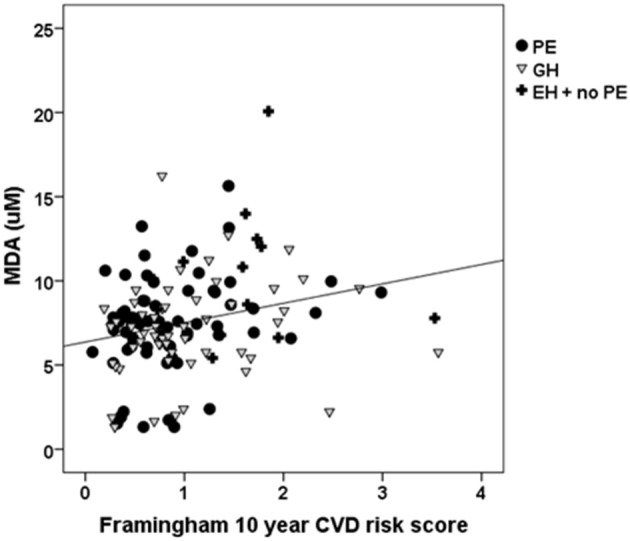
Discussion continues as to whether de novo hypertension in pregnancy with significant proteinuria (pre-eclampsia; PE) and non-proteinuric new hypertension (gestational hypertension; GH) are parts of the same disease spectrum or represent different conditions. Non-pregnant hypertension, pregnancy and PE are all associated with oxidative stress. We have established a 6 weeks postpartum clinic for women who experienced a hypertensive pregnancy. We hypothesized that PE and GH could be distinguished by markers of oxidative stress; thiobarbituric acid reactive substances (TBARS) and antioxidants (ferric ion reducing ability of plasma; FRAP). Since the severity of PE and GH is greater pre-term, we also compared pre-term and term disease. Fifty-eight women had term PE, 23 pre-term PE, 60 had term GH and 6 pre-term GH, 11 pre-existing (essential) hypertension (EH) without PE. Limited data were available from normotensive pregnancies (n = 7) and non-pregnant controls (n = 14). There were no differences in postpartum TBARS or FRAP between hypertensive states; TBARS (P = 0.001) and FRAP (P = 0.009) were lower in plasma of non-pregnant controls compared to recently-pregnant women. Interestingly FRAP was higher in preterm than term GH (P = 0.013). In PE and GH, TBARS correlated with low density lipoprotein (LDL)-cholesterol (P = 0.036); this association strengthened with inclusion of EH (P = 0.011). The 10 year Framingham index for cardiovascular risk was positively associated with TBARS (P = 0.003). Oxidative stress profiles do not differ between hypertensive states but appear to distinguish between recently-pregnant and non-pregnant states. This suggests that pregnancy may alter vascular integrity with changes remaining 6 weeks postpartum. LDL-cholesterol is a known determinant of oxidative stress in cardiovascular disease and we have shown this association to be present in hypertensive pregnancy further emphasizing that such a pregnancy may be revealing a pre-existing cardiovascular risk.
Keywords: hypertension; oxidative stress; pre-eclampsia; pregnancy; preterm; term.
Figures
References
-
- Al-Benna S., Hamilton C. A., McClure J. D., Rogers P. N., Berg G. A., Ford I., et al. (2006). Low-density lipoprotein cholesterol determines oxidative stress and endothelial dysfunction in saphenous veins from patients with coronary artery disease. Arterioscler. Thromb. Vasc. Biol. 26, 218–223 10.1161/01.ATV.0000193626.22269.45 - DOI - PubMed
-
- Bazavilvaso-Rodriguez M. A., Hernandez-Valencia M., Santillan-Morelos J. G., Galvan-Duarte R. E., Campos-Leon S., Lemus-Rocha S. R., et al. (2011). Oxidative stress changes in pregnant patients with and without severe preeclampsia. Arch. Med. Res. 42, 195–198 10.1016/j.arcmed.2011.04.011 - DOI - PubMed
LinkOut - more resources
Full Text Sources
Other Literature Sources
Miscellaneous
