


Mean annual precipitation explains spatiotemporal patterns of Cenozoic mammal beta diversity and latitudinal diversity gradients in North America
- PMID: 25203658
- PMCID: PMC4159275
- DOI: 10.1371/journal.pone.0106499
Mean annual precipitation explains spatiotemporal patterns of Cenozoic mammal beta diversity and latitudinal diversity gradients in North America
Abstract
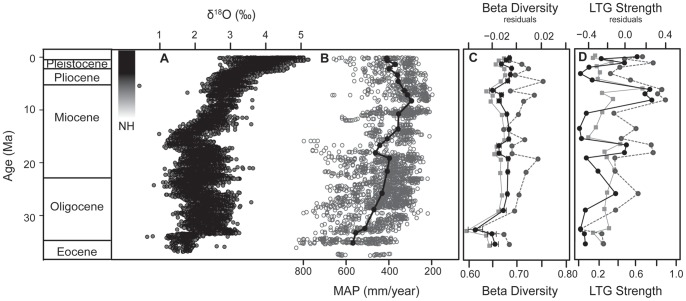
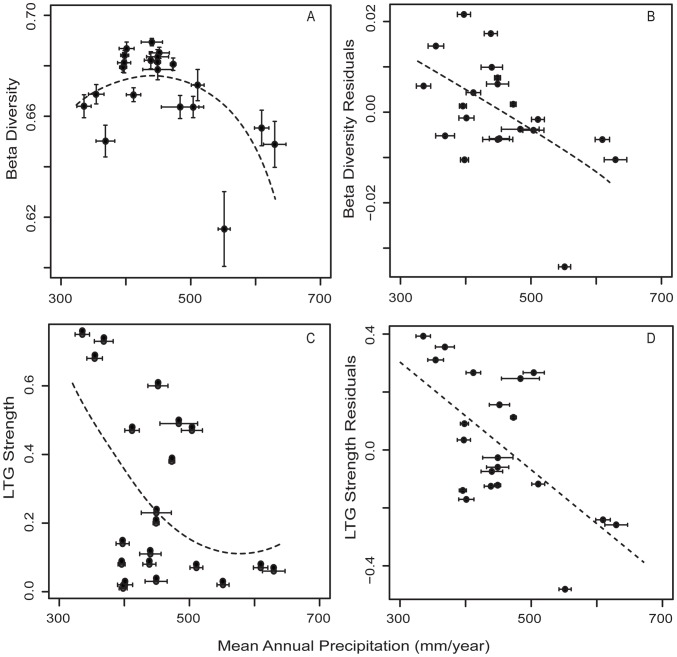
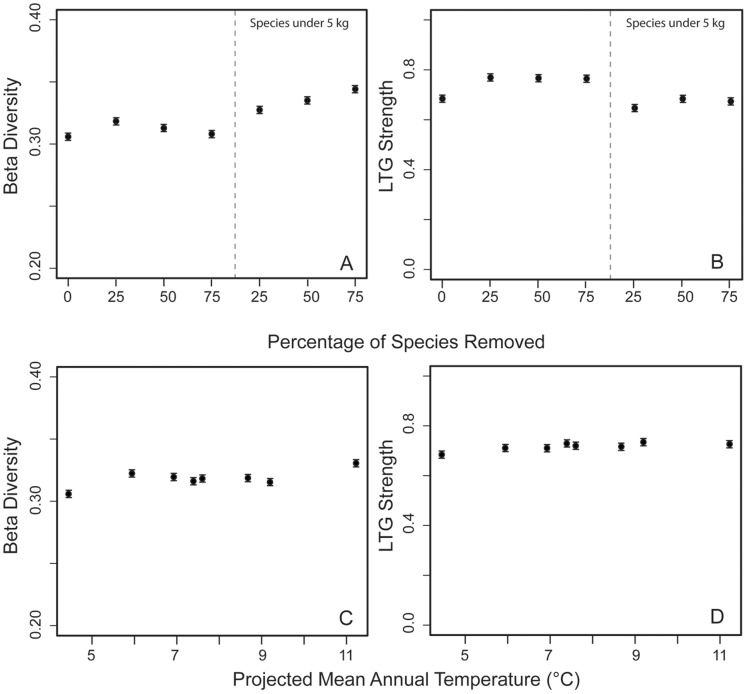
Spatial diversity patterns are thought to be driven by climate-mediated processes. However, temporal patterns of community composition remain poorly studied. We provide two complementary analyses of North American mammal diversity, using (i) a paleontological dataset (2077 localities with 2493 taxon occurrences) spanning 21 discrete subdivisions of the Cenozoic based on North American Land Mammal Ages (36 Ma--present), and (ii) climate space model predictions for 744 extant mammals under eight scenarios of future climate change. Spatial variation in fossil mammal community structure (β diversity) is highest at intermediate values of continental mean annual precipitation (MAP) estimated from paleosols (∼ 450 mm/year) and declines under both wetter and drier conditions, reflecting diversity patterns of modern mammals. Latitudinal gradients in community change (latitudinal turnover gradients, aka LTGs) increase in strength through the Cenozoic, but also show a cyclical pattern that is significantly explained by MAP. In general, LTGs are weakest when continental MAP is highest, similar to modern tropical ecosystems in which latitudinal diversity gradients are weak or undetectable. Projections under modeled climate change show no substantial change in β diversity or LTG strength for North American mammals. Our results suggest that similar climate-mediated mechanisms might drive spatial and temporal patterns of community composition in both fossil and extant mammals. We also provide empirical evidence that the ecological processes on which climate space models are based are insufficient for accurately forecasting long-term mammalian response to anthropogenic climate change and inclusion of historical parameters may be essential.
Conflict of interest statement
Figures
References
-
- Hawkins BA, Field R, Cornell HV, Currie DJ, Guegan JF, et al. (2003) Energy, water, and broad-scale geographic patterns of species richness. Ecology 84: 3105–3117.
-
- Qian H, Badgley C, Fox DL (2009) The latitudinal gradient of beta diversity in relation to climate and topography for mammals in North America. Global Ecology and Biogeography 18: 111–122.
-
- Condit R, Pitman N, Leigh EG Jr, Chave J, Terborgh J, et al. (2002) Beta-diversity in tropical forest trees. Science 295: 666–669. - PubMed
-
- Baselga A, Lobo JM, Svenning JC, Aragón P, Araújo MB (2012) Dispersal ability modulates the strength of the latitudinal richness gradient in European beetles. Global Ecology and Biogeography 21: 1106–1113.
-
- Engle VD, Summers JK (1999) Latitudinal gradients in benthic community composition in Western Atlantic estuaries. Journal of Biogeography 26: 1007–1023.
Publication types
MeSH terms
LinkOut - more resources
Full Text Sources
Other Literature Sources
