


Proximity to natural gas wells and reported health status: results of a household survey in Washington County, Pennsylvania
- PMID: 25204871
- PMCID: PMC4286272
- DOI: 10.1289/ehp.1307732
Proximity to natural gas wells and reported health status: results of a household survey in Washington County, Pennsylvania
Abstract
Background: Little is known about the environmental and public health impact of unconventional natural gas extraction activities, including hydraulic fracturing, that occur near residential areas.
Objectives: Our aim was to assess the relationship between household proximity to natural gas wells and reported health symptoms.
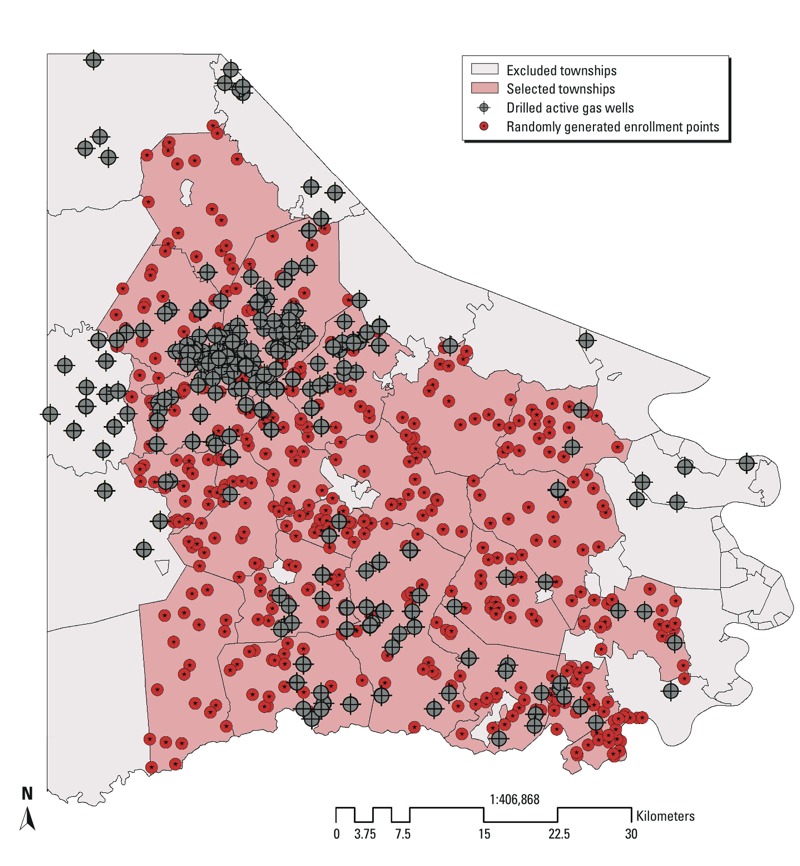
Methods: We conducted a hypothesis-generating health symptom survey of 492 persons in 180 randomly selected households with ground-fed wells in an area of active natural gas drilling. Gas well proximity for each household was compared with the prevalence and frequency of reported dermal, respiratory, gastrointestinal, cardiovascular, and neurological symptoms.
Results: The number of reported health symptoms per person was higher among residents living < 1 km (mean ± SD, 3.27 ± 3.72) compared with > 2 km from the nearest gas well (mean ± SD, 1.60 ± 2.14; p = 0.0002). In a model that adjusted for age, sex, household education, smoking, awareness of environmental risk, work type, and animals in house, reported skin conditions were more common in households < 1 km compared with > 2 km from the nearest gas well (odds ratio = 4.1; 95% CI: 1.4, 12.3; p = 0.01). Upper respiratory symptoms were also more frequently reported in persons living in households < 1 km from gas wells (39%) compared with households 1-2 km or > 2 km from the nearest well (31 and 18%, respectively) (p = 0.004). No equivalent correlation was found between well proximity and other reported groups of respiratory, neurological, cardiovascular, or gastrointestinal conditions.
Conclusion: Although these results should be viewed as hypothesis generating, and the population studied was limited to households with a ground-fed water supply, proximity of natural gas wells may be associated with the prevalence of health symptoms including dermal and respiratory conditions in residents living near natural gas extraction activities. Further study of these associations, including the role of specific air and water exposures, is warranted.
Conflict of interest statement
The contents are solely the responsibility of the authors and do not necessarily represent the official views of NIH.
The authors declare they have no actual or potential competing financial interests.
Figures
References
-
- Allen DT. Atmospheric emissions and air quality impacts from natural gas production and use. Annu Rev Chem Biomol Eng. 2014;5:55–75. - PubMed
-
- Bamberger M, Oswald RE. Impacts of gas drilling on human and animal health. New Solut. 2012;22:51–77. - PubMed
-
- Carter KM, Harper JA, Schmid KW, Kostelnik J. Unconventional natural gas resources in Pennsylvania: the backstory of the modern Marcellus Shale play. Environ Geosci. 2011;18:217–257.
-
- Center for Rural Pennsylvania. Demographics for Washington County. 2014. Available: http://www.ruralpa2.org/county_profiles.cfm [accessed 29 July 2014]
-
- Chapman EC, Capo RC, Stewart BW, Kirby CS, Hammack RW, Schroeder KT, et al. Geochemical and strontium isotope characterization of produced waters from Marcellus Shale natural gas extraction. Environ Sci Technol. 2012;46:3545–3553. - PubMed
Publication types
MeSH terms
Substances
Grants and funding
LinkOut - more resources
Full Text Sources
Other Literature Sources