


Comment
doi: 10.1073/pnas.1414554111.
Epub 2014 Sep 9.
Toward a unified therapeutics approach targeting putative amyloid-β oligomer receptors
Affiliations
- PMID: 25205809
- PMCID: PMC4183328
- DOI: 10.1073/pnas.1414554111
Item in Clipboard
Comment
Toward a unified therapeutics approach targeting putative amyloid-β oligomer receptors
Proc Natl Acad Sci U S A.
.
No abstract available
Conflict of interest statement
The authors declare no conflict of interest.
Figures
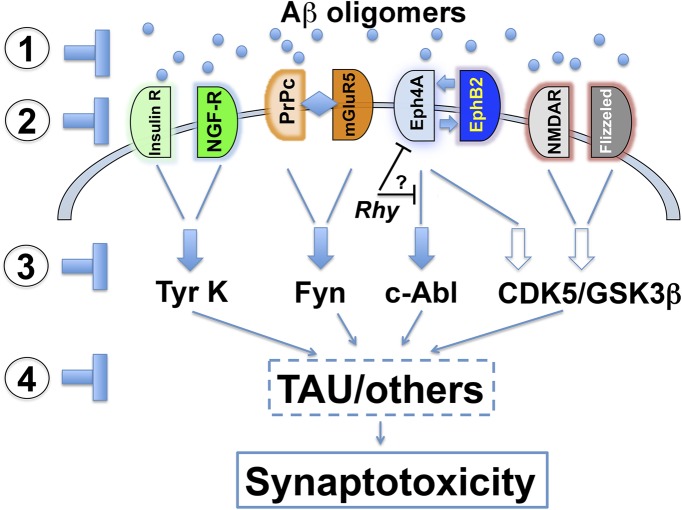
Putative Aβ oligomer receptors, signaling pathways, and therapeutic targets. A number of potential cell surface molecules (insulin receptor, NGF receptor, PrPc, mGluR5, EphA4, EphB2, NMDA, and Flizzed) that mediate the synaptotoxic effects of Aβ oligomers have been identified. In general terms, they can be divided into those that signal via tyrosine kinase (tyr k, fyn, and c-Abl) and those that hyperactivate CDK5/glycogen synthase kinase (GSK)3β. Therapeutics for AD might involve (1) directly clearing Aβ oligomers, (2) blocking the surface receptors, (3) interfering with signaling pathways, or (4) decreasing downstream effectors such as Tau. The study by Fu et al. identifies rhynchophylline (Rhy) as an antagonist of EphA4. The mechanisms as to how this compound protects neurons from the toxic effects of Aβ are unclear; however, Rhy might directly block EphA4 or interfere with signaling.
Comment on
-
Blockade of EphA4 signaling ameliorates hippocampal synaptic dysfunctions in mouse models of Alzheimer's disease.Proc Natl Acad Sci U S A. 2014 Jul 8;111(27):9959-64. doi: 10.1073/pnas.1405803111. Epub 2014 Jun 23. Proc Natl Acad Sci U S A. 2014. PMID: 24958880 Free PMC article.
References
-
- Terry RD, et al. Physical basis of cognitive alterations in Alzheimer’s disease: Synapse loss is the major correlate of cognitive impairment. Ann Neurol. 1991;30(4):572–580. - PubMed
Publication types
MeSH terms
Substances
Grants and funding
LinkOut - more resources
Full Text Sources
Other Literature Sources
Medical
