


Role of nuclear factor kappa B in central nervous system regeneration
- PMID: 25206877
- PMCID: PMC4146279
- DOI: 10.4103/1673-5374.131572
Role of nuclear factor kappa B in central nervous system regeneration
Abstract
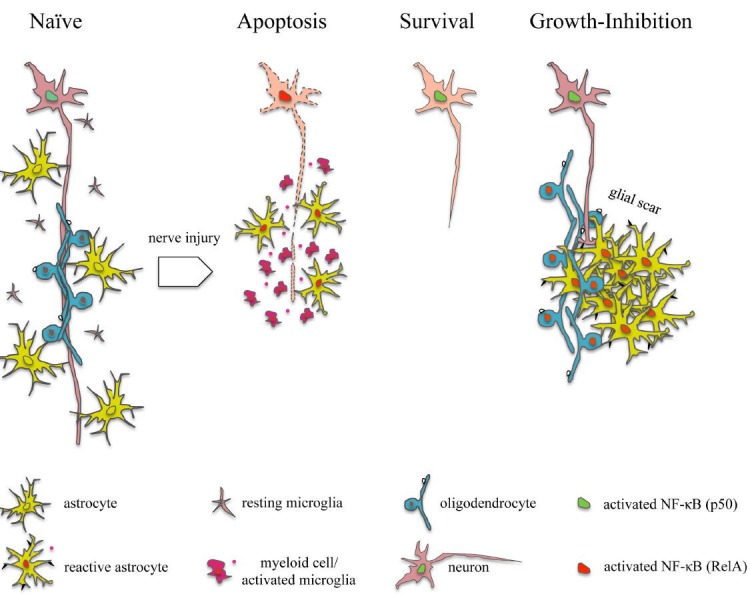
Activation of nuclear factor kappa B (NF-κB) is a hallmark of various central nervous system (CNS) pathologies. Neuron-specific inhibition of its transcriptional activator subunit RelA, also referred to as p65, promotes neuronal survival under a range of conditions, i.e., for ischemic or excitotoxic insults. In macro- and microglial cells, post-lesional activation of NF-κB triggers a growth-permissive program which contributes to neural tissue inflammation, scar formation, and the expression of axonal growth inhibitors. Intriguingly, inhibition of such inducible NF-κB in the neuro-glial compartment, i.e., by genetic ablation of RelA or overexpression of a transdominant negative mutant of its upstream regulator IκBα, significantly enhances functional recovery and promotes axonal regeneration in the mature CNS. By contrast, depletion of the NF-κB subunit p50, which lacks transcriptional activator function and acts as a transcriptional repressor on its own, causes precocious neuronal loss and exacerbates axonal degeneration in the lesioned brain. Collectively, the data imply that NF-κB orchestrates a multicellular program in which κB-dependent gene expression establishes a growth-repulsive terrain within the post-lesioned brain that limits structural regeneration of neuronal circuits. Considering these subunit-specific functions, interference with the NF-κB pathway might hold clinical potentials to improve functional restoration following traumatic CNS injury.
Keywords: RelA; axonal regeneration; central nervous system injury; neural regeneration; nuclear factor kappa B; p50; p65.
Conflict of interest statement
Figures
References
-
- Bracken MB. Steroids for acute spinal cord injury. Cochrane Database Syst Rev. 2002;(3):CD001046. - PubMed
Publication types
LinkOut - more resources
Full Text Sources
Other Literature Sources
Research Materials