


A review and analysis of the use of 'habit' in understanding, predicting and influencing health-related behaviour
- PMID: 25207647
- PMCID: PMC4566897
- DOI: 10.1080/17437199.2013.876238
A review and analysis of the use of 'habit' in understanding, predicting and influencing health-related behaviour
Abstract
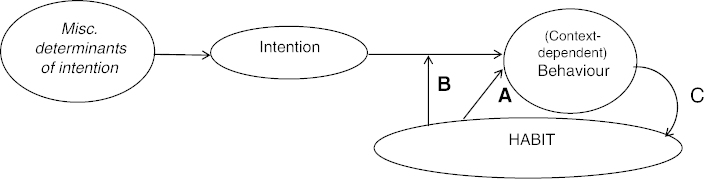
The term 'habit' is widely used to predict and explain behaviour. This paper examines use of the term in the context of health-related behaviour, and explores how the concept might be made more useful. A narrative review is presented, drawing on a scoping review of 136 empirical studies and 8 literature reviews undertaken to document usage of the term 'habit', and methods to measure it. A coherent definition of 'habit', and proposals for improved methods for studying it, were derived from findings. Definitions of 'habit' have varied in ways that are often implicit and not coherently linked with an underlying theory. A definition is proposed whereby habit is a process by which a stimulus generates an impulse to act as a result of a learned stimulus-response association. Habit-generated impulses may compete or combine with impulses and inhibitions arising from other sources, including conscious decision-making, to influence responses, and need not generate behaviour. Most research on habit is based on correlational studies using self-report measures. Adopting a coherent definition of 'habit', and a wider range of paradigms, designs and measures to study it, may accelerate progress in habit theory and application.
Keywords: automaticity; behaviour change; habit; review; study design.
Figures
Comment in
-
The subjective experience of habit captured by self-report indexes may lead to inaccuracies in the measurement of habitual action.Health Psychol Rev. 2015;9(3):296-302. doi: 10.1080/17437199.2014.959728. Epub 2014 Dec 18. Health Psychol Rev. 2015. PMID: 25189762 No abstract available.
-
The strength of habit.Health Psychol Rev. 2015;9(3):311-7. doi: 10.1080/17437199.2014.992031. Epub 2015 Apr 17. Health Psychol Rev. 2015. PMID: 25559285 No abstract available.
-
What measures of habit strength to use? Comment on Gardner (2015).Health Psychol Rev. 2015;9(3):303-10. doi: 10.1080/17437199.2014.992030. Epub 2015 Apr 17. Health Psychol Rev. 2015. PMID: 25559353 No abstract available.
-
Defining and measuring the habit impulse: response to commentaries.Health Psychol Rev. 2015;9(3):318-22. doi: 10.1080/17437199.2015.1009844. Epub 2015 Apr 21. Health Psychol Rev. 2015. PMID: 25622215 No abstract available.
References
-
- Adriaanse M. A., Oettingen B., Gollwitzer P. M., Hennes E. P., de Ridder D. T. D., de Wit J. B. F. When planning is not enough: Fighting unhealthy snacking habits by mental contrasting with implementation intentions (MCII) European Journal of Social Psychology. 2010:1277–1293. doi: 10.1002/ejsp.730. - DOI
-
- Ajzen I. The theory of planned behavior. Organizational Behavior and Human Decision Processes. 1991:179–211. doi: 10.1016/0749-5978(91)90020-T. - DOI
-
- Ajzen I. Residual effects of past on later behavior: Habituation and reasoned action perspectives. Personality and Social Psychology Review. 2002:107–122. doi: 10.1207/S15327957PSPR0602_02. - DOI
-
- Bargh J. A. The four horsemen of automaticity: Awareness, intention, efficiency, and control in social cognition. In: Wyer R. S., Srull T. K., editors. Handbook of social cognition. Hillsdale, NJ: Lawrence Erlbaum; 1994. pp. 1–40.
Publication types
MeSH terms
LinkOut - more resources
Full Text Sources
Other Literature Sources
Medical