Review
. 2014 Nov 26;57(22):9259-91.
doi: 10.1021/jm500828f. Epub 2014 Sep 10.

Desferrithiocin: a search for clinically effective iron chelators

Affiliations
Review

Desferrithiocin: a search for clinically effective iron chelators

Raymond J Bergeron et al. J Med Chem. .

Abstract

The successful search for orally active iron chelators to treat transfusional iron-overload diseases, e.g., thalassemia, is overviewed. The critical role of iron in nature as a redox engine is first described, as well as how primitive life forms and humans manage the metal. The problems that derive when iron homeostasis in humans is disrupted and the mechanism of the ensuing damage, uncontrolled Fenton chemistry, are discussed. The solution to the problem, chelator-mediated iron removal, is clear. Design options for the assembly of ligands that sequester and decorporate iron are reviewed, along with the shortcomings of the currently available therapeutics. The rationale for choosing desferrithiocin, a natural product iron chelator (a siderophore), as a platform for structure-activity relationship studies in the search for an orally active iron chelator is thoroughly developed. The study provides an excellent example of how to systematically reengineer a pharmacophore in order to overcome toxicological problems while maintaining iron clearing efficacy and has led to three ligands being evaluated in human clinical trials.


Figures

Chart 1
Chart 1. Electron Transport Chain Illustrating the Redox Role of Iron
Figure 1
Figure 1
Catecholamide siderophores.
Figure 2
Figure 2
Hydroxamate siderophores.
Figure 3
Figure 3
Putative structure of the Fe(III)/parabactin complex.
Figure 4
Figure 4
Retrosynthetic analysis of petrobactin.
Figure 5
Figure 5
Siderophores outside of the catecholamate and hydroxamate motif: rhizobactin, rhizoferrin, pyochelin, and desferrithiocin (DFT).
Figure 6
Figure 6
Iron absorption and processing.
Figure 7
Figure 7
Transferrin/transferrin receptor cycle. The major steps, depicted counter clockwise, are (a) binding of Fe(III) (●) to transferrin (□, Tf), (b) binding of diferric transferrin to the transferrin receptor (TfR), (c) endocytosis by way of a clathrin-coated pit, (d) iron removal, (e) return of the apotransferrin–transferrin receptor complex to the cell surface, and (f) release of apotransferrin (ApoTf).
Figure 8
Figure 8
Biliary ferrokinetics and iron excretion in non-iron-overloaded, bile duct-cannulated rats given a DFT analogue orally at a dose of 300 μmol/kg.
Figure 9
Figure 9
Iron excretion induced by DFO given to Cebus monkeys sc at a dose of 150 μmol/kg.
Figure 10
Figure 10
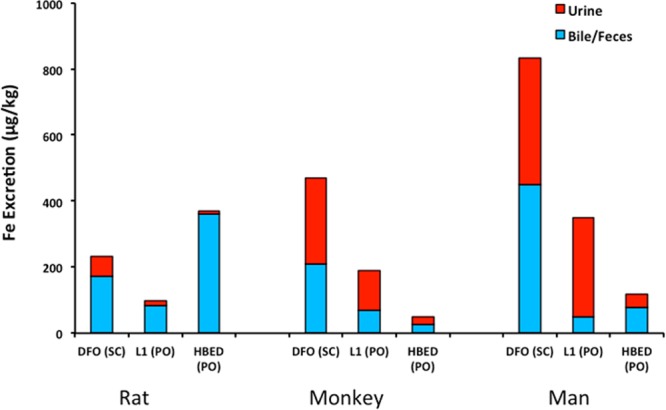
Comparison of chelator-induced iron excretion in rats, monkeys, and man. DFO was given as a sc injection in rats and primates and as an 8 h sc infusion in humans. HBED and L1 were given to all three species po.
Figure 11
Figure 11
Six synthetic chelators, four of which (Exjade, DTPA, L1, and HBED) have been used successfully in humans. CP94 represents a failed attempt to improve on the plasma residence of L1 with the idea of increasing the ICE. TREN-(Me-3,2-HOPO) articulates a successful effort to construct a hexacoordinate ligand from the bidentate L1 platform. Unfortunately, it did not perform well in animals.
Figure 12
Figure 12
A retrosynthetic overview of desferrithiocin (DFT).
Figure 13
Figure 13
Structure–activity relationships of the desferrithiocins and iron clearing efficiency. The dose of DFT or analogue in the rats is 150 μmol/kg; the dose in the monkeys is as shown in parentheses for each ligand. The mode of administration is shown in parentheses next to the efficiency (%, ±standard deviation). The fraction of iron excreted in the bile or stool and urine is shown in brackets.
Figure 14
Figure 14
Structure–activity relationship of the DFTs and toxicity. The ligands were administered orally at a dose of 384 μmol/kg/day for up to 10 days. Note that this dose is equivalent to 100 mg/kg/day of the sodium salt of DFT.
Figure 15
Figure 15
Alteration of distances between chelating centers. The rats were given the ligands po or sc at a dose of 150 μmol/kg.
Figure 16
Figure 16
Thiazoline ring modifications. The rats were given the ligands po or sc at a dose of 150 μmol/kg; the dose in the monkeys is as shown in parentheses. The mode of administration is shown in parentheses next to the efficiency.
Figure 17
Figure 17
Impact of C-4 stereochemistry of DMDFT, DADMDFT, and 4′-(HO)-DADMDFT on iron clearing efficiency. The rats were given the chelators po at a dose of 150 μmol/kg; the dose in the monkeys is as shown in parentheses for each ligand. The mode of administration is shown in parentheses next to the efficiency (%, ± standard deviation). The fraction of iron excreted in the bile or stool and urine is shown in brackets.
Figure 18
Figure 18
Increase in lipophilicity by benzfusion. The rats were given the chelators at a dose of 150 μmol/kg; the dose in the monkeys is as shown in parentheses for each ligand. The mode of administration is shown in parentheses next to the efficiency (%, ± standard deviation). The fraction of iron excreted in the bile or stool and urine is shown in brackets.
Figure 19
Figure 19
Iron-clearing efficiency (percent) in Cebus monkeys of 4′-substituted ligands 17, 26–28 (blue circles) and 3′-substituted analogues 29–32 (red squares) plotted versus the respective partition coefficients (log Papp) of the compounds. The primates were given the drugs po at a dose of 150 μmol/kg.
Figure 20
Figure 20
Outcome of structure–activity relationship studies on desferrithiocin. Small structural alterations can have a profound effect on renal and GI toxicity. The kidney from the animal treated with DFT is blanched and very friable, while the stomach is normal. In contrast, the kidney from rats given DADFT (4) or DADMDFT (5) appears normal, while the stomach is bloated and hemorrhagic. Finally, the kidney and stomach of rats dosed with (S)-4′-(HO)-DADFT (26) or (S)-4′-(HO)-DADMDFT (17) appear normal.
Scheme 1
Scheme 1. Synthesis of 34
Reagents and conditions: (a) K2CO3 (2.1 equiv), acetone, 84%; (b) 50% NaOH (13 equiv), CH3OH, then 1 N HCl, rt, 16 h, 93%.
Scheme 2
Scheme 2. Synthesis of 36
Reagents and conditions: (a) 60% NaH (2.0 equiv), DMSO, 70%; (b) CH3OH(aq), pH 6, 70 °C, 16 h, 90%.
Figure 21
Figure 21
Renal perfusion. Control (A), 26 474 μmol/kg s.i.d. × 7 days (B), 26 237 μmol/kg b.i.d. × 7 days (C), 34 237 μmol/kg b.i.d. × 7 days (D), and 36 237 μmol/kg b.i.d. × 7 days (E). Magnification = 400×.
Figure 22
Figure 22
Metabolic profiles of desazadesferrithiocin analogues 26, 28, 34, and 36 in the rodent liver. The rats (n = 3 per group) were given the drugs sc at a dose of 300 μmol/kg.
Scheme 3
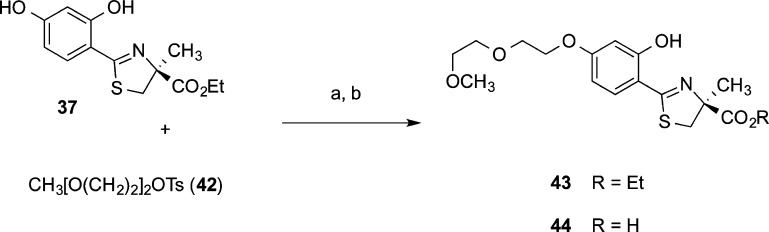
Scheme 3. Synthesis of (S)-4,5-Dihydro-2-[2-hydroxy-4-(3,6-dioxaheptyloxy)phenyl]-4-methyl-4-thiazolecarboxylic Acid (44) and Its Ethyl Ester (43)
Reagents and conditions: (a) K2CO3 (1.1 equiv), acetone, reflux, 2 days, 73%; (c) 50% NaOH(aq) (13 equiv), CH3OH, 80%.
Figure 23
Figure 23
X-ray of (S)-4,5-dihydro-2-[2-hydroxy-4-(3,6-dioxaheptyloxy)phenyl]-4-methyl-4-thiazolecarboxylic acid (44). Structure is drawn at 50% probability ellipsoids.
Figure 24
Figure 24
X-ray of ethyl (S)-4,5-dihydro-2-[2-hydroxy-4-(3,6-dioxaheptyloxy)phenyl]-4-methyl-4-thiazolecarboxylate (43). Structure is drawn at 50% probability ellipsoids.
Figure 25
Figure 25
Biliary ferrokinetics of DFT-related chelators 26, 36, and 44 given orally to non-iron-overloaded, bile duct-cannulated rats at a dose of 300 μmol/kg. The iron excretion (y axis) is reported as micrograms of iron per kilogram of body weight.
Figure 26
Figure 26
A comparison of the tissue distribution of deferitrin (26), (S)-3′-(HO)-DADFT-PE (36), and (S)-4′-(HO)-DADFT-norPE (44). Rodents were given the drugs sc at 300 μmol/kg and sacrificed at 0.5, 1, 2, 4, and 8 h postexposure. The drug concentrations (y axis) are reported as nanomoles of compound per gram of wet weight of tissue or as micromolar (plasma). For all time points, n = 3.
Figure 27
Figure 27
Urinary Kim-1 excretion, expressed as Kim-1 (ng/kg/24 h), for the following groups: (A) untreated age-matched control rats, (B) rats treated with 44 po once daily at a dose of 170.7 μmol/kg/day × 28 days, (C) rats given Exjade po once daily at a dose of 384 μmol/kg/day, (D) rats given 44 po once daily at a dose of 384 μmol/kg/day × 10 days, (E) rats given deferitrin (26) po twice daily at a dose of 237 μmol/kg/dose (474 μmol/kg/day) × 7 days, and (F) rats given 44 po twice daily at a dose of 237 μmol/kg/dose (474 μmol/kg/day) × 7 days. Note that none of the rats survived the planned 10 day exposure to Exjade. For groups A–D and F, n = 5; for group E, n = 3.
Figure 28
Figure 28
Tissue iron concentration of rats treated with 44 once daily at a dose of 384 μmol/kg/day × 10 days. The chelator was administered orally in gelatin capsules (n = 5) or by gavage as its monosodium salt (n = 10). Age-matched rats (n = 12) served as untreated controls.
Figure 29
Figure 29
Modifications of desferrithiocin compatible with iron clearance and the absence of renal toxicity.
Scheme 4
Scheme 4. Synthesis of 46 and 47
Reagents and conditions: (a) 4-methoxybenzyl alcohol, 60% NaH (2.5 equiv each), DMF, 95–100 °C, 18 h, 73%. (b) TFA, pentamethylbenzene, 22 h, quantitative. (c) CH3OH, 0.1 M pH 6 buffer, NaHCO3, 73–76 °C, 45 h. (d) EtI, DIEA (1.5 equiv each), DMF, 47 h, 70%. (e) K2CO3 (1.6 equiv), acetone, reflux, 1 d, 65%. (f) 50% NaOH(aq), CH3OH, then HCl, 96% (46), 97% (47).
Scheme 5
Scheme 5. Synthesis of 48
Reagents and conditions: (a) K2CO3 (2 equiv), CH3CN, 68%. (b) m-CPBA, CH2Cl2. (c) Ac2O, reflux. (d) NaOH(aq), EtOH, reflux, 4 h, 87%. (e) SO3·pyridine, NEt3, DMSO, CHCl3, 16 h, 83%. (f) H2NOH·HCl, NaOAc, CH3OH, reflux, 2 h, 90%. (g) Ac2O, reflux, 94%. (h) H2, 10% Pd–C, CH3OH, 85%. (i) CH3OH, 0.1 M pH 6 buffer, NaHCO3, 75 °C, 48 h, 95%.
Figure 30
Figure 30
Urinary Kim-1 excretion (y axis) is expressed as Kim-1 (ng/kg/24 h) of rats treated with DFT, DFT analogues 4648, or DADFT analogues 26 and 44. The rodents were given the drugs po twice daily (b.i.d.) at a dose of 237 μmol/kg/dose (474 μmol/kg/day) for up to 7 days. Note that none of the rats survived the planned 7 day exposure to DFT. n = 5 for DFT, 44, and 4648; n = 3 for ligand 26.

References

    1. Mladenka P.; Hrdina R.; Hübl M.; Simunek T. The Fate of Iron in the Organism and Its Regulatory Pathways. Acta Med. (Hradec Kralove, Czech Repub.) 2005, 48, 127–135. - PubMed
    1. Bauer I.; Knolker H.-J.. Iron Complexes in Organic Chemistry. In Iron Catalysis in Organic Chemistry; Plietker B., Ed.; Wiley-VCH: Weinheim, Germany, 2008; pp 1–28.
    1. Sutton H. C.; Winterbourn C. C. On the Participation of Higher Oxidation States of Iron and Copper in Fenton Reactions. Free Radical Biol. Med. 1989, 6, 53–60. - PubMed
    1. Crichton R.Inorganic Biochemistry of Iron Metabolism: From Molecular Mechanisms to Clinical Consequences, 2nd ed.; Wiley: New York, 2001.
    1. Campanella L.; Capesciotti G. S.; Russo M. V.; Tomassetti M. Study of the Catalytic Mechanism of the Enzyme Catalase on Organic Hydroperoxides in Non-polar Organic Solvent. Curr. Enzyme Inhib. 2008, 4, 86–92.

Publication types

MeSH terms