


Sengers syndrome: six novel AGK mutations in seven new families and review of the phenotypic and mutational spectrum of 29 patients
- PMID: 25208612
- PMCID: PMC4167147
- DOI: 10.1186/s13023-014-0119-3
Sengers syndrome: six novel AGK mutations in seven new families and review of the phenotypic and mutational spectrum of 29 patients
Abstract
Background: Sengers syndrome is an autosomal recessive condition characterized by congenital cataract, hypertrophic cardiomyopathy, skeletal myopathy and lactic acidosis. Mutations in the acylglycerol kinase (AGK) gene have been recently described as the cause of Sengers syndrome in nine families.
Methods: We investigated the clinical and molecular features of Sengers syndrome in seven new families; five families with the severe and two with the milder form.
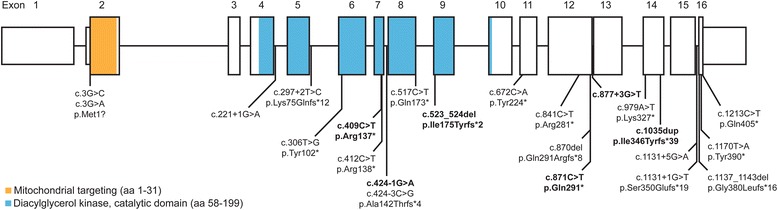
Results: Sequence analysis of AGK revealed compound heterozygous or homozygous predicted loss-of-function mutations in all affected individuals. A total of eight different disease alleles were identified, of which six were novel, homozygous c.523_524delAT (p.Ile175Tyrfs*2), c.424-1G > A (splice site), c.409C > T (p.Arg137*) and c.877 + 3G > T (splice site), and compound heterozygous c.871C > T (p.Gln291*) and c.1035dup (p.Ile346Tyrfs*39). All patients displayed perinatal or early-onset cardiomyopathy and cataract, clinical features pathognomonic for Sengers syndrome. Other common findings included blood lactic acidosis and tachydyspnoea while nystagmus, eosinophilia and cervical meningocele were documented in only either one or two cases. Deficiency of the adenine nucleotide translocator was found in heart and skeletal muscle biopsies from two patients associated with respiratory chain complex I deficiency. In contrast to previous findings, mitochondrial DNA content was normal in both tissues.
Conclusion: We compare our findings to those in 21 previously reported AGK mutation-positive Sengers patients, confirming that Sengers syndrome is a clinically recognisable disorder of mitochondrial energy metabolism.
Figures



References
-
- Mayr JA, Haack TB, Graf E, Zimmermann FA, Wieland T, Haberberger B, Superti-Furga A, Kirschner J, Steinmann B, Baumgartner MR, Baumgartner MR, Moroni I, Lamantea E, Zeviani M, Rodenburg RJ, Smeitink J, Strom TM, Meitinger T, Sperl W, Prokisch H. Lack of the mitochondrial protein acylglycerol kinase causes Sengers syndrome. Am J Hum Genet. 2012;90:314–320. doi: 10.1016/j.ajhg.2011.12.005. - DOI - PMC - PubMed
Publication types
MeSH terms
Substances
Supplementary concepts
Grants and funding
LinkOut - more resources
Full Text Sources
Other Literature Sources
Medical
Molecular Biology Databases
