


Heat shock proteins in neurodegenerative disorders and aging
- PMID: 25208934
- PMCID: PMC4390795
- DOI: 10.1007/s12079-014-0243-9
Heat shock proteins in neurodegenerative disorders and aging
Abstract
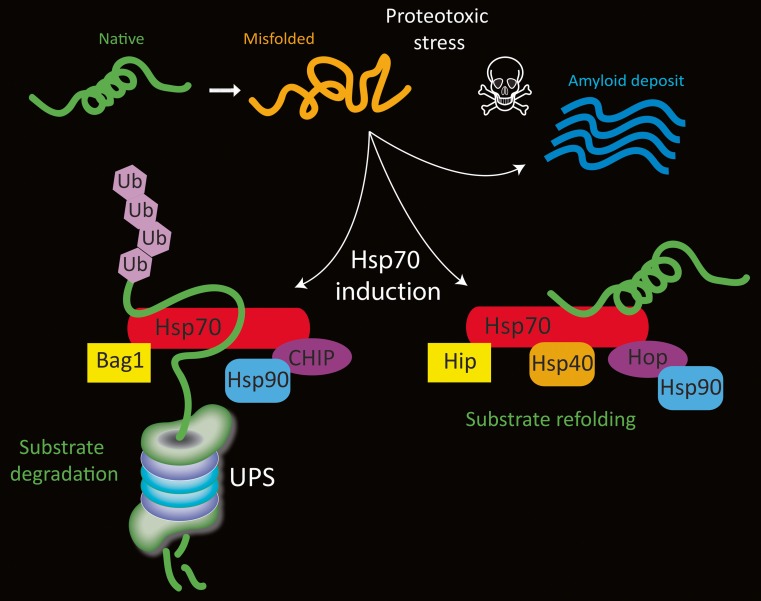
Many members of the heat shock protein family act in unison to refold or degrade misfolded proteins. Some heat shock proteins also directly interfere with apoptosis. These homeostatic functions are especially important in proteinopathic neurodegenerative diseases, in which specific proteins misfold, aggregate, and kill cells through proteotoxic stress. Heat shock protein levels may be increased or decreased in these disorders, with the direction of the response depending on the individual heat shock protein, the disease, cell type, and brain region. Aging is also associated with an accrual of proteotoxic stress and modulates expression of several heat shock proteins. We speculate that the increase in some heat shock proteins in neurodegenerative conditions may be partly responsible for the slow progression of these disorders, whereas the increase in some heat shock proteins with aging may help delay senescence. The protective nature of many heat shock proteins in experimental models of neurodegeneration supports these hypotheses. Furthermore, some heat shock proteins appear to be expressed at higher levels in longer-lived species. However, increases in heat shock proteins may be insufficient to override overwhelming proteotoxic stress or reverse the course of these conditions, because the expression of several other heat shock proteins and endogenous defense systems is lowered. In this review we describe a number of stress-induced changes in heat shock proteins as a function of age and neurodegenerative pathology, with an emphasis on the heat shock protein 70 (Hsp70) family and the two most common proteinopathic disorders of the brain, Alzheimer's and Parkinson's disease.
Figures
References
-
- Acunzo J, Katsogiannou M, Rocchi P. Small heat shock proteins HSP27 (HspB1), alphaB-crystallin (HspB5) and HSP22 (HspB8) as regulators of cell death. Int J Biochem Cell Biol. 2012;44:1622–31. - PubMed
-
- Alladi PA, Mahadevan A, Vijayalakshmi K, Muthane U, Shankar SK, Raju TR. Ageing enhances alpha-synuclein, ubiquitin and endoplasmic reticular stress protein expression in the nigral neurons of Asian Indians. Neurochem Int. 2010;57:530–9. - PubMed
-
- Allen NJ, Barres BA. Neuroscience: Glia - more than just brain glue. Nature. 2009;457:675–7. - PubMed
-
- Alvarez-Erviti L, Rodriguez-Oroz MC, Cooper JM, Caballero C, Ferrer I, Obeso JA, Schapira AH. Chaperone-mediated autophagy markers in Parkinson disease brains. Arch Neurol. 2010;67:1464–72. - PubMed
-
- Angot E, Steiner JA, Hansen C, Li JY, Brundin P. Are synucleinopathies prion-like disorders? Lancet Neurol. 2010;9:1128–38. - PubMed
LinkOut - more resources
Full Text Sources
Other Literature Sources
Medical
