. 2014 Nov;88(22):13429-35.
doi: 10.1128/JVI.01801-14. Epub 2014 Sep 10.

In vivo cellular tropism of gorilla simian foamy virus in blood of infected humans

Affiliations

In vivo cellular tropism of gorilla simian foamy virus in blood of infected humans

Rejane Rua et al. J Virol. 2014 Nov.

Abstract

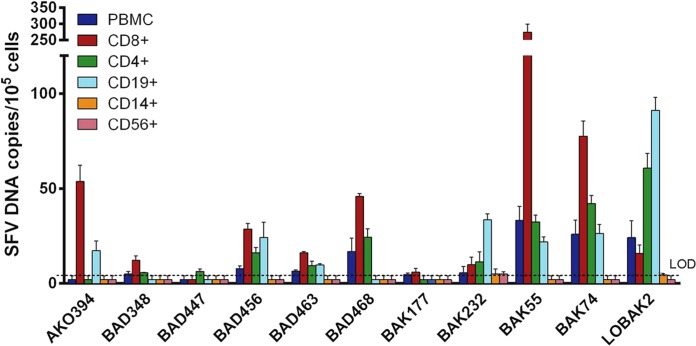
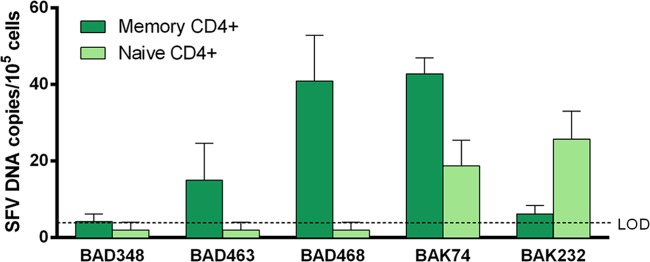
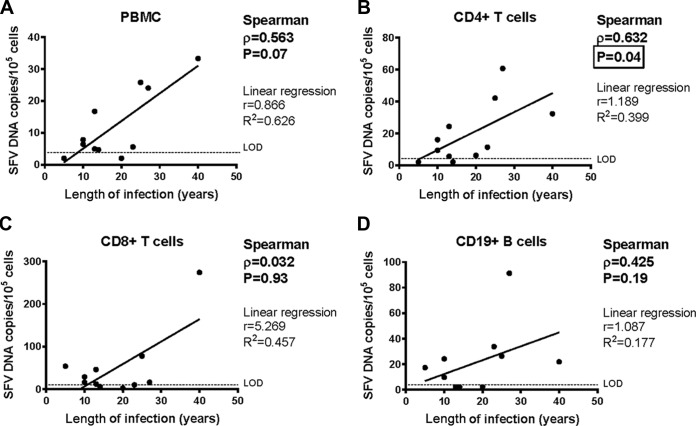
Simian foamy viruses (SFV) are retroviruses that are widespread among nonhuman primates. SFV can be transmitted to humans, giving rise to a persistent infection. Only a few data are available concerning the distribution of SFV in human blood cells. Here we purified blood mononuclear cell subsets from 11 individuals infected with a Gorilla gorilla SFV strain and quantified SFV DNA levels by quantitative PCR. SFV DNA was detected in the majority of the CD8(+), CD4(+), and CD19(+) lymphocyte samples and rarely in CD14(+) monocyte and CD56(+) NK lymphocyte samples. The median (interquartile range [IQR]) SFV DNA counts were 16.0 (11.0 to 49.8), 11.3 (5.9 to 28.3), and 17.2 (2.0 to 25.2) copies/10(5) cells in CD8(+) T lymphocytes, CD4(+) T lymphocytes, and CD19(+) B lymphocytes, respectively. In the CD4 compartment, SFV DNA was detected in both memory and naive CD4(+) T lymphocytes. SFV DNA levels in CD4(+) T cells were positively correlated with the duration of the infection. Our study shows with a quantitative method that CD8(+), CD4(+), and B lymphocytes are major cellular targets of SFV in the blood of infected humans.

Importance: Investigation of SFV infections in humans is important due to the origin of human immunodeficiency viruses (HIV) and human T cell lymphotropic viruses (HTLV) from cross-species transmission of their simian counterparts to humans. Surprisingly little is known about many aspects of the biology of SFV in infected humans, including quantitative data concerning the cellular targets of SFV in vivo. Here we show that the distribution of SFV DNA among the different leukocyte populations is not homogeneous and that viral load in CD4(+) T lymphocytes is correlated with the duration of infection. These new data will help in understanding the biology of retroviral infections in humans and can be useful in the growing field of SFV-based gene therapy.


Figures

FIG 1
FIG 1
SFV DNA loads in PBMC populations of 11 hunters infected with a Gorilla gorilla SFV strain. PBMC populations from 11 SFV-infected individuals were isolated, and the SFV DNA load was quantified in each PBMC population. Each quantification was performed twice in triplicate (e.g., n = 6). Means ± standard deviations are shown. Values below the limit of detection (LOD) were arbitrarily set as half the LOD, 2 SFV DNA copies/105 cells.
FIG 2
FIG 2
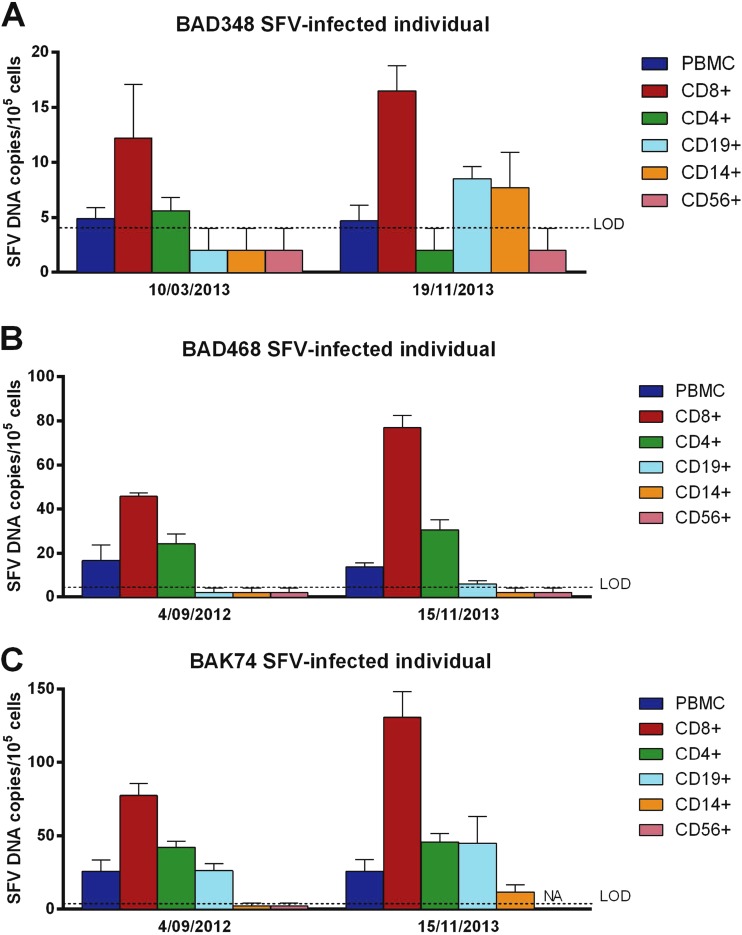
SFV DNA loads in PBMC populations of 3 hunters infected with a Gorilla gorilla SFV strain at two time points. PBMC populations from 3 SFV-infected individuals were isolated, and the SFV DNA load was quantified in each PBMC population at two different time points. Each quantification was performed twice in triplicate (e.g., n = 6). Means ± standard deviations are shown. NA, not available. Values below the limit of detection (LOD) were arbitrarily set as half the LOD, 2 SFV DNA copies/105 cells.
FIG 3
FIG 3
SFV DNA loads in memory and naive CD4+ T cells of 5 hunters infected with a Gorilla gorilla SFV strain. CD4+ cells were separated into naive and memory cells before quantification of the SFV DNA load in 5 SFV-infected individuals. Each quantification was performed twice in triplicate (e.g., n = 6). Means ± standard deviations are shown. Values below the limit of detection (LOD) were arbitrarily set as half the LOD, 2 SFV DNA copies/105 cells.
FIG 4
FIG 4
SFV DNA loads in PBMCs, CD4+ T cells, CD8+ T cells, and CD19+ B cells as a function of the duration of infection. PBMC populations from 11 individuals infected with a Gorilla gorilla SFV strain were isolated, and the SFV DNA load was quantified in each PBMC population. Each quantification was performed twice in triplicate (e.g., n = 6) and plotted as a function of the duration of infection. Time of infection was based on interviews, as described previously (4). Means are shown as well as Spearman's test results (bold characters). Of note, Spearman's test is nonparametric and thus appropriate for our set of data (there were no assumptions about the probability distributions of the variables, here viral loads). Linear regression (parametric) is provided for visualization but has no statistical relevance, as the correlation existing between viral load and the duration of infection is not linear. The values below the limit of detection (LOD) were arbitrarily set as half the LOD, 2 SFV DNA copies/105 cells.

References

    1. Khan AS. 2009. Simian foamy virus infection in humans: prevalence and management. Expert Rev. Anti Infect. Ther. 7:569–580. 10.1586/eri.09.39. - DOI - PubMed
    1. Gessain A, Rua R, Betsem E, Turpin J, Mahieux R. 2013. HTLV-3/4 and simian foamy retroviruses in humans: discovery, epidemiology, cross-species transmission and molecular virology. Virology 435:187–199. 10.1016/j.virol.2012.09.035. - DOI - PMC - PubMed
    1. Calattini S, Betsem EB, Froment A, Mauclère P, Tortevoye P, Schmitt C, Njouom R, Saib A, Gessain A. 2007. Simian foamy virus transmission from apes to humans, rural Cameroon. Emerg. Infect. Dis. 13:1314–1320. 10.3201/eid1309.061162. - DOI - PMC - PubMed
    1. Betsem E, Rua R, Tortevoye P, Froment A, Gessain A. 2011. Frequent and recent human acquisition of simian foamy viruses through apes' bites in central Africa. PLoS Pathog. 7:e1002306. 10.1371/journal.ppat.1002306. - DOI - PMC - PubMed
    1. Rua R, Betsem E, Gessain A. 2013. Viral latency in blood and saliva of simian foamy virus-infected humans. PLoS One 8:e77072. 10.1371/journal.pone.0077072. - DOI - PMC - PubMed

Publication types

Associated data