Ring-screening to control endemic transmission of Taenia solium
- PMID: 25210748
- PMCID: PMC4161340
- DOI: 10.1371/journal.pntd.0003125
Ring-screening to control endemic transmission of Taenia solium
Abstract
Background: Taenia solium is a major cause of preventable epilepsy in developing nations. Screening and treatment of human intestinal stage infection (taeniasis) within high-risk foci may reduce transmission and prevent epilepsy by limiting human exposure to infective eggs. We piloted a ring-strategy that involves screening and treatment for taeniasis among households located nearby pigs heavily-infected with the larval stage (cysticercosis). These pigs mark areas of increased transmission and can be identified by tongue examination.
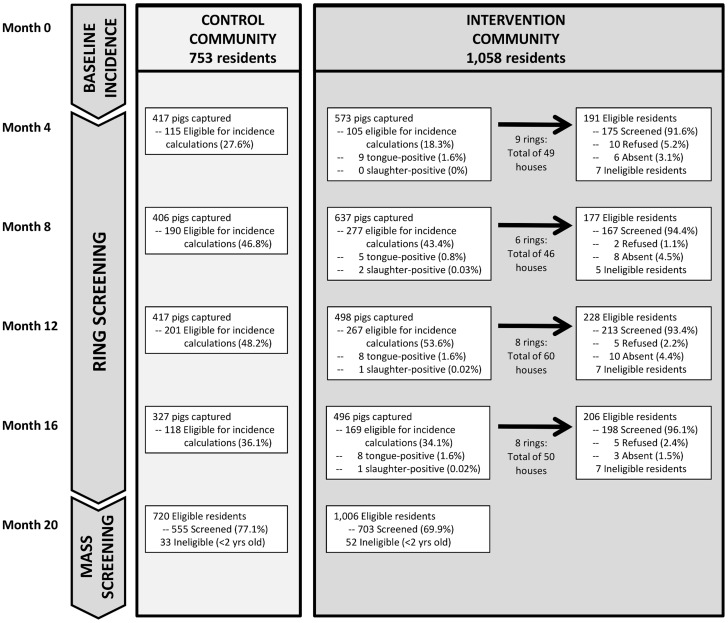
Methodology: We selected two villages in northern Peru for a controlled prospective interventional cohort pilot study. In the intervention village (1,058 residents) we examined the tongues of all pigs every 4 months for nodules characteristic of cysticercosis. We then screened all residents living within 100-meters of any tongue-positive pig using enzyme-linked immunosorbent assay to detect Taenia antigens in stool. Residents with taeniasis were treated with niclosamide. In both the intervention and control (753 residents) we measured incidence of exposure by sampling the pig population every 4 months for serum antibodies against cysticercosis using enzyme-linked immunoelectrotransfer blot.
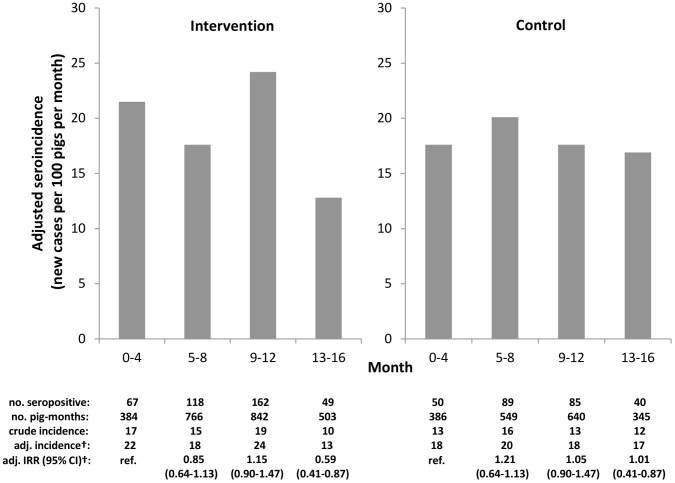
Principal findings: Baseline seroincidence among pigs born during the study was 22.6 cases per 100 pigs per-month (95% confidence interval [CI] 17.0-30.0) in the intervention and 18.1 (95% CI 12.7-25.9) in the control. After one year we observed a 41% reduction in seroincidence in the intervention village compared to baseline (incidence rate ratio 0.59, 95% CI 0.41-0.87) while the seroincidence in the control village remained unchanged. At study end, the prevalence of taeniasis was nearly 4 times lower in the intervention than in the control (prevalence ratio 0.28, 95% CI 0.08-0.91).
Conclusions/significance: Ring-screening reduced transmission of T. solium in this pilot study and may provide an effective and practical approach for regions where resources are limited. However, this strategy requires validation in larger populations over a greater period of time.
Conflict of interest statement
The authors have declared that no competing interests exist.
Figures
References
-
- Scharf D (1988) Neurocysticercosis. Two hundred thirty-eight cases from a California hospital. Arch Neurol 45: 777–780. - PubMed
-
- Shandera WX, White AC, Chen JC, Diaz P, Armstrong R (1994) Neurocysticercosis in Houston, Texas. A report of 112 cases. Medicine (Baltimore) 73: 37–52. - PubMed
-
- Cruz ME, Schantz PM, Cruz I, Espinosa P, Preux PM, et al. (1999) Epilepsy and neurocysticercosis in an Andean community. Int J Epidemiol 28: 799–803. - PubMed
-
- Garcia-Noval J, Moreno E, de Mata F, Soto de Alfaro H, Fletes C, et al. (2001) An epidemiological study of epilepsy and epileptic seizures in two rural Guatemalan communities. Ann Trop Med Parasitol 95: 167–175. - PubMed
-
- Montano SM, Villaran MV, Ylquimiche L, Figueroa JJ, Rodriguez S, et al. (2005) Neurocysticercosis: association between seizures, serology, and brain CT in rural Peru. Neurology. 65: 229–234. - PubMed
Publication types
MeSH terms
Substances
Grants and funding
LinkOut - more resources
Full Text Sources
Other Literature Sources