Mathematical modeling of bacterial kinetics to predict the impact of antibiotic colonic exposure and treatment duration on the amount of resistant enterobacteria excreted
- PMID: 25210849
- PMCID: PMC4161292
- DOI: 10.1371/journal.pcbi.1003840
Mathematical modeling of bacterial kinetics to predict the impact of antibiotic colonic exposure and treatment duration on the amount of resistant enterobacteria excreted
Abstract
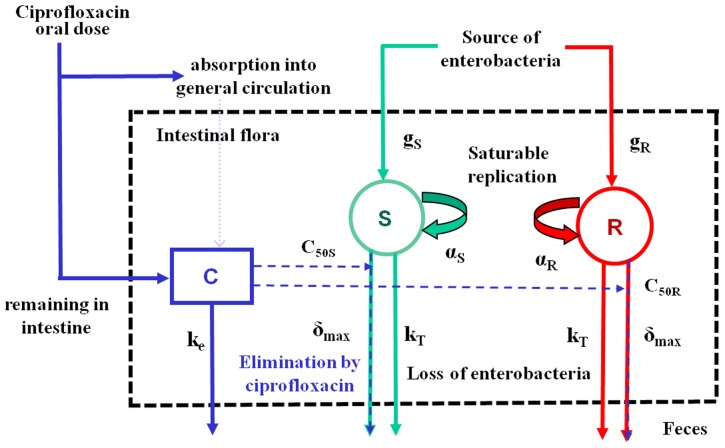
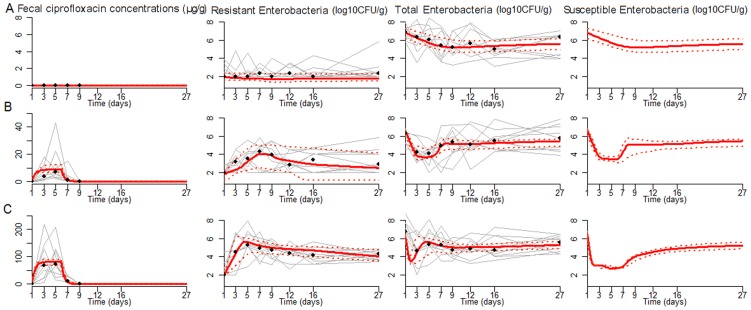
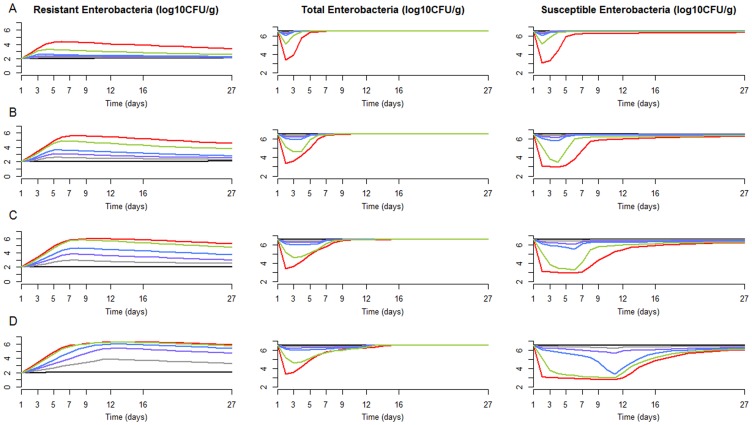
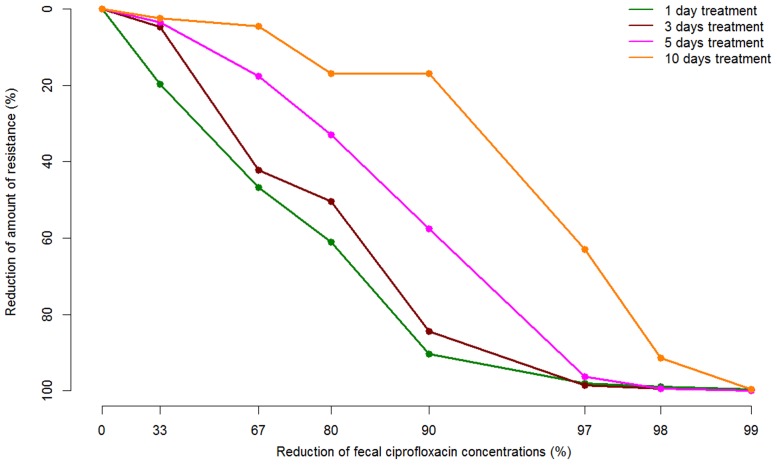
Fecal excretion of antibiotics and resistant bacteria in the environment are major public health threats associated with extensive farming and modern medical care. Innovative strategies that can reduce the intestinal antibiotic concentrations during treatments are in development. However, the effect of lower exposure on the amount of resistant enterobacteria excreted has not been quantified, making it difficult to anticipate the impact of these strategies. Here, we introduce a bacterial kinetic model to capture the complex relationships between drug exposure, loss of susceptible enterobacteria and growth of resistant strains in the feces of piglets receiving placebo, 1.5 or 15 mg/kg/day ciprofloxacin, a fluoroquinolone, for 5 days. The model could well describe the kinetics of drug susceptible and resistant enterobacteria observed during treatment, and up to 22 days after treatment cessation. Next, the model was used to predict the expected amount of resistant enterobacteria excreted over an average piglet's lifetime (150 days) when varying drug exposure and treatment duration. For the clinically relevant dose of 15 mg/kg/day for 5 days, the total amount of resistant enterobacteria excreted was predicted to be reduced by 75% and 98% when reducing treatment duration to 3 and 1 day treatment, respectively. Alternatively, for a fixed 5-days treatment, the level of resistance excreted could be reduced by 18%, 33%, 57.5% and 97% if 3, 5, 10 and 30 times lower levels of colonic drug concentrations were achieved, respectively. This characterization on in vivo data of the dynamics of resistance to antibiotics in the colonic flora could provide new insights into the mechanism of dissemination of resistance and can be used to design strategies aiming to reduce it.
Conflict of interest statement
We have read the journal's policy and have the following conflicts: Thu Thuy Nguyen performed statistical work for the Da Volterra Company through a contract with UMR 738 INSERM and University Paris Diderot. Elisabeth Chachaty is a consultant for the Da Volterra Company. Antoine Andremont is a scientific adviser of the Da Volterra Company within the framework of the French law on Innovation and Research. France Mentré is a consultant for the Da Volterra Company.
Figures
References
-
- Zhou L-J, Ying G-G, Liu S, Zhang R-Q, Lai H-J, Chen Z-F, Pan C-G (2013) Excretion masses and environmental occurrence of antibiotics in typical swine and dairy cattle farms in China. Sci Total Environ 444: 183–195. - PubMed
-
- Li Y-X, Zhang X-L, Li W, Lu X-F, Liu B, Wang J (2013) The residues and environmental risks of multiple veterinary antibiotics in animal faeces. Environ Monit Assess 85 (3) 2211–2220. - PubMed
-
- Aarestrup FM, Seyfarth AM, Emborg H-D, Pedersen K, Hendriksen RS, Bager F (2001) Effect of Abolishment of the Use of Antimicrobial Agents for Growth Promotion on Occurrence of Antimicrobial Resistance in Fecal Enterococci from Food Animals in Denmark. Antimicrob Agents Chemother 45 (7) 2054–2059. - PMC - PubMed
-
- Risk Response Network (2013) The Dangers of Hubris on Human Health. Global Risk Report Eighth Edition, World Economic Forum.
MeSH terms
Substances
LinkOut - more resources
Full Text Sources
Other Literature Sources
Medical