


Role of pill-taking, expectation and therapeutic alliance in the placebo response in clinical trials for major depression
- PMID: 25213159
- PMCID: PMC4248233
- DOI: 10.1192/bjp.bp.113.140343
Role of pill-taking, expectation and therapeutic alliance in the placebo response in clinical trials for major depression
Abstract
Background: Pill-taking, expectations and therapeutic alliance may account for much of the benefit of medication and placebo treatment for major depressive disorder (MDD). Aims To examine the effects of medication, placebo and supportive care on treatment outcome, and the relationships of expectations and therapeutic alliance to improvement.
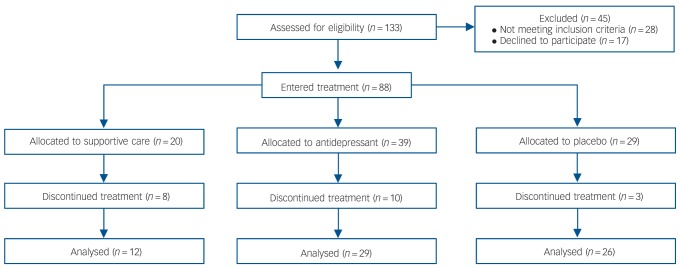
Method: A total of 88 participants were randomised to 8 weeks of treatment with supportive care alone or combined with double-blind treatment with placebo or antidepressant medication. Expectations of medication effectiveness, general treatment effectiveness and therapeutic alliance were measured (trial registration at ClinicalTrials.gov: NCT00200902).
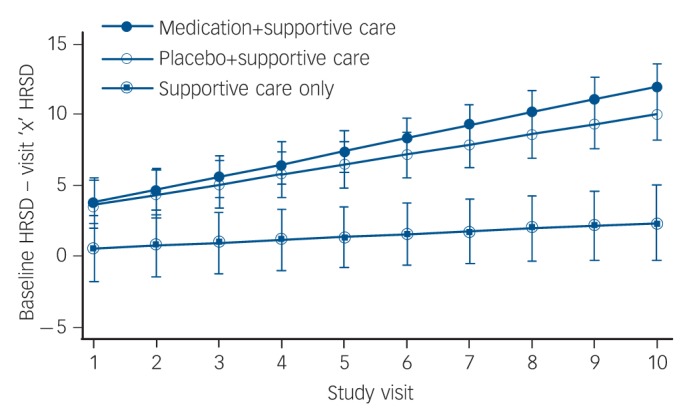
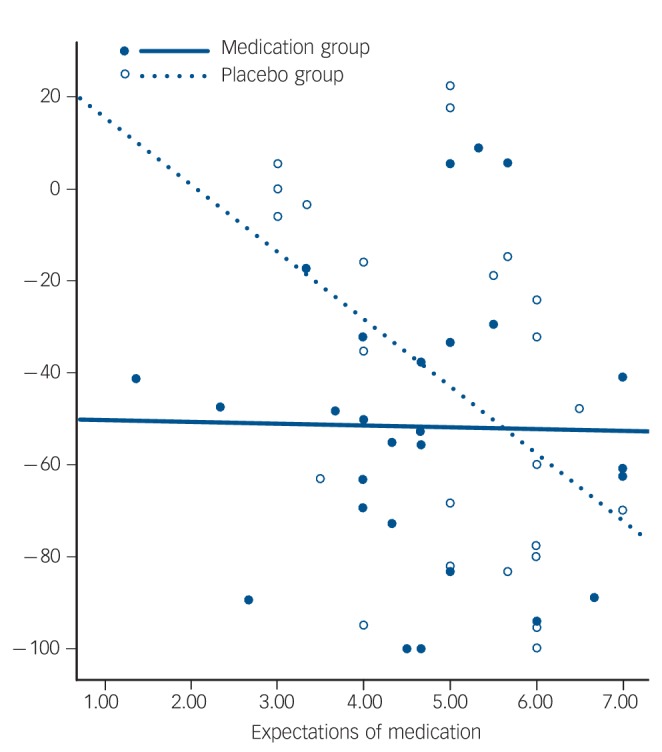
Results: Medication or placebo plus supportive care were not significantly different but had significantly better outcome than supportive care alone. Therapeutic alliance predicted response to medication and placebo; expectations of medication effectiveness at enrolment predicted only placebo response.
Conclusions: Pill treatment yielded better outcome than supportive care alone. Medication expectations uniquely predicted placebo treatment outcome and were formed by time of enrolment, suggesting that they were shaped by prior experiences outside the clinical trial.
Royal College of Psychiatrists.
Conflict of interest statement
A.F.L, within the past 5 years, has received research support from the National Institutes of Health, Wyeth Pharmaceuticals, Novartis Pharmaceuticals, Seaside Therapeutics, Genentech, Shire Pharmaceuticals, Neuronetics, Eli Lilly and Company, and Neurosigma. He has served as a consultant to NeoSync Inc., Brain Cells, Inc., Taisho Pharmaceuticals, Eli Lilly and Company, and Aspect Medical Systems/Covidien. He is Chief Scientific Officer of Brain Biomarker Analytics LLC (BBA). He owns stock options in NeoSync, Inc. and has equity interest in BBA. I.A.C., within the past 5 years, has received research support from Aspect Medical Systems/Covidien, National Institutes of Health, Neuronetics and Shire; he has been on the speakers’ bureau for Neuronetics and the Medical Education Speakers Network; he has been an advisor/consultant/reviewer for Allergan, Covidien, Pfizer, Neuronetics, NeuroSigma, NIH (ITVS), US Department of Defense, US Department of Justice, VA (DSMB); his biomedical intellectual property is assigned to the Regents of the University of California, and he owns stock options in NeuroSigma.
Figures
Comment in
-
Are conclusions overstated for placebo response?Br J Psychiatry. 2015 May;206(5):434-5. doi: 10.1192/bjp.206.5.434a. Br J Psychiatry. 2015. PMID: 25934308 No abstract available.
-
Author's reply: To PMID 25213159.Br J Psychiatry. 2015 May;206(5):435. doi: 10.1192/bjp.206.5.435. Br J Psychiatry. 2015. PMID: 25934309 No abstract available.
-
Does previous experience of antidepressants form the expectations necessary for a placebo response?Br J Psychiatry. 2015 Dec;207(6):561. doi: 10.1192/bjp.207.6.561a. Br J Psychiatry. 2015. PMID: 26628699 No abstract available.
-
Authors' reply.Br J Psychiatry. 2015 Dec;207(6):561-2. doi: 10.1192/bjp.207.6.561b. Br J Psychiatry. 2015. PMID: 26628700 No abstract available.
References
-
- Khan A, Redding N, Brown WA. The persistence of the placebo response in antidepressant clinical trials. J Psychiatr Res 2008; 42: 791–6. - PubMed
-
- Walsh BT, Seidman SN, Sysko R, Gould M. Placebo response in studies of major depression: variable, substantial and growing. JAMA 2002; 287: 1840–7. - PubMed
Publication types
MeSH terms
Substances
Associated data
Grants and funding
LinkOut - more resources
Full Text Sources
Other Literature Sources
Medical
