Phenomic assessment of genetic buffering by kinetic analysis of cell arrays
- PMID: 25213246
- PMCID: PMC4920064
- DOI: 10.1007/978-1-4939-1363-3_12
Phenomic assessment of genetic buffering by kinetic analysis of cell arrays
Abstract
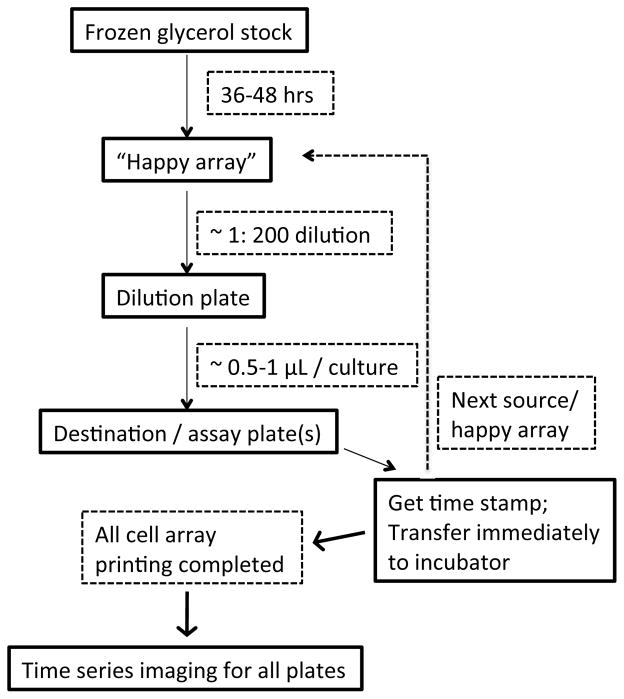
Quantitative high-throughput cell array phenotyping (Q-HTCP) is applied to the genomic collection of yeast gene deletion mutants for systematic, comprehensive assessment of the contribution of genes and gene combinations to any phenotype of interest (phenomic analysis). Interacting gene networks influence every phenotype. Genetic buffering refers to how gene interaction networks stabilize or destabilize a phenotype. Like genomics, phenomics varies in its resolution with there being a trade-off allocating a greater number of measurements per sample to enhance quantification of the phenotype vs. increasing the number of different samples by obtaining fewer measurements per sample. The Q-HTCP protocol we describe assesses 50,000-70,000 cultures per experiment by obtaining kinetic growth curves from time series imaging of agar cell arrays. This approach was developed for the yeast gene deletion strains, but it could be applied as well to other microbial mutant arrays grown on solid agar media. The methods we describe are for creation and maintenance of frozen stocks, liquid source array preparation, agar destination plate printing, image scanning, image analysis, curve fitting, and evaluation of gene interaction.
Conflict of interest statement
Competing interests: JLH holds an equity interest in Spectrum PhenomX, LLC, which has a license to commercialize Q-HTCP technology. All other authors declare no competing interests.
Figures
References
-
- Hartman JL, IV, Garvik B, Hartwell L. Principles for the buffering of genetic variation. Science. 2001;291:1001–1004. - PubMed
-
- Dixon SJ, Costanzo M, Baryshnikova A, et al. Systematic mapping of genetic interaction networks. Annu Rev Genet. 2009;43:601–625. - PubMed
-
- Schuldiner M, Collins SR, Thompson NJ, et al. Exploration of the function and organization of the yeast early secretory pathway through an epistatic miniarray profile. Cell. 2005;123:507–519. - PubMed
MeSH terms
Grants and funding
LinkOut - more resources
Full Text Sources
Other Literature Sources
Molecular Biology Databases