


Aldosterone, cognitive function, and cerebral hemodynamics in hypertension and antihypertensive therapy
- PMID: 25213687
- PMCID: PMC4402350
- DOI: 10.1093/ajh/hpu161
Aldosterone, cognitive function, and cerebral hemodynamics in hypertension and antihypertensive therapy
Abstract
Background: Animal studies suggest that the renin-angiotensin-aldosterone system is involved in neurocognitive function and the response to antihypertensive therapy. We investigated the impact of circulating aldosterone and renin activity on cognition and cerebral hemodynamics at baseline and after antihypertensive therapy for 1 year.
Methods: Participants were older adults (n = 47; mean age = 71 years) enrolled in a clinical trial. Routine antihypertensive medications were replaced with the study regimen to achieve a blood pressure <140/90 mm Hg. Executive function, memory, cerebral hemodynamics (blood flow velocity), CO2 vasoreactivity (measured using transcranial Doppler ultrasonography), plasma renin activity, and aldosterone were measured at baseline and at 6 and 12 months after the initiation of treatment.
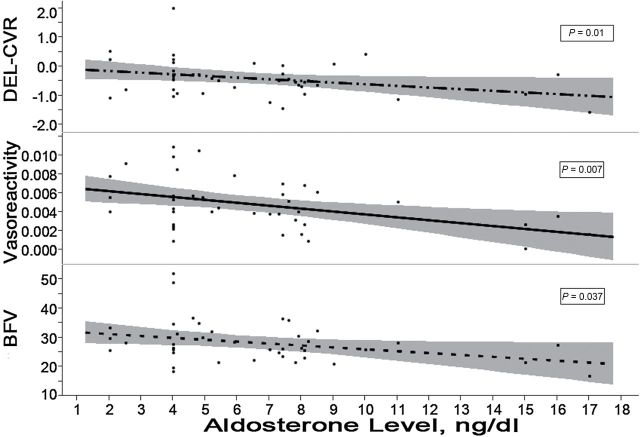
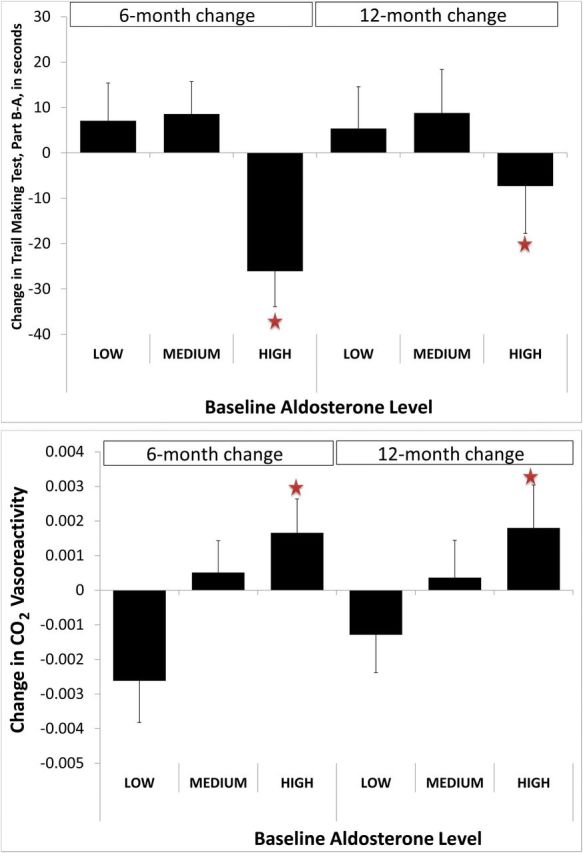
Results: At baseline, higher levels of circulating aldosterone were associated with lower blood flow velocity (β = -0.02; P = 0.03), lower CO2 vasoreactivity (β = -0.11; P = 0.007), and decreased autoregulation abilities (β = -0.09; P = 0.01). Those with higher levels of aldosterone at baseline demonstrated the greatest improvement in executive function (P = 0.014 for the aldosterone effect) and in CO2 vasoreactivity (P = 0.026 for the aldosterone effect) after 12 months of lowering blood pressure (<140/90 mm Hg). Plasma renin activity was not associated with any of the measures.
Conclusions: Higher levels of aldosterone may be associated with decreased cerebrovascular function in hypertension. Those with higher aldosterone levels may benefit the most from lowering blood pressure. The role of aldosterone in brain health warrants further investigation in a larger trial.
Keywords: aldosterone; blood flow velocity hypertension; blood pressure.; cognition; renin; vasoreactivity.
© American Journal of Hypertension, Ltd 2014. All rights reserved. For Permissions, please email: journals.permissions@oup.com.
Figures
References
-
- Diz DI, Kasper SO, Sakima A, Ferrario CM. Aging and the brain renin-angiotensin system: insights from studies in transgenic rats. Cleve Clin J Med 2007; 74 Suppl 1:S95–98. - PubMed
-
- Savaskan E. The role of the brain renin-angiotensin system in neurodegenerative disorders. Curr Alzheimer Res 2005; 2:29–35. - PubMed
-
- Wright JW, Harding JW. The brain renin-angiotensin system: a diversity of functions and implications for CNS diseases. Pflugers Arch 2013; 465:133–151. - PubMed
-
- Bonini JS, Bevilaqua LR, Zinn CG, Kerr DS, Medina JH, Izquierdo I, Cammarota M. Angiotensin II disrupts inhibitory avoidance memory retrieval. Horm Behav 2006; 50:308–313. - PubMed
-
- Kazama K, Wang G, Frys K, Anrather J, Iadecola C. Angiotensin II attenuates functional hyperemia in the mouse somatosensory cortex. Am J Physiol Heart Circ Physiol 2003; 285:H1890–H1899. - PubMed
Publication types
MeSH terms
Substances
Grants and funding
LinkOut - more resources
Full Text Sources
Other Literature Sources
Medical
