


Using drug response data to identify molecular effectors, and molecular "omic" data to identify candidate drugs in cancer
- PMID: 25213708
- PMCID: PMC4282979
- DOI: 10.1007/s00439-014-1482-9
Using drug response data to identify molecular effectors, and molecular "omic" data to identify candidate drugs in cancer
Erratum in
-
Erratum to: The Special Issue on "Computational Molecular Medicine", edited by Rachel Karchin and Melissa S. Cline.Hum Genet. 2015 May;134(5):509. doi: 10.1007/s00439-015-1543-8. Hum Genet. 2015. PMID: 25800701 Free PMC article. No abstract available.
Abstract
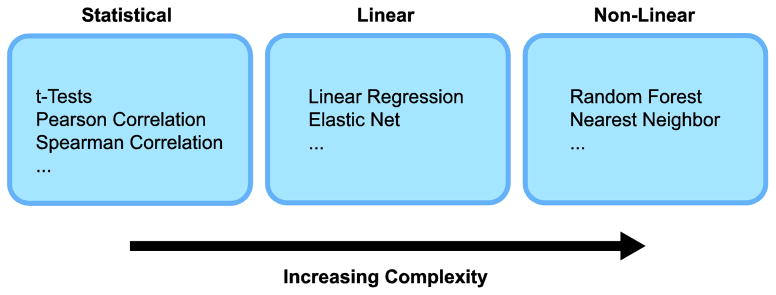
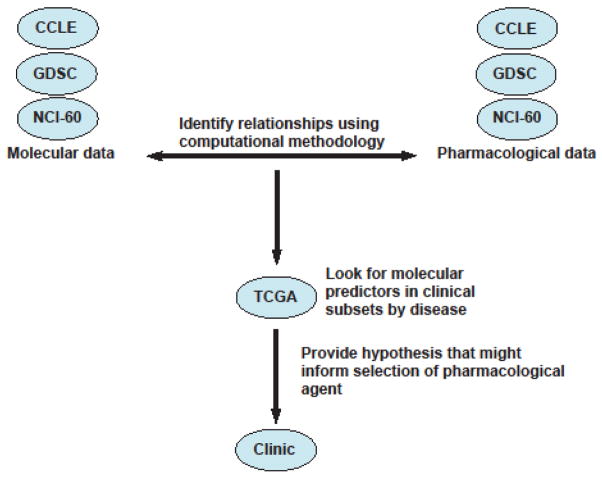
The current convergence of molecular and pharmacological data provides unprecedented opportunities to gain insights into the relationships between the two types of data. Multiple forms of large-scale molecular data, including but not limited to gene and microRNA transcript expression, DNA somatic and germline variations from next-generation DNA and RNA sequencing, and DNA copy number from array comparative genomic hybridization are all potentially informative when one attempts to recognize the panoply of potentially influential events both for cancer progression and therapeutic outcome. Concurrently, there has also been a substantial expansion of the pharmacological data being accrued in a systematic fashion. For cancer cell lines, the National Cancer Institute cell line panel (NCI-60), the Cancer Cell Line Encyclopedia (CCLE), and the collaborative Genomics of Drug Sensitivity in Cancer (GDSC) databases all provide subsets of these forms of data. For the patient-derived data, The Cancer Genome Atlas (TCGA) provides analogous forms of genomic information along with treatment histories. Integration of these data in turn relies on the fields of statistics and statistical learning. Multiple algorithmic approaches may be chosen, depending on the data being considered, and the nature of the question being asked. Combining these algorithms with prior biological knowledge, the results of molecular biological studies, and the consideration of genes as pathways or functional groups provides both the challenge and the potential of the field. The ultimate goal is to provide a paradigm shift in the way that drugs are selected to provide a more targeted and efficacious outcome for the patient.
Conflict of interest statement
No conflicts of interest to report.
Figures
References
-
- Abaan OD, Polley EC, Davis SR, Zhu YJ, Bilke S, Walker RL, Pineda M, Gindin Y, Jiang Y, Reinhold WC, Holbeck SL, Simon RM, Doroshow JH, Pommier Y, Meltzer PS. The Exomes of the NCI-60 Panel: A Genomic Resource for Cancer Biology and Systems Pharmacology. Cancer Research. 2013;73:4372–82. doi: 10.1158/0008-5472.CAN-12-3342. - DOI - PMC - PubMed
-
- Amundson SA, Do KT, Vinikoor LC, Lee RA, Koch-Paiz CA, Ahn J, Reimers M, Chen Y, Scudiero DA, Weinstein JN, Trent JM, Bittner ML, Meltzer PS, Fornace AJ., Jr Integrating global gene expression and radiation survival parameters across the 60 cell lines of the National Cancer Institute Anticancer Drug Screen. Cancer Res. 2008;68:415–24. doi: 10.1158/0008-5472.CAN-07-2120. - DOI - PubMed
Publication types
MeSH terms
Substances
Grants and funding
LinkOut - more resources
Full Text Sources
Other Literature Sources
