Review
. 2014 Dec;71(23):4507-17.
doi: 10.1007/s00018-014-1718-9. Epub 2014 Sep 13.

Replication fork recovery and regulation of common fragile sites stability

Affiliations
Review

Replication fork recovery and regulation of common fragile sites stability

Annapaola Franchitto et al. Cell Mol Life Sci. 2014 Dec.

Abstract

The acquisition of genomic instability is a triggering factor in cancer development, and common fragile sites (CFS) are the preferential target of chromosomal instability under conditions of replicative stress in the human genome. Although the mechanisms leading to CFS expression and the cellular factors required to suppress CFS instability remain largely undefined, it is clear that DNA becomes more susceptible to breakage when replication is impaired. The models proposed so far to explain how CFS instability arises imply that replication fork progression along these regions is perturbed due to intrinsic features of fragile sites and events that directly affect DNA replication. The observation that proteins implicated in the safe recovery of stalled forks or in engaging recombination at collapsed forks increase CFS expression when downregulated or mutated suggests that the stabilization and recovery of perturbed replication forks are crucial to guarantee CFS integrity.


Figures
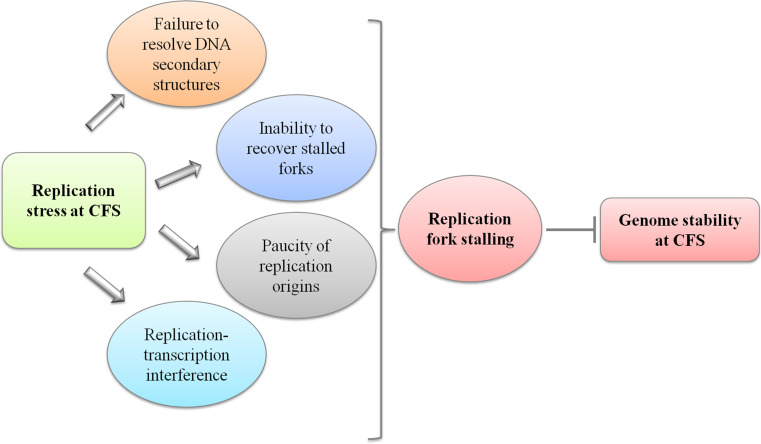
Fig. 1
Fig. 1
General scheme of the potential sources of replication stress at CFS. Multiple factors can threaten DNA replication contributing to replication perturbation, and all the proposed causes implicate the requirement of a replication recovery mechanism to avoid CFS instability
Fig. 2
Fig. 2
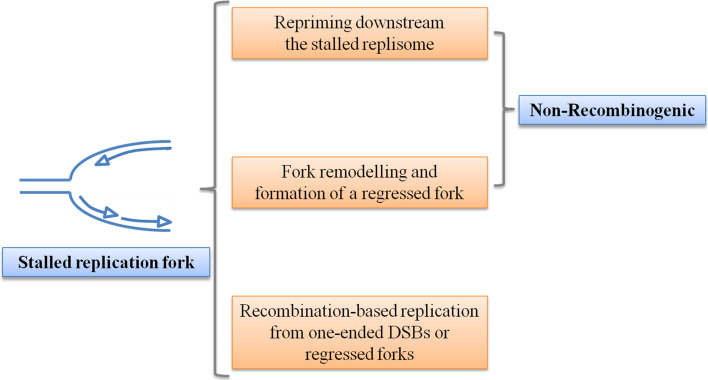
Pathways by which DNA replication can reinitiate after replication fork arrest. Upon stalling of a replication fork, DNA synthesis can be reinitiated through three different mechanisms (from top to bottom): replication can be restarted by repriming downstream of the site of stalling; alternatively, specialized enzymes, such as DNA translocases and helicases, are recruited to remodel the DNA at stalled forks to produce a regressed fork, which is used to protect ssDNA at the site of fork stalling and to restore a functional replication fork; finally, replication can be resumed using recombination from either collapsed forks, after production of one-ended DSBs, or from the regressed replication fork (see text for details). Perturbation of replication at CFS most probably engages a non-recombinogenic pathway of fork restart
Fig. 3
Fig. 3
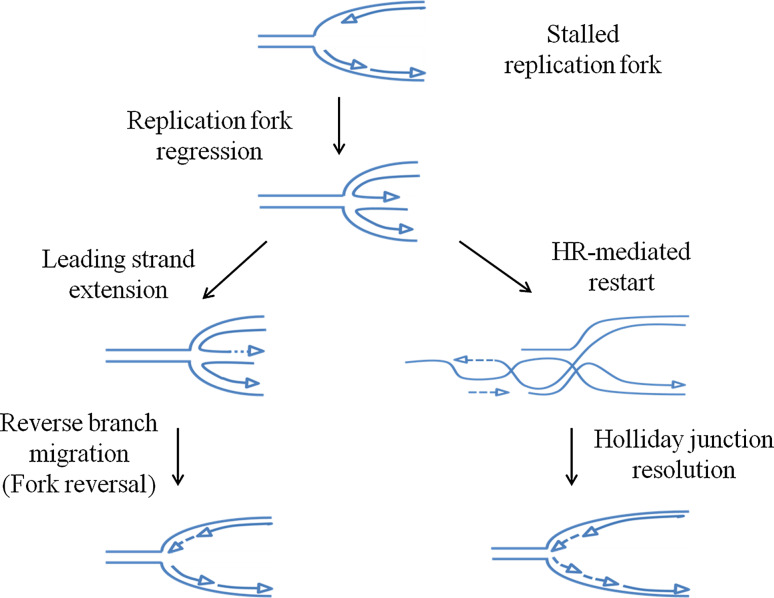
The replication fork regression is a versatile intermediate for replication restart. A stalled replication fork is characterized by formation of a ssDNA region ahead of the fork as a consequence of helicase–polymerase uncoupling. The need for stabilize and protect ssDNA determines the engagement of DNA translocases and/or helicases at the fork to regress the replisome, leading to extrusion of the nascent DNA strands and their pairing. The four-way DNA structure that forms, which is called the regressed fork or chicken foot, can be further reversed by branch migrating activities to restore a forked DNA or engaged in recombination-mediated replication restart. In this latter event, resolution of the D-loop formed behind the fork is required to support replisome reassembly
Fig. 4
Fig. 4
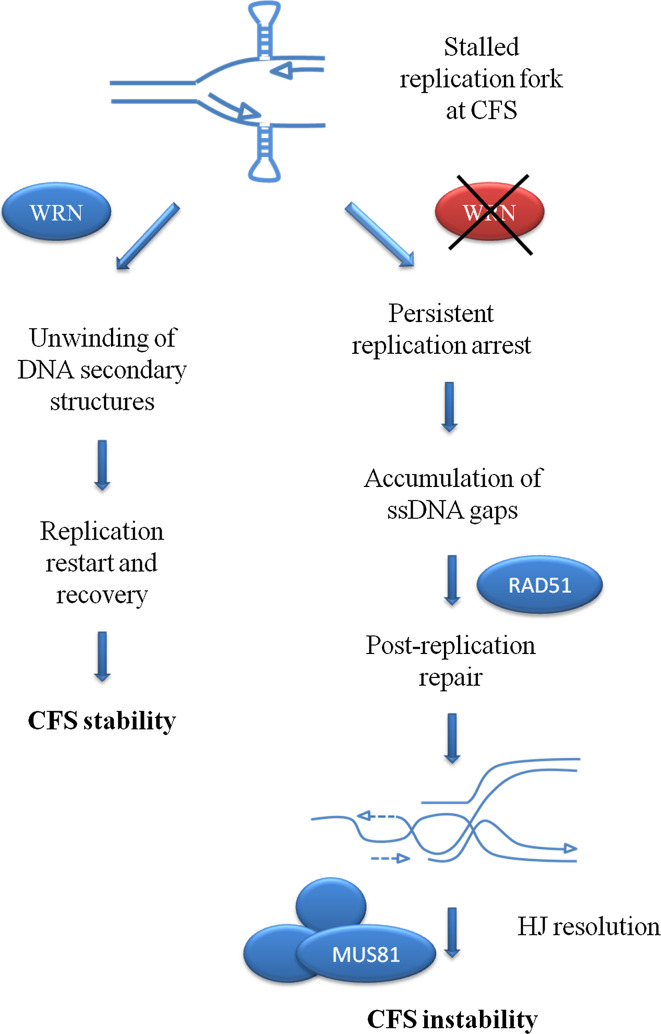
Proposed model of the WRN RecQ helicase function for the replication restart at CFS. Formation of DNA secondary structures (depicted as hairpins) at a subset of CFS may hinder the progression of the replisome inducing a transient replication arrest. The WRN RecQ helicase, in cooperation with the replication checkpoint, is recruited at the fork stalling site to help in removal of the roadblock and possibly in the restoration of an active replisome, either directly or after fork regression. In the absence of WRN, the fork stalling becomes permanent because the DNA secondary structures cannot be unwound, resulting in regions of unreplicated DNA. In late S or G2, the unreplicated regions are targeted by RAD51-mediated recombination to be replicated. Extensive requirement of this backup mechanism, as probably occurs in the absence of WRN or other factors involved in replication restart at CFS, leads to accumulation of recombination intermediates that have to be resolved before mitosis. Resolution of these intermediates by resolvases such as MUS81 contributes to generate chromosome breaks and gaps at CFS, which are commonly observed in metaphase cells

References

    1. Glover TW, Berger C, Coyle J, Echo B. DNA polymerase alpha inhibition by aphidicolin induces gaps and breaks at common fragile sites in human chromosomes. Hum Genet. 1984;67(2):136–142. doi: 10.1007/BF00272988. - DOI - PubMed
    1. Glover TW, Arlt MF, Casper AM, Durkin SG. Mechanisms of common fragile site instability. Hum Mol Genet. 2005;14 Spec No. 2:R197–R205. doi: 10.1093/hmg/ddi265. - DOI - PubMed
    1. Hecht F, Glover TW. Cancer chromosome breakpoints and common fragile sites induced by aphidicolin. Cancer Genet Cytogenet. 1984;13(2):185–188. doi: 10.1016/0165-4608(84)90060-8. - DOI - PubMed
    1. Mangelsdorf M, Ried K, Woollatt E, Dayan S, Eyre H, Finnis M, Hobson L, Nancarrow J, Venter D, Baker E, Richards RI. Chromosomal fragile site FRA16D and DNA instability in cancer. Cancer Res. 2000;60(6):1683–1689. - PubMed
    1. Mimori K, Druck T, Inoue H, Alder H, Berk L, Mori M, Huebner K, Croce CM. Cancer-specific chromosome alterations in the constitutive fragile region FRA3B. Proc Natl Acad Sci USA. 1999;96(13):7456–7461. doi: 10.1073/pnas.96.13.7456. - DOI - PMC - PubMed

Publication types

Substances

LinkOut - more resources