. 2014 Dec;42(12):1982-90.
doi: 10.1124/dmd.114.059535. Epub 2014 Sep 12.

Wuzhi tablet (Schisandra Sphenanthera extract) protects against acetaminophen-induced hepatotoxicity by inhibition of CYP-mediated bioactivation and regulation of NRF2-ARE and p53/p21 pathways

Affiliations

Wuzhi tablet (Schisandra Sphenanthera extract) protects against acetaminophen-induced hepatotoxicity by inhibition of CYP-mediated bioactivation and regulation of NRF2-ARE and p53/p21 pathways

Xiaomei Fan et al. Drug Metab Dispos. 2014 Dec.

Abstract

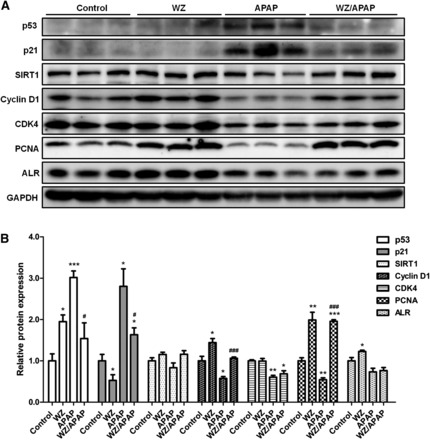
Schisandra sphenanthera is widely used as a tonic and restorative in many countries to enhance the function of liver and other organs. Wuzhi tablet (WZ) is a preparation of an ethanol extract of Schisandra sphenanthera. Our previous study demonstrated that WZ exerted a protective effect toward acetaminophen (APAP)-induced hepatotoxicity. However, the molecular mechanisms of this protection remain unclear. This study aimed to determine what molecular pathways contributed to the hepatoprotective effects of WZ against APAP toxicity. Administration of WZ 3 days before APAP treatment significantly attenuated APAP hepatotoxicity in a dose-dependent manner and reduced APAP-induced JNK activation. Treatment with WZ resulted in potent inhibition of CYP2E1, CYP3A11, and CYP1A2 activities and then caused significant inhibition of the formation of the oxidized APAP metabolite N-acetyl-p-benzoquinone imine-reduced glutathione. The expression of NRF2 was increased after APAP and/or WZ treatment, whereas KEAP1 levels were decreased. The protein expression of NRF2 target genes including Gclc, Gclm, Ho-1, and Nqo1 was significantly increased by WZ treatment. Furthermore, APAP increased the levels of p53 and its downstream gene p21 to trigger cell cycle arrest and apoptosis, whereas WZ pretreatment could inhibit p53/p21 signaling to induce cell proliferation-associated proteins including cyclin D1, CDK4, PCNA, and ALR to promote hepatocyte proliferation. This study demonstrated that WZ prevented APAP-induced liver injury by inhibition of cytochrome P450-mediated APAP bioactivation, activation of the NRF2-antioxidant response element pathway to induce detoxification and antioxidation, and regulation of the p53, p21, cyclin D1, CDK4, PCNA, and ALR to facilitate liver regeneration after APAP-induced liver injury.


Figures

Fig. 1.
Fig. 1.
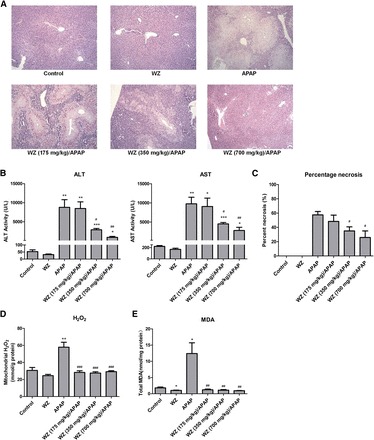
Pretreatment with WZ protects mice against APAP-induced hepatotoxicity. (A) H&E-stained liver sections, (B) serum ALT and AST activities, (C) percentage necrosis, (D) mitochondrial H2O2 levels, (E) total MDA levels from mice in each experimental group (n = 6). *P < 0.05, **P < 0.01, ***P < 0.001 versus control mice; #P < 0.05, ##P < 0.01, ###P < 0.001 versus APAP-treated mice.
Fig. 2.
Fig. 2.
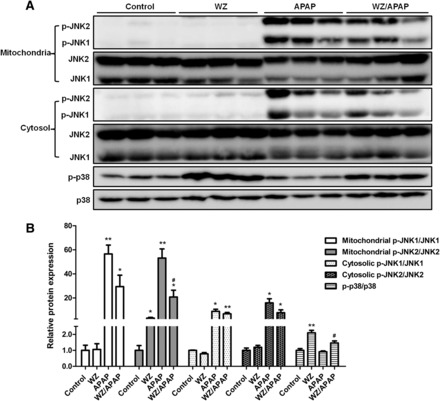
Pretreatment with WZ inactivates JNK, but activates p38 MAPK after APAP challenge. (A) Western blot analysis of p-JNK, JNK, p-p38, and p38 levels in livers from control, WZ (700 mg/kg)-treated, APAP-treated, WZ (700 mg/kg)/APAP-treated mice. (B) Densitometric analysis of Western blots (n = 3). *P < 0.05, **P < 0.01 versus control mice; #P < 0.05 versus APAP-treated mice.
Fig. 3.
Fig. 3.
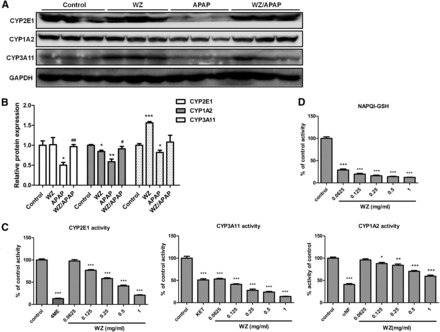
WZ possesses marked inhibitory effects on the activities of P450 enzymes and NAPQI-GSH formation. (A) Western blot analysis of CYP2E1, CYP1A2, CYP3A11, and glyceraldehyde-3-phosphate dehydrogenase levels in livers from control, WZ (700 mg/kg)-treated, APAP-treated, WZ (700 mg/kg)/APAP-treated mice. (B) Densitometric analysis of Western blots (n = 3). (C) Effect of WZ on the activities of CYP2E1, CYP1A2, CYP3A11 enzymes in mouse liver microsomes (n = 5). (D) Effect of WZ on NAPQI-GSH formation in mouse liver microsomes (n = 5). *P < 0.05, **P < 0.01, ***P < 0.001 versus control mice; #P < 0.05, ##P < 0.01 versus APAP-treated mice.
Fig. 4.
Fig. 4.
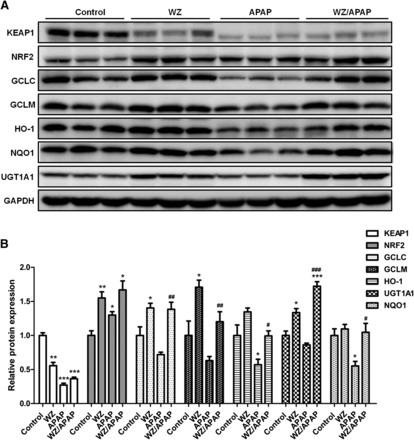
WZ activates NRF2-ARE signaling pathway in mice. (A) Western blot analysis of KEAP1, NRF2, GCLC, GCLM, HO-1, NQO1, UGT1A1, and glyceraldehyde-3-phosphate dehydrogenase proteins in livers from control, WZ (700 mg/kg)-treated, APAP-treated, WZ (700 mg/kg)/APAP-treated mice. (B) Densitometric analysis of Western blots (n = 3). *P < 0.05, **P < 0.01, ***P < 0.001 versus control mice; #P < 0.05, ##P < 0.01, ###P < 0.001 versus APAP-treated mice.
Fig. 5.
Fig. 5.
WZ suppresses p53/p21 signaling pathway in mice. (A) Western blot analysis of p53, p21, SIRT1, cyclin D1, CDK4, PCNA, ALR, and glyceraldehyde-3-phosphate dehydrogenase proteins in livers from control, WZ (700 mg/kg)-treated, APAP-treated, WZ (700 mg/kg)/APAP-treated mice. (B) Densitometric analysis of Western blots (n = 3). *P < 0.05, **P < 0.01, ***P < 0.001 versus control mice; #P < 0.05, ###P < 0.001 versus APAP-treated mice.

References

    1. Bajt ML, Yan HM, Farhood A, Jaeschke H. (2008) Plasminogen activator inhibitor-1 limits liver injury and facilitates regeneration after acetaminophen overdose. Toxicol Sci 104:419–427. - PMC - PubMed
    1. Bi H, Li F, Krausz KW, Qu A, Johnson CH, Gonzalez FJ. (2013) Targeted Metabolomics of Serum Acylcarnitines Evaluates Hepatoprotective Effect of Wuzhi Tablet (Schisandra sphenanthera Extract) against Acute Acetaminophen Toxicity. Evid Based Complement Alternat Med 2013:985257. - PMC - PubMed
    1. Checker R, Patwardhan RS, Sharma D, Menon J, Thoh M, Bhilwade HN, Konishi T, Sandur SK. (2012) Schisandrin B exhibits anti-inflammatory activity through modulation of the redox-sensitive transcription factors Nrf2 and NF-κB. Free Radic Biol Med 53:1421–1430. - PubMed
    1. Dayoub R, Vogel A, Schuett J, Lupke M, Spieker SM, Kettern N, Hildt E, Melter M, Weiss TS. (2013) Nrf2 activates augmenter of liver regeneration (ALR) via antioxidant response element and links oxidative stress to liver regeneration. Mol Med 19:237–244. - PMC - PubMed
    1. Diehl AM, Chute J. (2013) Underlying potential: cellular and molecular determinants of adult liver repair. J Clin Invest 123:1858–1860. - PMC - PubMed

Publication types

MeSH terms