


Using the Society for Assisted Reproductive Technology Clinic Outcome System morphological measures to predict live birth after assisted reproductive technology
- PMID: 25217871
- PMCID: PMC4252875
- DOI: 10.1016/j.fertnstert.2014.07.1242
Using the Society for Assisted Reproductive Technology Clinic Outcome System morphological measures to predict live birth after assisted reproductive technology
Abstract
Objective: To model morphological assessments of embryo quality that are predictive of live birth.
Design: Longitudinal cohort using cycles reported in the Society for Assisted Reproductive Technology Clinic Outcomes Reporting System (SART CORS) between 2007 and 2011.
Setting: Clinic-based data.
Patient(s): Fresh autologous assisted reproductive technology (ART) cycles with ETs on day 3 or day 5 and morphological assessments reported (25,409 cycles with one embryo transferred and 96,093 cycles with two embryos transferred). Live-birth rates were modeled by morphological assessments using backward-stepping logistic regression for cycle 1 and over five cycles, separately for day 3 and day 5 transfers and number of embryos transferred (1 or 2). Additional models for each day of transfer also included the number of oocytes retrieved and the number of embryos cryopreserved.
Intervention(s): None.
Main outcome measure(s): Live births.
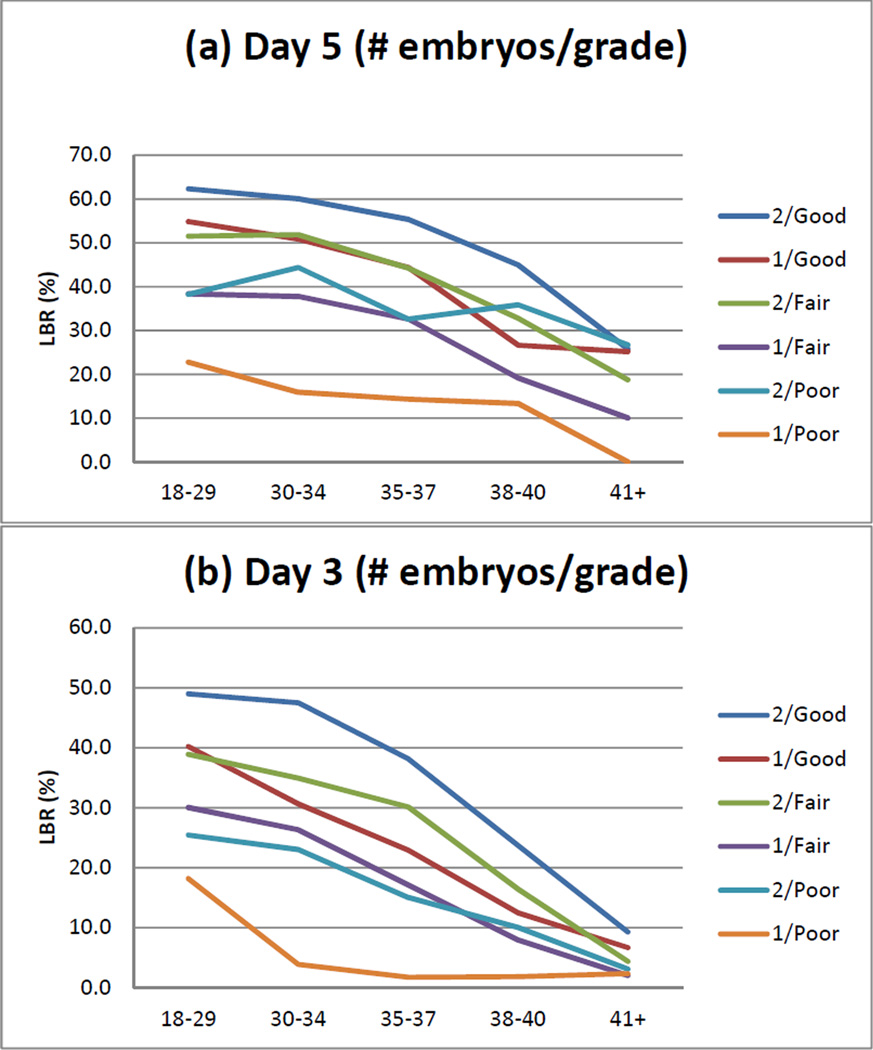
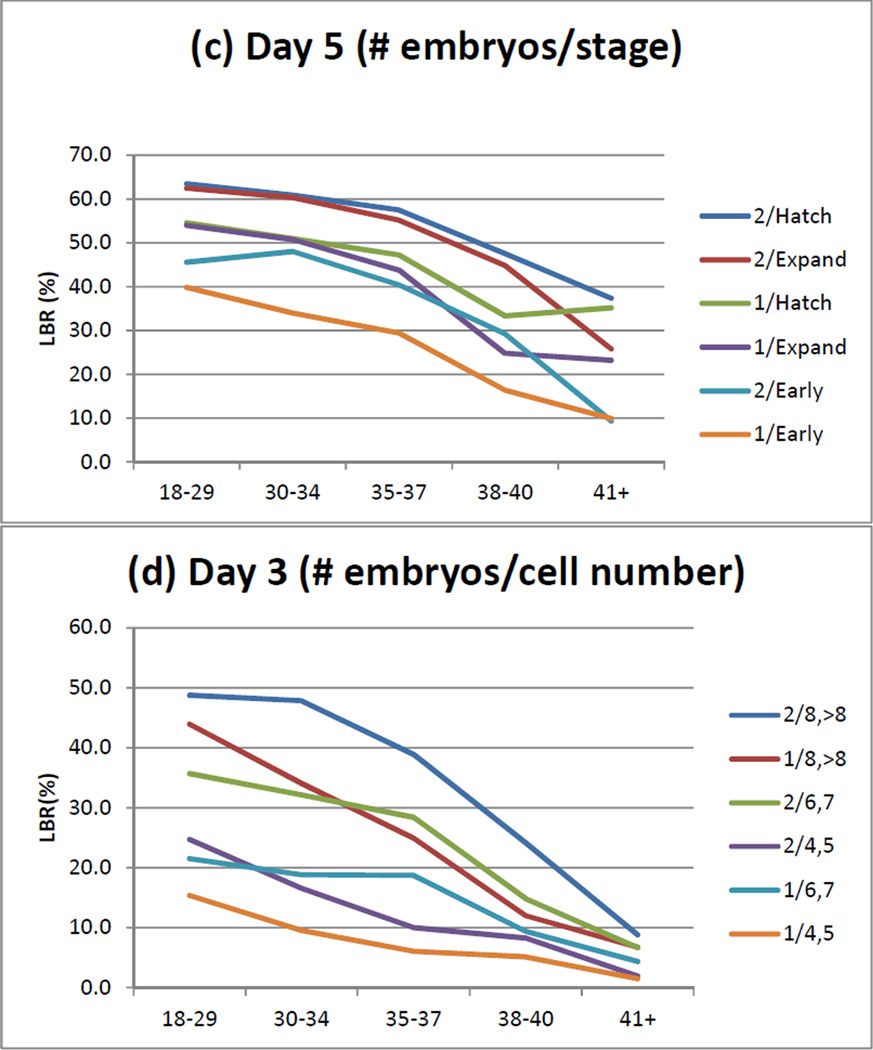
Result(s): Morphological assessments of grade, stage, fragmentation, and symmetry were significant for the day 3 models; grade, stage, and trophectoderm were significant in the day 5 model; inner-cell mass was significant in the models when two embryos were transferred. Number of oocytes retrieved and number of embryos cryopreserved were significant for both day 3 and day 5 models.
Conclusion(s): These findings confirm the significant association between embryo quality parameters reported to SART CORS and live-birth rate after ART.
Keywords: Embryo morphology; embryo fragmentation; embryo symmetry; live birth rate; trophoblast.
Copyright © 2014 American Society for Reproductive Medicine. Published by Elsevier Inc. All rights reserved.
Figures
References
-
- Tesarik J, Junca AM, Hazout A, Aubriot FX, Nathan C, Cohen-Bacrie P, et al. Embryos with high implantation potential after intracytoplasmic sperm injection can be recognized by a simple, noninvasive examination of pronuclear morphology. Hum Reprod. 2000;15:1396–1399. - PubMed
-
- Van Royen E, Mangelschots K, De Neubourg D, Laureys I, Ryckaert G, Gerris J. Calculating the implantation potential of day 3 embryos in women younger than 38 years of age: a new model. Hum Reprod. 2001;16:326–332. - PubMed
-
- Boiso I, Veiga A, Edwards RG. Fundamentals of human embryonic growth in vitro and the selection of high-quality embryos for transfer. Reprod Biomed Online. 2002;5:328–350. - PubMed
-
- Gardner DK, Sakkas D. Assessment of embryo viability: the ability to select a single embryo for transfer--a review. Placenta. 2003;24(Suppl B):S5–S12. - PubMed
Publication types
MeSH terms
Grants and funding
LinkOut - more resources
Full Text Sources
Other Literature Sources
Medical
