. 2014 Nov:128:15-22.
doi: 10.1016/j.exer.2014.09.001. Epub 2014 Sep 11.

Time course of cytokine upregulation in the lacrimal gland and presence of autoantibodies in a predisposed mouse model of Sjögren's Syndrome: the influence of sex hormones and genetic background

Affiliations

Time course of cytokine upregulation in the lacrimal gland and presence of autoantibodies in a predisposed mouse model of Sjögren's Syndrome: the influence of sex hormones and genetic background

Stefanie Czerwinski et al. Exp Eye Res. 2014 Nov.

Abstract

Sjögren's Syndrome (SS) is a chronic, inflammatory autoimmune disease characterized by lacrimal gland lymphocytic infiltration and epithelial cell death, as well as by the presence of serum autoantibodies. Although the symptoms of this syndrome are well characterized, patients are not diagnosed until 5-10 years into disease progression; furthermore, the early series of events leading to the initiation of SS are not well understood. In order to better understand the early events of the disease, we have been using ovariectomized (OVX) NOD.B10.H2(b) mice as a genetically predisposed model of SS. Previously, we have shown that removal of ovarian hormones through ovariectomy accelerated the symptoms of this disease, and in early events of SS in the lacrimal glands, lymphocytic infiltration preceded acinar cell apoptosis. To further elucidate the earlier events of this disease in the SS animal model, we investigated the expression and concentration of pro-inflammatory cytokines in the lacrimal glands as well as the presence of autoantibodies in both lacrimal glands and serum. Six weeks old NOD.B10.H2(b) and C57BL/10 control mice were either sham-operated, OVX, OVX and treated with 17β-estradiol (E2), or OVX and treated with dihydrotestosterone (DHT). Lacrimal glands were collected at 3, 7, 21, and 30 days after surgery and analyzed for cytokines IL-1β, TNF-α, IFN-γ, IL-10, and IL-4 gene expression by using quantitative RT-PCR and for cytokine levels using ELISA. Furthermore, anti-Ro/SSA and anti-La/SSB autoantibodies were measured in the serum and lacrimal glands supernatants using ELISA. The results of this study showed that OVX caused a significant increase in the expression and levels of the cytokines IL-1β, TNF-α, and IL-4 in the lacrimal glands of the NOD.B10.H2(b) mice starting at 3 days after OVX, while a significant increase of IL-10 gene expression and levels was observed only at later experimental time points. A small but significant increase in the expression of IL-1β and IL-4 was observed only at later experimental time points in the lacrimal glands of OVX C57BL/10 mice, while no significant changes in the expression of TNF-α and IL-10 were seen at any experimental times in this group. No significant differences were observed in the levels of the cytokines IL-1β, TNF-α, IL-4, and IL-10 in the lacrimal glands of the OVX C57BL/10 mice at any of the experimental times studied compared to the sham-operated group. IFN-γ was not detected in either mouse strains at the level of mRNA and protein. OVX in the NOD.B10.H2(b) mice also caused an increase in the levels of anti-Ro/SSA autoantibodies in the serum only, while no anti-La/SSB autoantibodies were found in the serum or lacrimal gland supernatants. Physiological doses of E2 or DHT at time of OVX prevented the upregulation of cytokines and the presence of anti-Ro/SSA autoantibodies in these animals. These results showed that a decrease in the concentrations of ovarian hormones in the genetically predisposed mice accelerated the onset of the disease by upregulating various pro-inflammatory cytokines at different time points and promoting the formation of anti-Ro/SSA serum autoantibodies, creating an environment favorable for the initiation of SS.

Keywords: Anti-La/SSB; Anti-Ro/SSA; Cytokines; Lacrimal glands; NOD.B10.H2(b); Sex hormones; Sjögren's Syndrome.


Conflict of interest statement

Proprietary Interest: N

Figures

Figure 1
Figure 1
Microarray Analysis of Inflammatory Cytokines, Chemokines and their Receptors in the lacrimal glands of sham-operated NOD.B10.H2b and C57BL/10 mice at 7 weeks of age. Changes in gene expression exceeding 2 fold were considered to be significant.
Figure 2
Figure 2
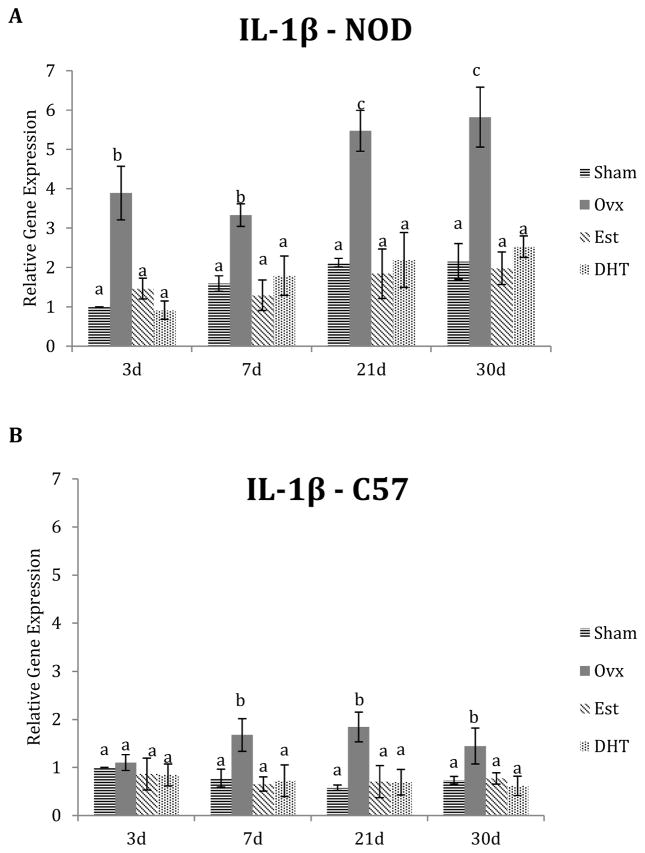
Gene Expression of IL-1β by quantitative real-time RT-PCR in NOD.B10.H2b (A) and C57BL/10 (B) mice at 3, 7, 21, and 30 days after sham operation, ovariectomy (OVX), OVX treated with 17β-estradiol (Est), or OVX treated with dihydrotestosterone (DHT). Results are expressed in relative gene expression, relative to the 3d Sham sample (mean = 1, SE = 0), and normalized by GAPDH. Values (mean ± SE), with different letter subscripts differing from each other at P < 0.05 (by ANOVA and Duncan’s new multiple range test), at least one letter in common indicating insignificance, N=9.
Figure 3
Figure 3
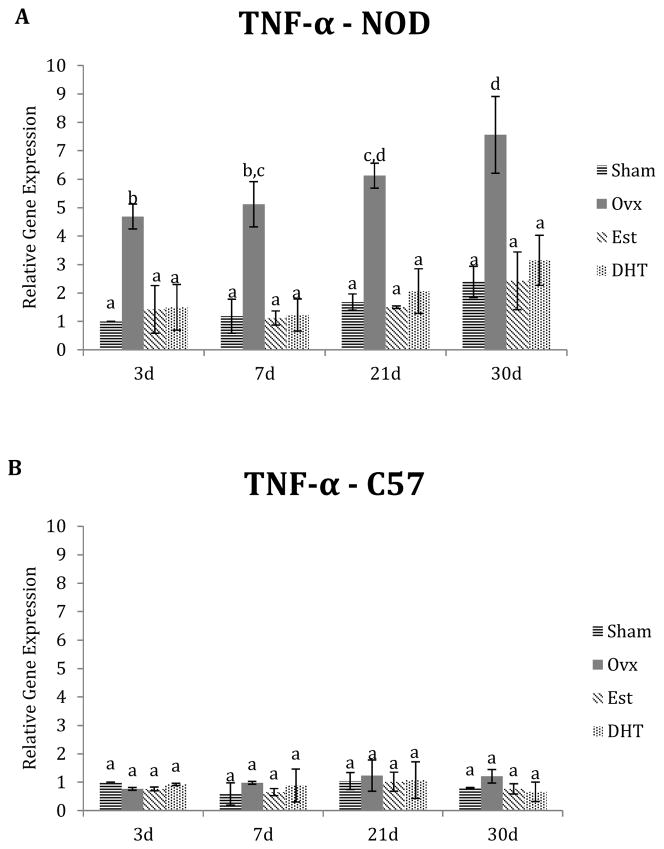
Gene Expression of TNF-α by quantitative real-time RT-PCR in NOD.B10.H2b (A) and C57BL/10 (B) mice at 3, 7, 21, and 30 days after sham operation, ovariectomy (OVX), OVX treated with 17β-estradiol (E2), or OVX treated with dihydrotestosterone (DHT). Results are expressed in relative gene expression, relative to the 3d Sham sample (mean = 1, SE = 0), and normalized by GAPDH. Values (mean ± SE), with different letter subscripts differing from each other at P < 0.05 (by ANOVA and Duncan’s new multiple range test), at least one letter in common indicating insignificance, N=9.
Figure 4
Figure 4
Gene Expression of IL-4 by quantitative real-time RT-PCR in NOD.B10.H2b (A) and C57BL/10 (B) mice at 3, 7, 21, and 30 days after sham operation, ovariectomy (OVX), OVX treated with 17β-estradiol (E2), or OVX treated with dihydrotestosterone (DHT). Results are expressed in relative gene expression, relative to the 3d Sham sample (mean = 1, SE = 0), and normalized by GAPDH. Values (mean ± SE), with different letter subscripts differing from each other at P < 0.05 (by ANOVA and Duncan’s new multiple range test), at least one letter in common indicating insignificance, N=9.
Figure 5
Figure 5
Gene Expression of IL-10 by quantitative real-time RT-PCR in NOD.B10.H2b (A) and C57BL/10 (B) mice at 3, 7, 21, and 30 days after sham operation, ovariectomy (OVX), OVX treated with 17β-estradiol (E2), or OVX treated with dihydrotestosterone (DHT). Results are expressed in relative gene expression, relative to the 3d Sham sample (mean = 1, SE = 0), and normalized by GAPDH. Values (mean ± SE), with different letter subscripts differing from each other at P < 0.05 (by ANOVA and Duncan’s new multiple range test), at least one letter in common indicating insignificance, N=9.
Figure 6
Figure 6
Protein levels of IL-1β by ELISA analysis in NOD.B10.H2b (A) and C57BL/10 (B) mice at 3, 7, 21, and 30 days after sham operation, ovariectomy (OVX), OVX treated with 17β-estradiol (E2), or OVX treated with dihydrotestosterone (DHT). Values = pg/ml. Values (mean ± SE), with different letter subscripts differing from each other at P < 0.05 (by ANOVA and Duncan’s new multiple range test), at least one letter in common indicating insignificance, N=4.
Figure 7
Figure 7
Protein levels of TNF-α by ELISA analysis in NOD.B10.H2b (A) and C57BL/10 (B) mice at 3, 7, 21, and 30 days after sham operation, ovariectomy (OVX), OVX treated with 17β-estradiol (E2), or OVX treated with dihydrotestosterone (DHT). Values = pg/ml. Values (mean ± SE), with different letter subscripts differing from each other at P < 0.05 (by ANOVA and Duncan’s new multiple range test), at least one letter in common indicating insignificance, N=4.
Figure 8
Figure 8
Protein levels of IL-4 by ELISA analysis in NOD.B10.H2b (A) and C57BL/10 (B) mice at 3, 7, 21, and 30 days after sham operation, ovariectomy (OVX), OVX treated with 17β-estradiol (E2), or OVX treated with dihydrotestosterone (DHT). Values = pg/ml. Values (mean ± SE), with different letter subscripts differing from each other at P < 0.05 (by ANOVA and Duncan’s new multiple range test), at least one letter in common indicating insignificance, N=4.
Figure 9
Figure 9
Protein levels of IL-10 by ELISA analysis in NOD.B10.H2b (A) and C57BL/10 (B) mice at 3, 7, 21, and 30 days after sham operation, ovariectomy (OVX), OVX treated with 17β-estradiol (E2), or OVX treated with dihydrotestosterone (DHT). Values = pg/ml. Values (mean ± SE), with different letter subscripts differing from each other at P < 0.05 (by ANOVA and Duncan’s new multiple range test), at least one letter in common indicating insignificance, N=4.

References

    1. Buhrmann C, Mobasheri A, Busch F, Aldinger C, Stahlmann R, Montaseri A, Shakibaei M. Curcumin modulates nuclear factor kappaB (NF-kappaB)-mediated inflammation in human tenocytes in vitro: role of the phosphatidylinositol 3-kinase/Akt pathway. J Biol Chem. 2011;286:28556–28566. - PMC - PubMed
    1. Cha S, Brayer J, Gao J, Brown V, Killedar S, Yasunari U, Peck AB. A dual role for interferon-gamma in the pathogenesis of Sjogren’s syndrome-like autoimmune exocrinopathy in the nonobese diabetic mouse. Scand J Immunol. 2004;60:552–65. - PubMed
    1. Dong J, Jimi E, Zeiss C, Hayden MS, Ghosh S. Constitutively active NF kappaB triggers systemic TNFalpha-dependent inflammation and localized TNFalpha-independent inflammatory disease. Genes Dev. 2010;24:1709–1717. - PMC - PubMed
    1. Fiorentino DF, Bond MW, Mosmann TR. Two types of mouse T helper cell. IV. Th2 clones secrete a factor that inhibits cytokine production by Th1 clones. J Exp Med. 1989;170:2081–2095. - PMC - PubMed
    1. Hayashi T. Dysfunction of lacrimal and salivary glands in Sjögren’s syndrome: nonimmunologic injury in preinflammatory phase and mouse model. J Biomed Biotechnol. 2011;2011:407031. - PMC - PubMed

Publication types

MeSH terms