


Common genes for non-syndromic deafness are uncommon in sub-Saharan Africa: a report from Nigeria
- PMID: 25218342
- PMCID: PMC4208623
- DOI: 10.1016/j.ijporl.2014.08.014
Common genes for non-syndromic deafness are uncommon in sub-Saharan Africa: a report from Nigeria
Abstract
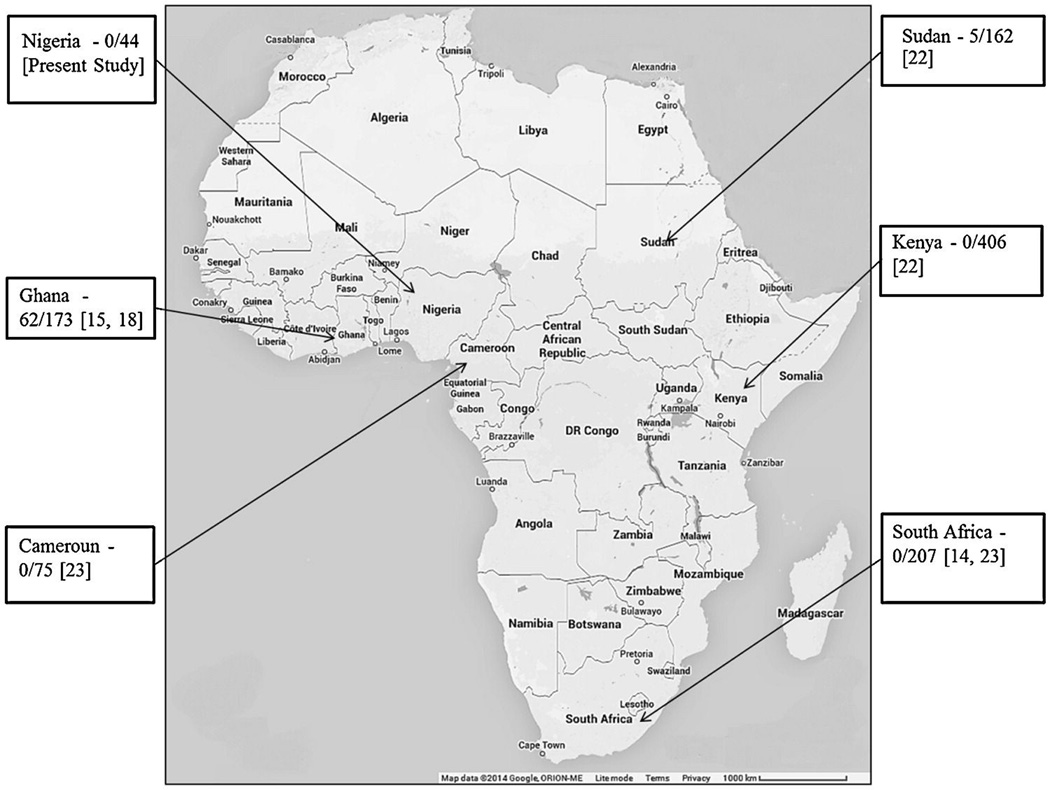
Introduction: Little is known about the molecular epidemiology of deafness in sub-Saharan Africa (SSA). Even in Nigeria, the most populous African nation, no genetic studies of deafness have been conducted. This pioneering work aims at investigating the frequencies of gene mutations relatively common in other parts of the world (i.e. those in GJB2, GJB6, and mitochondrial DNA) among subjects from Nigeria with hearing loss (HL) with no evidence of acquired pathology or syndromic findings. In addition, we review the literature on the genetics of deafness in SSA.
Method: We evaluated 81 unrelated deaf probands from the Yoruba tribe residing in Ibadan, a suburban city in Nigeria, for the aetiology of their deafness. Subjects underwent genetic testing if their history was negative for an environmental cause and physical examination did not find evidence of a syndrome. Both exons of GJB2 and mitochondrial DNA flanking the 1555A>G mutations were PCR-amplified followed by Sanger sequencing. GJB6 deletions were screened via quantitative PCR.
Result: We identified 44 probands who had nonsyndromic deafness with no environmental cause. The age at study time ranged between 8 months and 45 years (mean=24 years) and age at onset was congenital or prelingual (<age 2 years) in 37 (84%) probands and postlingual in 7 (16%) probands. Among these, 35 probands were the only affected members of their families (simplex cases), while there were at least two affected family members in nine cases (multiplex). Molecular analyses did not show a pathogenic variant in any one of the 44 probands studied.
Conclusion: GJB2, GJB6 and mitochondrial DNA 1555A>G mutations were not found among this initial cohort of the deaf in Nigeria. This makes imperative the search for other genes in the aetiology of HL in this population.
Keywords: GJB2; GJB6 deletion; Molecular diagnosis; Nigeria; Non-syndromic deafness; mtDNA mutation.
Copyright © 2014 Elsevier Ireland Ltd. All rights reserved.
Figures
Comment in
-
Letter to the editor regarding "GJB2, GJB6 or GJA1 genes should not be investigated in routine in non syndromic deafness in people of sub-Saharan African descent".Int J Pediatr Otorhinolaryngol. 2015 Apr;79(4):632-3. doi: 10.1016/j.ijporl.2015.01.012. Epub 2015 Jan 20. Int J Pediatr Otorhinolaryngol. 2015. PMID: 25639550 No abstract available.
References
-
- Alford RL, Arnos KS, Fox M, et al. American College of Medical Genetics and Genomics Guideline for the clinical evaluation and aetiologic diagnosis of hearing loss. Genet Med. 2014:1–9. - PubMed
-
- WHO global estimates on prevalence of hearing loss, Mortality and Burden of Diseases and Prevention of Blindness and Deafness. WHO; 2012.
-
- Holborow C, Martinson F, Anger N. A study of deafness in West Africa. Int J Pediatr Otorhinolaryngol. 1982;4(2):107–132. - PubMed
-
- McPherson B, Holborow CA. A study of deafness in West Africa: the Gambian Hearing Health Project. Int J Pediatr Otorhinolaryngol. 1985;10(2):115–135. - PubMed
-
- Seely DR1, Gloyd SS, Wright AD, Norton SJ. Hearing loss prevalence and risk factors among Sierra Leonean children. Arch Otolaryngol Head Neck Surg. 1995;121(8):853–858. - PubMed
Publication types
MeSH terms
Substances
Grants and funding
LinkOut - more resources
Full Text Sources
Other Literature Sources
Medical
Research Materials
