


Preanalytical variables and performance of diagnostic RNA-based gene expression analysis in breast cancer
- PMID: 25218890
- PMCID: PMC4180906
- DOI: 10.1007/s00428-014-1652-0
Preanalytical variables and performance of diagnostic RNA-based gene expression analysis in breast cancer
Abstract
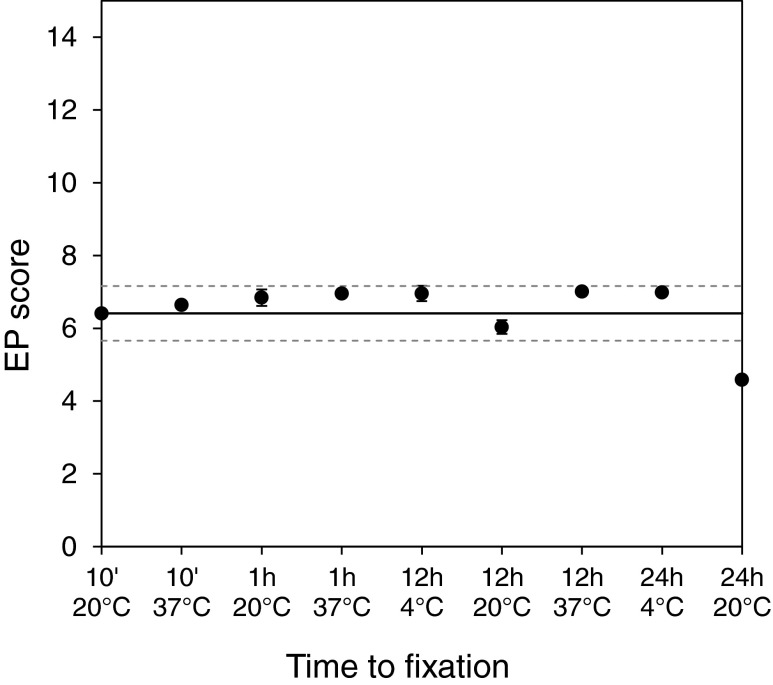
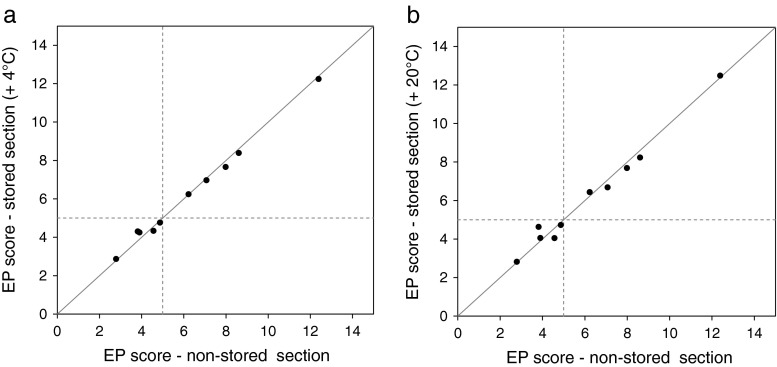
Prognostic multigene expression assays have become widely available to provide additional information to standard clinical parameters and to support clinicians in treatment decisions. In this study, we analyzed the impact of variations in tissue handling on the diagnostic EndoPredict test results. EndoPredict is a quantitative reverse transcription PCR assay conducted on RNA from formalin-fixed, paraffin-embedded (FFPE) tissue that predicts the likelihood of distant recurrence in patients with ER-positive/HER2-negative breast cancer. In this study, we performed a total of 138 EndoPredict assays to study the effects of preanalytical variables such as time to fixation, fixation time, tumor cell content, and section storage time on the EndoPredict test results. A time to fixation of up to 12 h and fixation of up to 5 days did not affect the results of the gene expression test. Paired samples of FFPE sections with tumor cell content ranging from 15 to 95 % and tumor-enriched samples showed a correlation coefficient of 0.97. Test results of tissue sections that have been stored for 12 months at +4 or +20 °C showed a correlation of 0.99 when compared to results of nonstored sections. In conclusion, preanalytical tissue handling is not a critical factor for diagnostic gene expression analysis with the EndoPredict assay. The test can therefore be easily integrated into the standard workflow of molecular pathology.
Figures



References
-
- Filipits M, Rudas M, Jakesz R, Dubsky P, Fitzal F, Singer CF, Dietze O, Greil R, Jelen A, Sevelda P, Freibauer C, Muller V, Janicke F, Schmidt M, Kolbl H, Rody A, Kaufmann M, Schroth W, Brauch H, Schwab M, Fritz P, Weber KE, Feder IS, Hennig G, Kronenwett R, Gehrmann M, Gnant M. A new molecular predictor of distant recurrence in ER-positive, HER2-negative breast cancer adds independent information to conventional clinical risk factors Clin. Cancer Res. 2011;17:6012–6020. - PubMed
-
- Paik S, Shak S, Tang G, Kim C, Baker J, Cronin M, Baehner FL, Walker MG, Watson D, Park T, Hiller W, Fisher ER, Wickerham DL, Bryant J, Wolmark N. A multigene assay to predict recurrence of tamoxifen-treated, node-negative breast cancer N. Engl J Med. 2004;351:2817–2826. doi: 10.1056/NEJMoa041588. - DOI - PubMed
-
- Parker JS, Mullins M, Cheang MC, Leung S, Voduc D, Vickery T, Davies S, Fauron C, He X, Hu Z, Quackenbush JF, Stijleman IJ, Palazzo J, Marron JS, Nobel AB, Mardis E, Nielsen TO, Ellis MJ, Perou CM, Bernard PS. Supervised risk predictor of breast cancer based on intrinsic subtypes J. Clin Oncol. 2009;27:1160–1167. doi: 10.1200/JCO.2008.18.1370. - DOI - PMC - PubMed
-
- van’t Veer LJ, Dai H, van de Vijver MJ, He YD, Hart AA, Mao M, Peterse HL, van der Kooy K, Marton MJ, Witteveen AT, Schreiber GJ, Kerkhoven RM, Roberts C, Linsley PS, Bernards R, Friend SH. Gene expression profiling predicts clinical outcome of breast cancer. Nature. 2002;415:530–536. doi: 10.1038/415530a. - DOI - PubMed
MeSH terms
Substances
LinkOut - more resources
Full Text Sources
Other Literature Sources
Medical
Research Materials
Miscellaneous
