


Subjective-objective sleep discrepancy among older adults: associations with insomnia diagnosis and insomnia treatment
- PMID: 25219802
- PMCID: PMC4747029
- DOI: 10.1111/jsr.12220
Subjective-objective sleep discrepancy among older adults: associations with insomnia diagnosis and insomnia treatment
Abstract
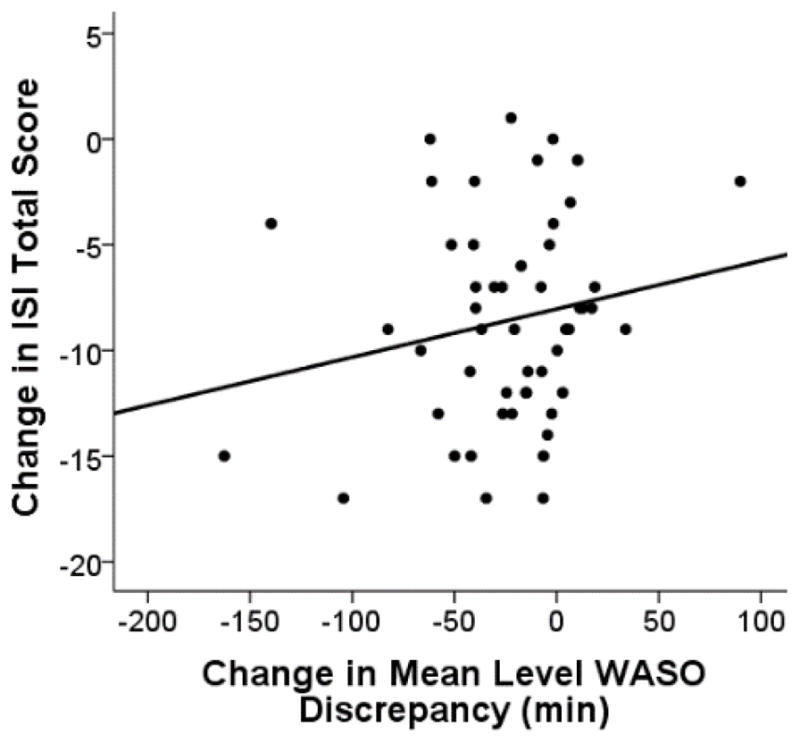
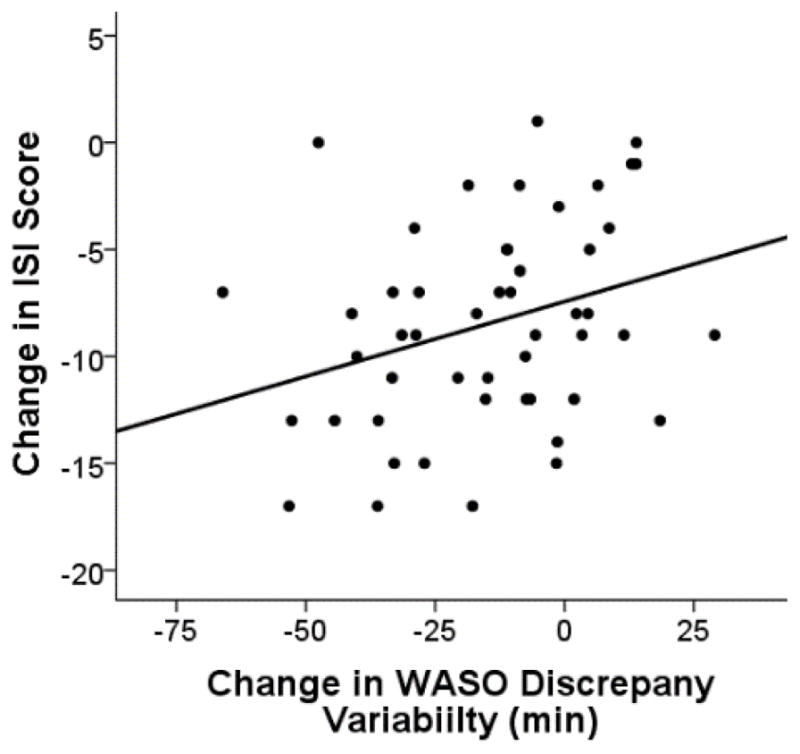
Discrepancy between subjective and objective measures of sleep is associated with insomnia and increasing age. Cognitive behavioural therapy for insomnia improves sleep quality and decreases subjective-objective sleep discrepancy. This study describes differences between older adults with insomnia and controls in sleep discrepancy, and tests the hypothesis that reduced sleep discrepancy following cognitive behavioural therapy for insomnia correlates with the magnitude of symptom improvement reported by older adults with insomnia. Participants were 63 adults >60 years of age with insomnia, and 51 controls. At baseline, participants completed sleep diaries for 7 days while wearing wrist actigraphs. After receiving cognitive behavioural therapy for insomnia, insomnia patients repeated this sleep assessment. Sleep discrepancy variables were calculated by subtracting actigraphic sleep onset latency and wake after sleep onset from respective self-reported estimates, pre- and post-treatment. Mean level and night-to-night variability in sleep discrepancy were investigated. Baseline sleep discrepancies were compared between groups. Pre-post-treatment changes in Insomnia Severity Index score and sleep discrepancy variables were investigated within older adults with insomnia. Sleep discrepancy was significantly greater and more variable across nights in older adults with insomnia than controls, P ≤ 0.001 for all. Treatment with cognitive behavioural therapy for insomnia was associated with significant reduction in the Insomnia Severity Index score that correlated with changes in mean level and night-to-night variability in wake after sleep onset discrepancy, P < 0.001 for all. Study of sleep discrepancy patterns may guide more targeted treatments for late-life insomnia.
Keywords: CBTI; actigraphy; aging; sleep measurement.
© 2014 European Sleep Research Society.
Conflict of interest statement
Figures
References
-
- Hauri PJ, Sateia MJ. American Academy of Sleep Medicine. The International Classification of Sleep Disorders, Second Edition (ICSD-2): Diagnostic and Coding Manual. 2005.
-
- American Psychiatric Association. Diagnostic and Statistical Manual of Mental Disorders (DSM-IV-TR) 4. American Psychiatric Association; Washington, DC: 2000. Text Revision edition.
-
- Bastien CH, Vallieres A, Morin CM. Validation of the Insomnia Severity Index as an outcome measure for insomnia research. Sleep Med. 2001;2:297–307. - PubMed
-
- Bixler EO, Kales A, Soldatos CR, Kales JD, Healey S. Prevalence of sleep disorders in the Los Angeles metropolitan area. Am J Psychiatry. 1979;136:1257–1262. - PubMed
-
- Botteman MF, Ozminkowski RJ, Wang S, Pashos CL, Schaefer K, Foley DJ. Cost effectiveness of long-term treatment with eszopiclone for primary insomnia in adults: a decision analytical model. CNS Drugs. 2007;21:319–334. - PubMed
Publication types
MeSH terms
Grants and funding
LinkOut - more resources
Full Text Sources
Other Literature Sources
Medical
