. 2014 Oct;14(10):2275-87.
doi: 10.1111/ajt.12868. Epub 2014 Sep 12.

Pig-to-monkey islet xenotransplantation using multi-transgenic pigs

Affiliations

Pig-to-monkey islet xenotransplantation using multi-transgenic pigs

R Bottino et al. Am J Transplant. 2014 Oct.

Abstract

The generation of pigs with genetic modifications has significantly advanced the field of xenotransplantation. New genetically engineered pigs were produced on an α1,3-galactosyltransferase gene-knockout background with ubiquitous expression of human CD46, with islet beta cell-specific expression of human tissue factor pathway inhibitor and/or human CD39 and/or porcine CTLA4-lg. Isolated islets from pigs with 3, 4 or 5 genetic modifications were transplanted intraportally into streptozotocin-diabetic, immunosuppressed cynomolgus monkeys (n = 5). Immunosuppression was based on anti-CD154 mAb costimulation blockade. Monitoring included features of early islet destruction, glycemia, exogenous insulin requirement and histopathology of the islets at necropsy. Using these modified pig islets, there was evidence of reduced islet destruction in the first hours after transplantation, compared with two series of historical controls that received identical therapy but were transplanted with islets from pigs with either no or only one genetic modification. Despite encouraging effects on early islet loss, these multi-transgenic islet grafts did not demonstrate consistency in regard to long-term success, with only two of five demonstrating function beyond 5 months.

Keywords: Translational research/science; islets of Langerhans; nonhuman primate; xenotransplantation.


Figures

Figure 1
Figure 1
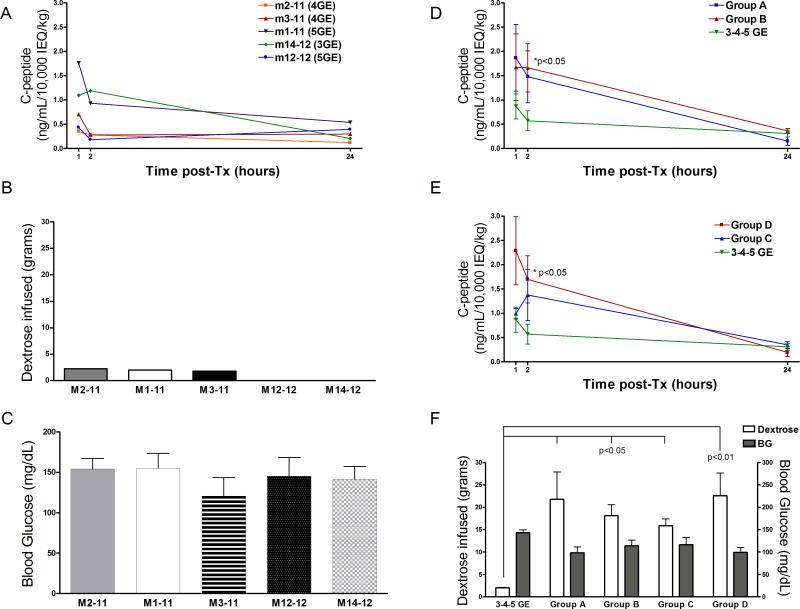
Panels A, B, C: Individual data for the 5 monkey recipients of 3-4-5 GE islets. (A) Porcine C-peptide levels measured 1, 2, and 24h after islet infusion. (B) Amount of dextrose infused in the first 24h post-Tx and (C) mean blood glucose during the same time period. Panels D, E, F: comparison between 3-4-5 GE recipients historical groups of monkey (D) Porcine C-peptide levels (mean of all recipients for each group) measured 1, 2, and 24h after islet infusion of 3-4-5 GE recipients and historical Groups A and B (monkeys that received the same islet mass and the same immunosuppressive and peri-Tx treatment but received islets from wild-type pigs (Group A, n=5) or hCD46 pig islets (Group B, n=5); or had (E) successful outcomes, i.e., normoglycemia >3mo (Group C, n=4) or unsuccessful, i.e., did not achieve normoglycemia after islet Tx (Group D, n=6). (F) Dextrose infused and mean blood glucose in the first 24h post-Tx for all groups (3-4-5 GE, Group A, Group B, Group C, and Group D). For monkeys of Group B (that received two transplants, C-peptide levels are those of the first transplant.
Figure 2
Figure 2
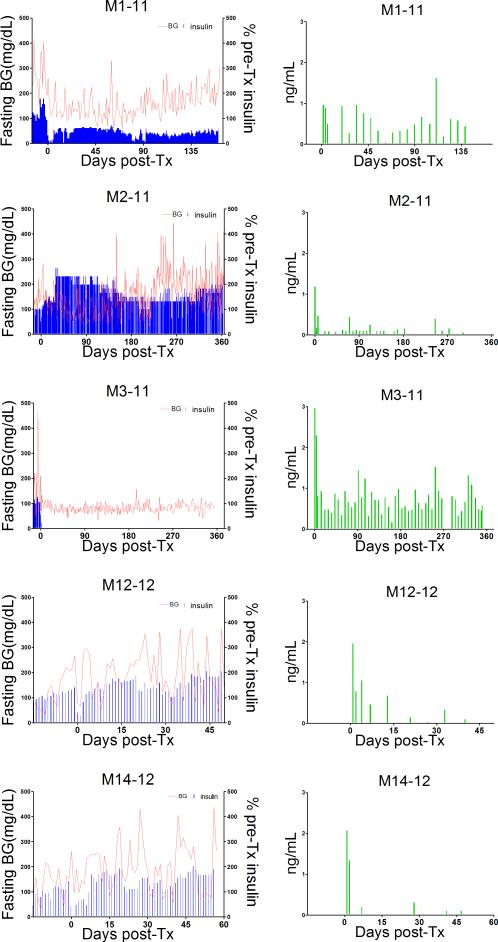
Left panels show blood glucose levels (red line) and daily exogenous insulin (as percent of pre-Tx dosages) in all monkey recipients of pig islets from the time of streptozotocin administration. Right panels show porcine C-peptide levels over the same time-periods.
Figure 3
Figure 3
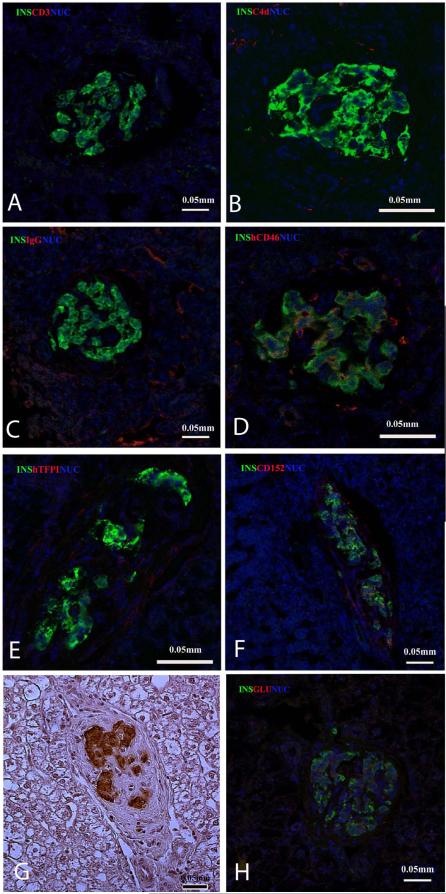
Immunofluorescence of M3-11 liver at necropsy one year after islet Tx (A-F). Staining for insulin (green) and nuclei (blue) with co-staining with antibodies (in red) significant for rejection (CD3 for T lymphocytes in panel A, C4d for complement activation in panel B, and IgG in panel C). There was no evidence of rejection. Immunostaining for human transgenes (hCD46 in D, hTFPI in E, and CD152 as a marker for CTLA4-Ig in F) shows transgene persistence except for hTFPI. (G) Immunostaining for insulin in the liver from M3-11 one year after Tx is also confirmed by immunocytochemistry in H. Immunostaining of the liver of M1-11 6mo after islet Tx shows well-preserved islet beta cells (green = insulin; red = glucagon; blue = nuclei).
Figure 4
Figure 4
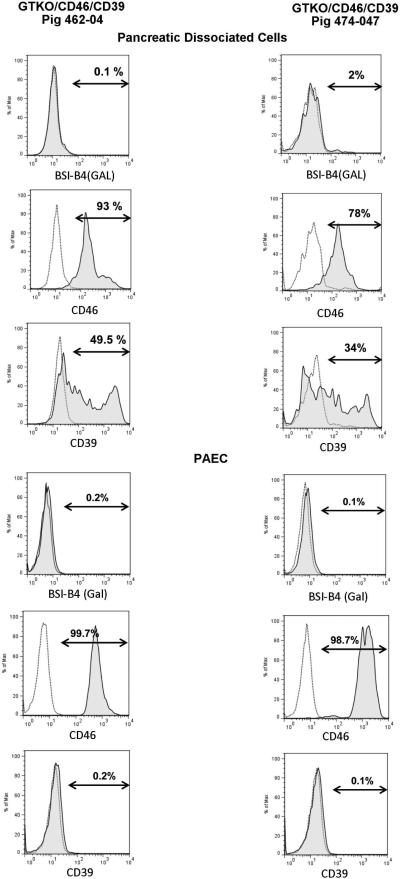
A single-cell suspension of pancreatic islets (A, B, C, G, H, and I) and PAEC (D, E, F, J, K, and L) from pigs P462-04 and P474-07 were stained with FITC-conjugated anti-Gal antibodies, anti-hCD46 and anti-hCD39 and subjected to flow cytometry. Expression of hCD39 was restricted to islets only (not in PAEC) since under control of the islet-specific rIns-2 promoter.
Figure 5
Figure 5
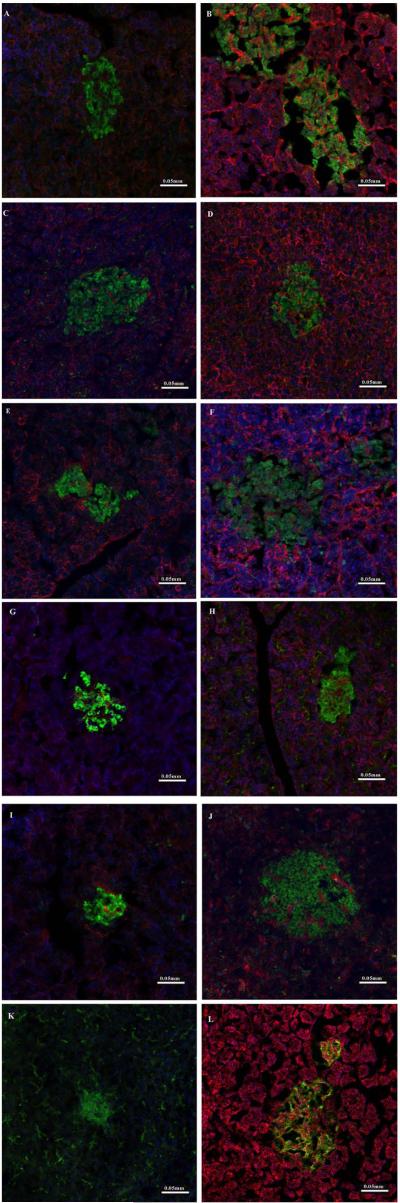
Immunostaining for insulin (green) and hCD46 (red) of pancreatic sections from the GE pig donors in the present study (A, C, E, G, I) and from hCD46 transgenic pigs used previously (B, D, F, H, J) (18). Tissues shown in A, C, E, G, I are respectively from donors for M2-11, M12-12, M1-11, M14-12, and M3-11. B, D, F, H tissues are homozygous for hCD46 while J shows tissue from a pig heterozygous for hCD46. Wild-type pig (K) and human (L) pancreases are used as negative and positive controls, respectively. Note that hCD46 transgene expression is not limited to beta cells. There is some variation in hCD46 expression, particularly in the pancreases from pigs in the present study (A, C, E, G, I). Nuclei are stained in blue.

References

    1. Ekser B, Ezzelarab M, Hara H, van der Windt DJ, Wijkstrom M, Bottino R, et al. Clinical xenotransplantation: the next medical revolution? Lancet. 2012;379:672–683. - PubMed
    1. van der Windt DJ, Bottino R, Kumar G, Wijkstrom M, Hara H, Ezzelarab M, et al. Clinical islet xenotransplantation: how close are we? Diabetes. 2012;61:3046–3055. - PMC - PubMed
    1. Cooper DKC, Bottino R, Satyananda V, Wijkstrom M, Trucco M. Toward clinical islet xenotransplantation – are revisions to the IXA guidelines warranted? Xenotransplantation. 2013;2:68–74. - PubMed
    1. Dufrane D, Gianello P. Pig islet xenotransplantation in human: structural and physiological compatibility for human clinical application. Transplant Rev. 2012;26:183–188. - PubMed
    1. Elliott RB. Towards xenotransplantation of pig islets in the clinic. Curr Opin Organ Transplant. 2011;16:195–200. - PubMed

Publication types