Review
. 2014 Aug 27:5:320.
doi: 10.3389/fphys.2014.00320. eCollection 2014.

Soluble proteins of chemical communication: an overview across arthropods

Affiliations
Review

Soluble proteins of chemical communication: an overview across arthropods

Paolo Pelosi et al. Front Physiol. .

Abstract

Detection of chemical signals both in insects and in vertebrates is mediated by soluble proteins, highly concentrated in olfactory organs, which bind semiochemicals and activate, with still largely unknown mechanisms, specific chemoreceptors. The same proteins are often found in structures where pheromones are synthesized and released, where they likely perform a second role in solubilizing and delivering chemical messengers in the environment. A single class of soluble polypeptides, called Odorant-Binding Proteins (OBPs) is known in vertebrates, while two have been identified in insects, OBPs and CSPs (Chemosensory Proteins). Despite their common name, OBPs of vertebrates bear no structural similarity with those of insects. We observed that in arthropods OBPs are strictly limited to insects, while a few members of the CSP family have been found in crustacean and other arthropods, where however, based on their very limited numbers, a function in chemical communication seems unlikely. The question we address in this review is whether another class of soluble proteins may have been adopted by other arthropods to perform the role of OBPs and CSPs in insects. We propose that lipid-transporter proteins of the Niemann-Pick type C2 family could represent likely candidates and report the results of an analysis of their sequences in representative species of different arthropods.

Keywords: Insect olfaction; Niemann-Pick type C2 proteins; arthropod chemoreception; basal hexapods; chemosensory proteins; odorant-binding proteins.


Figures
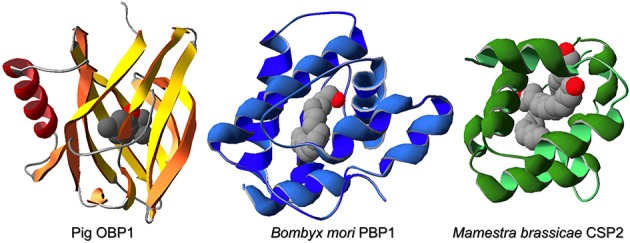
Figure 1
Figure 1
Three-dimensional structures of pig OBP (PDB: 1E06, Vincent et al., 2000), Bombyx mori PBP1 (PDB: 1DQE, Sandler et al., 2000), and Mamestra brassicae CSP2 (PDB: 1N8U, Campanacci et al., 2003), representative examples of a vertebrate OBP, an insect OBP and an insect CSP, respectively. Proteins of these three classes, despite marked structural differences, perform similar roles of transport and solubilization of semiochemicals and are extremely compact and stable. Structures have been visualized using the Swiss-Model PDB Viewer (Guex and Peitsch, 1997).
Figure 2
Figure 2
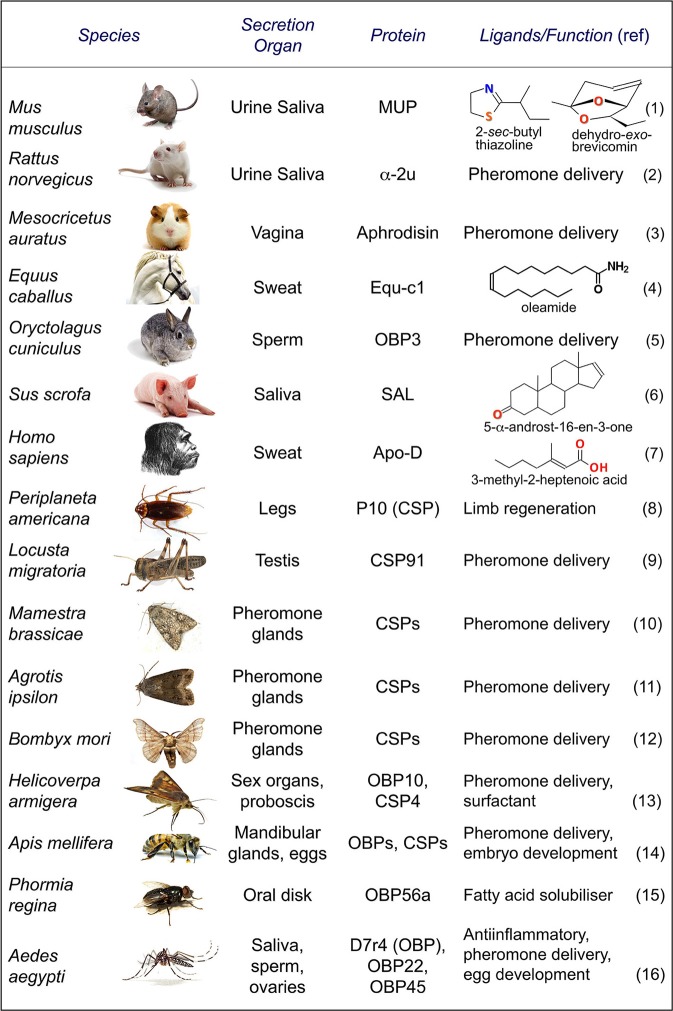
OBPs and CSPs involved in non-sensory functions. Mammalian OBPs have been found in secretions involved in the delivery of semiochemicals. In several cases, when isolated from such biological fluids, OBPs carry species-specific pheromones. Insect OBPs and CSPs have been reported both in pheromone glands and in reproductive organs, where they likely solubilize and bind specific pheromones. Moreover, members of both classes have been reported in other tissues and shown to be involved in functions unrelated to chemical communication. (1) Finlayson et al., ; Bacchini et al., ; (2) Dinh et al., ; (3) Singer et al., ; (4) D'Innocenzo et al., ; (5) Mastrogiacomo et al., ; (6) Marchese et al., ; (7) Zeng et al., ; (8) Nomura et al., ; Kitabayashi et al., ; (9) Zhou et al., ; (10) Jacquin-Joly et al., ; (11) Gu et al., ; (12) Dani et al., ; (13) Sun et al., ; Liu et al., ; (14) Iovinella et al., ; Maleszka et al., ; (15) Ishida et al., ; (16) Calvo et al., ; Costa-da-Silva et al., ; Marinotti et al., ; Li et al., .
Figure 3
Figure 3
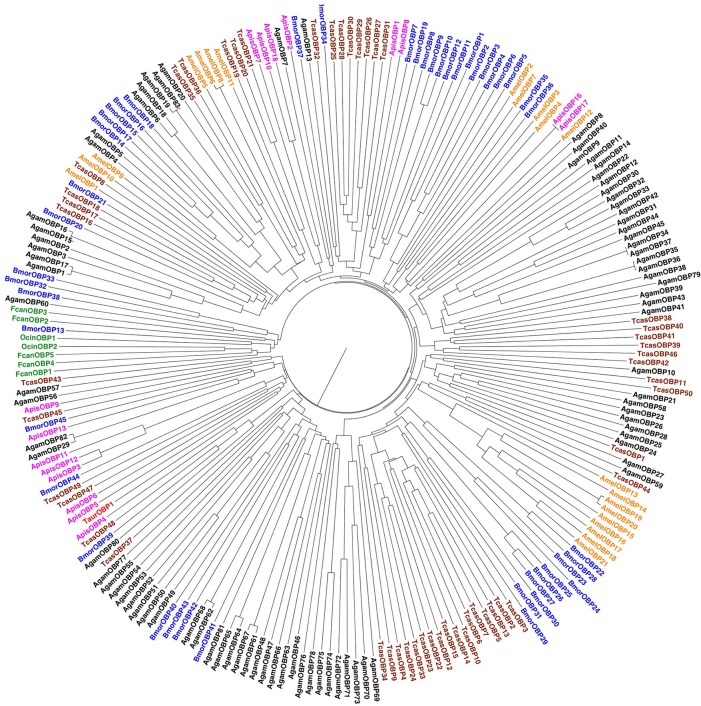
Phylogenetic tree of OBPs from selected species of insects and basal hexapods. Among arthropods, OBPs were only found in Hexapoda. Species and color codes are as follows. Red: Zygentoma (Taur: Thricolepisma aurea); green: Collembola (Fcan: Folsomia candida; Ocin: Orchesella cincta); magenta: Hemiptera (Apis: Acyrthosiphon pisum); brown: Coleoptera (Tcas: Tribolium castaneum); blue: Lepidoptera (Bmor: Bombyx mori); orange: Hymenoptera (Amel: Apis mellifera); black: Diptera (Agam: Anopheles gambiae). Sequences were aligned with the on-line software Clustal-W, using the following parameters. For Pairwise alignment: Protein Weight Matrix: Gonnet; Gap open: 10; Gap extension: 0.1. For Multiple sequence alignment: Protein Weight Matrix: Gonnet; Gap open: 10; Gap extension: 0.2; Gap distance: 5; Clustering: NJ. Phylogenetic trees were visualized with the software Fig Tree (http://tree.bio.ed.ac.uk/software/figtree/). Accession numbers are taken from Vieira and Rozas, .
Figure 4
Figure 4
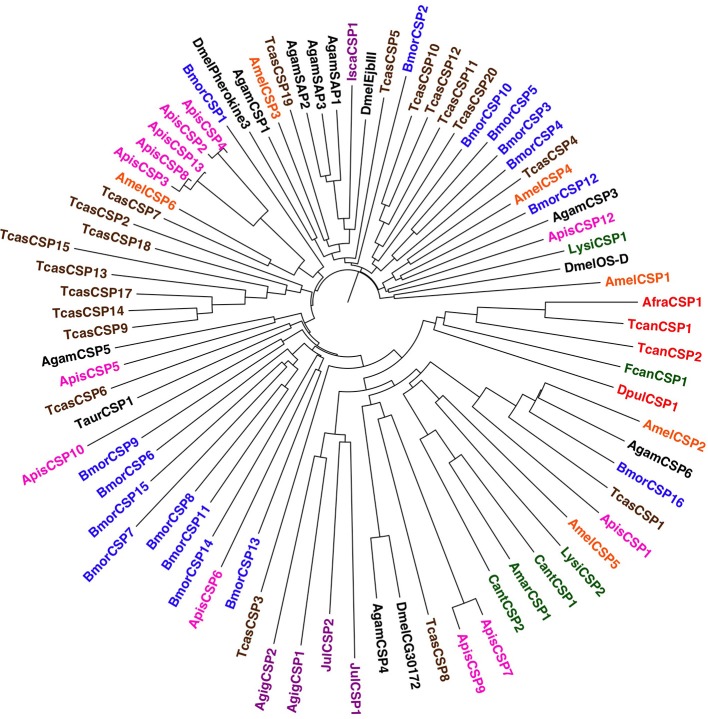
Phylogenetic tree of CSPs from selected species of insects and other arthropods. Apart from Hexapoda, members of the CSP family have also been found in species of Euchelicerata, Myriapoda, and Crustacea. Species and color codes are as follows. Violet: Euchelicerata (Isca: Ixodes scapularis) and Myriapoda (Jul: Julida sp.; Agig: Archispirostrepsus gigas); red: Crustacea (Afra: Artemia franciscana; Dpul: Daphnia pulex; Tcan: Triops cancriformis); green: Collembola (Fcan: Folsomia candida; Amar: Anurida maritima; Cant: Cryptopygus antarcticus; Ocin: Orchesella cincta), Archaeognatha (Lysi: Lepismachilis y-signata) and Zygentoma (Taur: Thricolepisma aurea); magenta: Hemiptera (Apis: Acyrthosiphon pisum); brown: Coleoptera (Tcas: Tribolium castaneum); blue: Lepidoptera (Bmor: Bombyx mori); orange: Hymenoptera (Amel: Apis mellifera); black: Diptera (Dmel: Drosophila melanogaster, Agam: Anopheles gambiae). Sequences were aligned and trees were visualized as in Figure 2. Accession numbers are taken from Vieira and Rozas (2011) or are reported in Table S1.
Figure 5
Figure 5
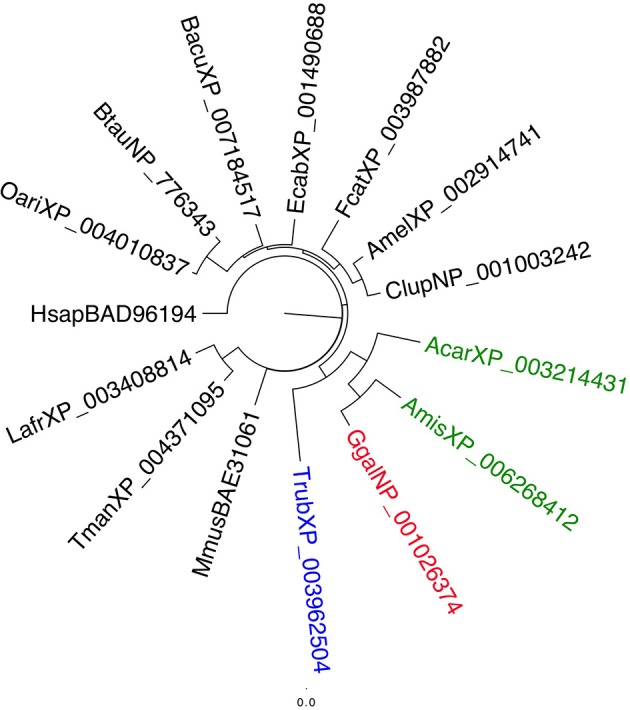
Phylogenetic tree of NPC2 proteins from selected species of vertebrates. These proteins are highly conserved in vertebrates and only a single gene is present in each species. Their role is to bind and transport cholesterol and other lipids. Species and color codes are as follows. Green: Reptiles (Acar: Anolis carolinensis; Amis: Alligator mississippiensis); blue: Fishes (Trub: Takifugu rubripes); red: Birds (Ggal: Gallus gallus); black: Mammals (Mmus: Mus musculus; Fcat: Felis catus; Clup: Canis lupus; Btau: Bos taurus; Ecab: Equus caballus; Oari: Ovis aries; Amel: Ailuropoda melanoleuca; Lafr: Loxodonta africana; Bacu: Balaenoptera acutorostrata; Tman: Trichechus manatus; Hsap: Homo sapiens). Sequences were aligned and trees were visualized as in Figure 2. Names of sequences include accession numbers.
Figure 6
Figure 6
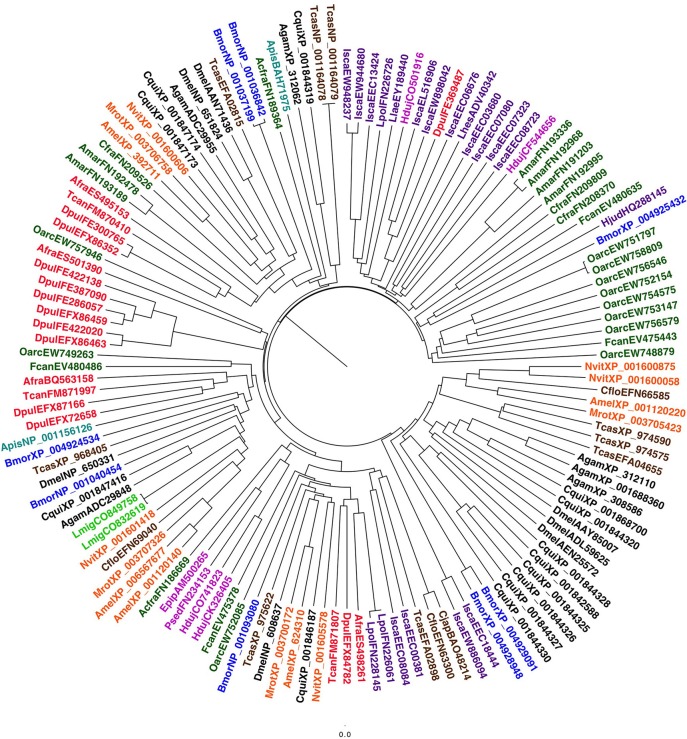
Similarity tree of Npc2s from selected species of insects and other arthropods. Phylogenetic tree of NPC2 proteins from selected species of insects and other arthropods, as well as “sister groups.” Species and color codes are as follows: magenta: Tardigrada (Hduj: Hypsibius dujardini) and Onychophora (Psed: Peripatopsis sedgwicki; Epip: Epiperipatus sp.); violet: Euchelicerata (Lpol: Limulus polyphemus; Lhesp: Latrodectus hesperus; Llae: Loxosceles laeta; Hjud: Hottentotta judaicus; Isca: Ixodes scapularis); red: Crustacea (Afra: Artemia franciscana; Dpul: Daphnia pulex; Tcan: Triops cancriformis); green: Collembola (Acfra: Acerentomon franzi; Fcan: Folsomia candida; Amar: Anurida maritima; Oarc: Onychiurus arcticus); light green: Orthoptera (Lmig: Locusta migratoria); light blue: Hemiptera (Apis: Acyrthosiphon pisum); brown: Coleoptera (Tcas: Tribolium castaneum; Cjap: Camponotus japonicus; Cflo: Camponotus floridanus); blue: Lepidoptera (Bmor: Bombyx mori); orange: Hymenoptera (Amel: Apis mellifera; Mrot: Megachile rotundata; Nvit: Nasonia vitripennis); black: Diptera (Dmel: Drosophila melanogaster, Cqui: Culex quinquefasciatus; Agam: Anopheles gambiae). Sequences were aligned and trees were visualized as in Figure 2. Names of sequences include accession numbers.
Figure 7
Figure 7
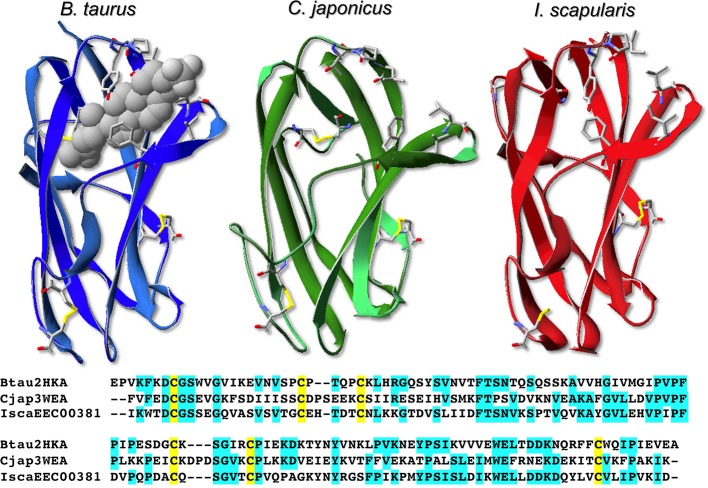
Three-dimensional structures of bovine (PDB ID: 2HKA) and Camponotus japonicus NPC2 (PDB ID: 3WEA), and model of Ixodes scapularis NPC2 (acc. no. EEC00381), built on the bovine NPC2 as a template. The model was obtained using the on-line software “Swiss-Model” (Arnold et al., 2006) and visualized using the Swiss-Model PDB Viewer (Guex and Peitsch, 1997).
Figure 8
Figure 8
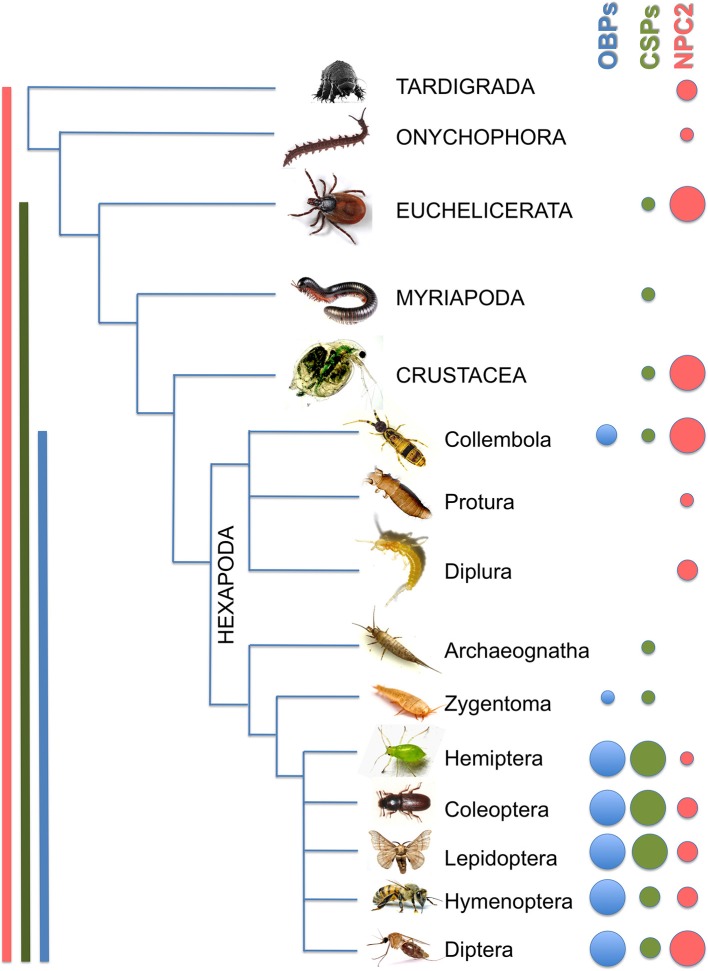
Overview of OBPs, CSPs and NPC2 genes in arthropods and sister groups. Taxa are reported in capital letters, Orders in sentence case. Sizes of the dots indicate the maximum number of genes found in each species of the same group (small: 1–2; medium: 3–10; large: >10). Detailed information is reported in Table 1.

References

    1. Angeli S., Ceron F., Scaloni A., Monti M., Monteforti G., Minnocci A., et al. (1999). Purification, structural characterization, cloning and immunocytochemical localization of chemoreception proteins from Schistocerca gregaria. Eur. J. Biochem. 262, 745–754 10.1046/j.1432-1327.1999.00438.x - DOI - PubMed
    1. Arnold K., Bordoli L., Kopp J., Schwede T. (2006). The SWISS-MODEL Workspace: a web-based environment for protein structure homology modelling. Bioinformatics 22, 195–201 10.1093/bioinformatics/bti770 - DOI - PubMed
    1. Bacchini A., Gaetani E., Cavaggioni A. (1992). Pheromone-binding proteins in the mouse Mus musculus. Experientia 48, 419–421 10.1007/BF01923448 - DOI - PubMed
    1. Baer B., Heazlewood J. L., Taylor N. L., Eubel H., Millar A. H. (2009). The seminal fluid proteome of the honeybee Apis mellifera. Proteomics 9, 2085–2097 10.1002/pmic.200800708 - DOI - PubMed
    1. Ban L., Napolitano E., Serra A., Zhou X., Iovinella I., Pelosi P. (2013). Identification of pheromone-like compounds in male reproductive organs of the oriental locust Locusta migratoria. Biochem. Biophys. Res. Commun. 437, 620–624 10.1016/j.bbrc.2013.07.015 - DOI - PubMed

LinkOut - more resources