


Amplitude of sensory nerve action potential in early stage diabetic peripheral neuropathy: an analysis of 500 cases
- PMID: 25221597
- PMCID: PMC4160871
- DOI: 10.4103/1673-5374.137593
Amplitude of sensory nerve action potential in early stage diabetic peripheral neuropathy: an analysis of 500 cases
Abstract
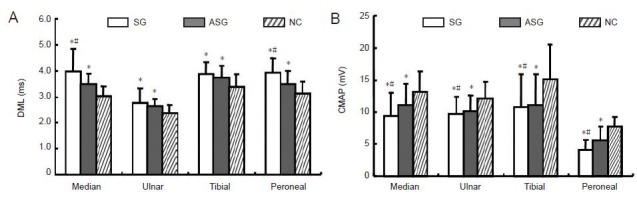
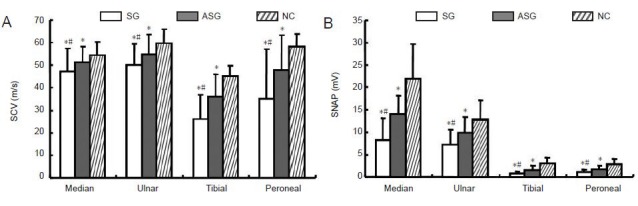
Early diagnosis of diabetic peripheral neuropathy is important for the successful treatment of diabetes mellitus. In the present study, we recruited 500 diabetic patients from the Fourth Affiliated Hospital of Kunming Medical University in China from June 2008 to September 2013: 221 cases showed symptoms of peripheral neuropathy (symptomatic group) and 279 cases had no symptoms of peripheral impairment (asymptomatic group). One hundred healthy control subjects were also recruited. Nerve conduction studies revealed that distal motor latency was longer, sensory nerve conduction velocity was slower, and sensory nerve action potential and amplitude of compound muscle action potential were significantly lower in the median, ulnar, posterior tibial and common peroneal nerve in the diabetic groups compared with control subjects. Moreover, the alterations were more obvious in patients with symptoms of peripheral neuropathy. Of the 500 diabetic patients, neural conduction abnormalities were detected in 358 cases (71.6%), among which impairment of the common peroneal nerve was most prominent. Sensory nerve abnormality was more obvious than motor nerve abnormality in the diabetic groups. The amplitude of sensory nerve action potential was the most sensitive measure of peripheral neuropathy. Our results reveal that varying degrees of nerve conduction changes are present in the early, asymptomatic stage of diabetic peripheral neuropathy.
Keywords: diabetic peripheral neuropathy; early diagnosis; electrophysiology; motor nerve; nerve regeneration; neural conduction; neural regeneration; peripheral nerve injury; sensory nerve.
Conflict of interest statement
Figures
References
-
- Altun Y, Demirkol A, Tumay Y, Ekmekci K, Unsal I, Koyluoglu AC, Ozkul Y. The medial plantar and medial peroneal cutaneous nerve conduction studies for diabetic polyneuropathy. Neurol Sci. 2011;32:849–854. - PubMed
-
- An JY, Park MS, Kim JS, Shon YM, Lee SJ, Kim YI, Lee KS, Kim BJ. Comparison of diabetic neuropathy symptom score and medial plantar sensory nerve conduction studies in diabetic patients showing normal routine nerve conduction studies. Intern Med. 2007;47:1395–1398. - PubMed
-
- Arimura A, Deguchi T, Sugimoto K, Uto T, Nakamura T, Arimura Y, Arimura K, Yagihashi S, Nishio Y, Takashima H. Intraepidermal nerve fiber density and nerve conduction study parameters correlate with clinical staging of diabetic polyneuropathy. Diabetes Res Clin Pract. 2013;99:24–29. - PubMed
-
- Asad A, Hameed MA, Khan UA, Butt M, Ahmed N, Nadeem A. Comparison of nerve conduction studies with diabetic neuropathy symptom score and diabetic neuropathy examination score in type-2 diabetics for detection of sensorimotor polyneuropathy. J Pak Med Assoc. 2009;59:594–598. - PubMed
LinkOut - more resources
Full Text Sources
Other Literature Sources