Fast mapping rapidly integrates information into existing memory networks
- PMID: 25222265
- PMCID: PMC4244253
- DOI: 10.1037/xge0000020
Fast mapping rapidly integrates information into existing memory networks
Abstract
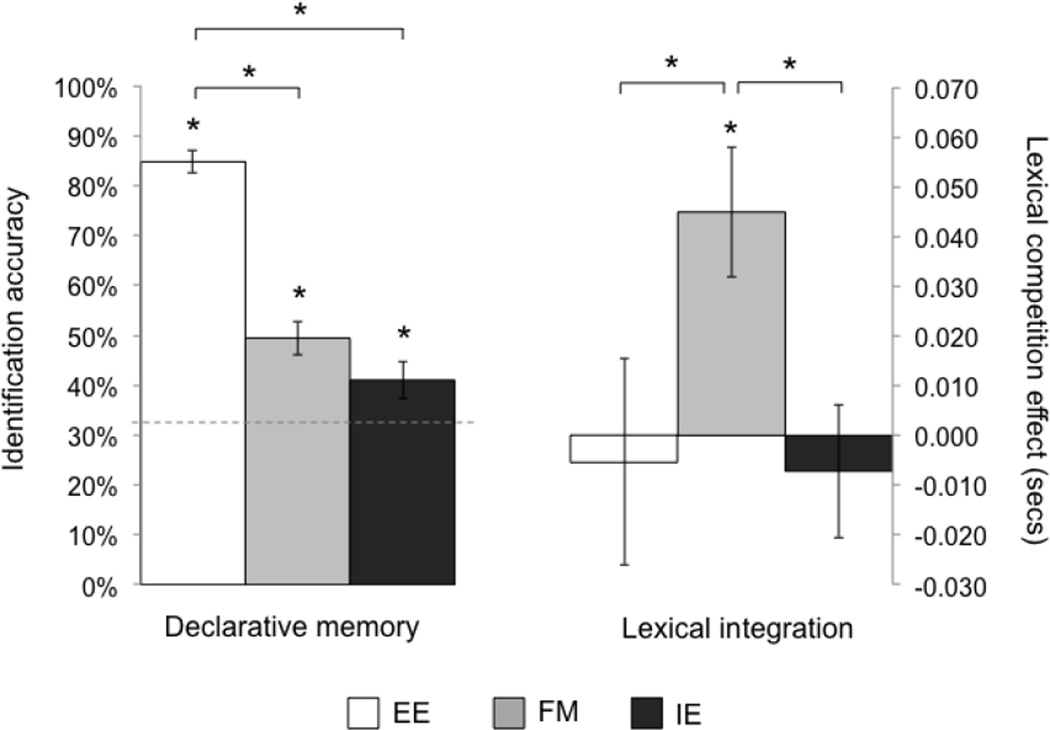
Successful learning involves integrating new material into existing memory networks. A learning procedure known as fast mapping (FM), thought to simulate the word-learning environment of children, has recently been linked to distinct neuroanatomical substrates in adults. This idea has suggested the (never-before tested) hypothesis that FM may promote rapid incorporation into cortical memory networks. We test this hypothesis here in 2 experiments. In our 1st experiment, we introduced 50 participants to 16 unfamiliar animals and names through FM or explicit encoding (EE) and tested participants on the training day, and again after sleep. Learning through EE produced strong declarative memories, without immediate lexical competition, as expected from slow-consolidation models. Learning through FM, however, led to almost immediate lexical competition, which continued to the next day. Additionally, the learned words began to prime related concepts on the day following FM (but not EE) training. In a 2nd experiment, we replicated the lexical integration results and determined that presenting an already-known item during learning was crucial for rapid integration through FM. The findings presented here indicate that learned items can be integrated into cortical memory networks at an accelerated rate through fast mapping. The retrieval of a related known concept, in order to infer the target of the FM question, is critical for this effect.
PsycINFO Database Record (c) 2014 APA, all rights reserved.
Figures



References
-
- Bloom P, Markson L. Capacities underlying word learning. Trends in Cognitive Sciences. 1998;2(2):67–73. - PubMed
-
- Bowers JS, Davis CJ, Hanley DA. Interfering neighbours: the impact of novel word learning on the identification of visually similar words. Cognition. 2005;97(3):B45–B54. - PubMed
-
- Carey S, Bartlett E. Acquiring a Single New Word. Proceedings of the Stanford Child Language Conference. 1978;15:17–29.
-
- Clay F, Bowers JS, Davis CJ, Hanley DA. Teaching adults new words: the role of practice and consolidation. Journal of experimental psychology. Learning, memory, and cognition. 2007;33(5):970–976. - PubMed
Publication types
MeSH terms
Grants and funding
LinkOut - more resources
Full Text Sources
Other Literature Sources
Medical