. 2014 Oct 8;6(19):16982-92.
doi: 10.1021/am504566v. Epub 2014 Sep 26.

Injectable dopamine-modified poly(ethylene glycol) nanocomposite hydrogel with enhanced adhesive property and bioactivity

Affiliations

Injectable dopamine-modified poly(ethylene glycol) nanocomposite hydrogel with enhanced adhesive property and bioactivity

Yuan Liu et al. ACS Appl Mater Interfaces. .

Abstract

A synthetic mimic of mussel adhesive protein, dopamine-modified four-armed poly(ethylene glycol) (PEG-D4), was combined with a synthetic nanosilicate, Laponite (Na(0.7+)(Mg5.5Li0.3Si8)O20(OH)4)(0.7-)), to form an injectable naoncomposite tissue adhesive hydrogel. Incorporation of up to 2 wt % Laponite significantly reduced the cure time while enhancing the bulk mechanical and adhesive properties of the adhesive due to strong interfacial binding between dopamine and Laponite. The addition of Laponite did not alter the degradation rate and cytocompatibility of PEG-D4 adhesive. On the basis of subcutaneous implantation in rat, PEG-D4 nanocomposite hydrogels elicited minimal inflammatory response and exhibited an enhanced level of cellular infiltration as compared to Laponite-free samples. The addition of Laponite is potentially a simple and effective method for promoting bioactivity in a bioinert, synthetic PEG-based adhesive while simultaneously enhancing its mechanical and adhesive properties.

Keywords: Laponite; biomimetic tissue adhesive; cell infiltration; dopamine; mussel adhesive proteins; subcutaneous implantation.


Figures

Scheme 1
Scheme 1. Chemical Structure of PEG-D4
Scheme 2
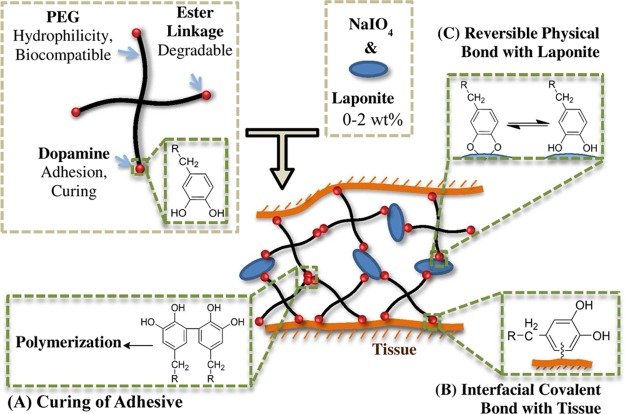
Scheme 2. Schematic Representation of Applying the Nanocomposite Adhesive to Tissue by Mixing PEG-D4 with NaIO4 and Laponite
Dopamine is capable of forming three types of crosslinks in this system: (A) covalent crosslinking and polymerization between dopamine moieties, resulting in curing of the adhesive, (B) interfacial covalent crosslinking between dopamine and functional groups (e.g., −NH2) found on tissue surface, and (C) reversible physical crosslinks between dopamine and Laponite.
Figure 1
Figure 1
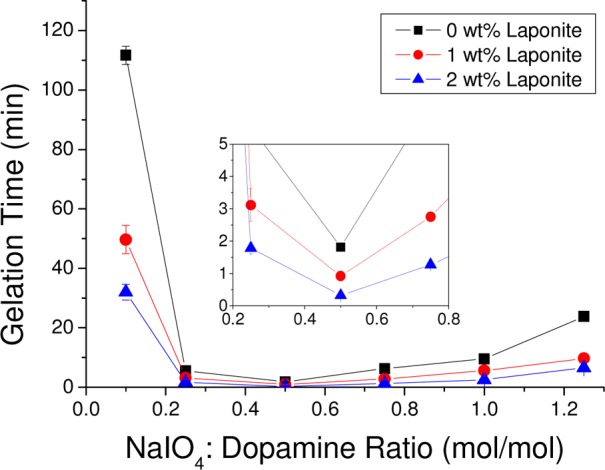
Curing time of PEG-D4 hydrogel as a function of NaIO4/dopamine molar ratio with different Laponite concentrations. (inset) Graph of the results for NaIO4/dopamine molar ratio between 0.2 and 0.8.
Figure 2
Figure 2
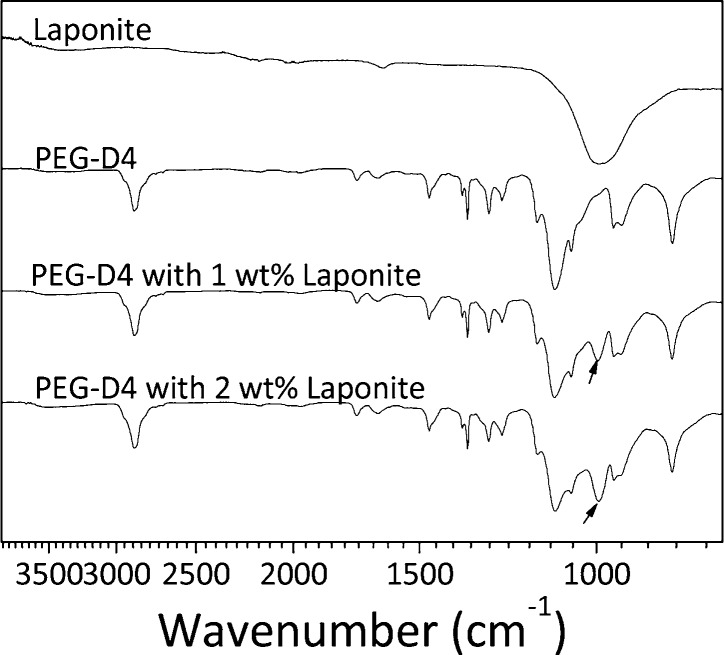
FTIR spectra of Laponite, PEG-D4, and PEG-D4 with 1 and 2 wt % Laponite. The arrows indicate the Si–O–Si peak in the nanocomposite hydrogel.
Figure 3
Figure 3
Equilibrium water content of PEG-D4 hydrogels cured using a NaIO4/dopamine molar ratio of 0.5 and Laponite content of 0–2 wt %. * p < 0.05 when compared to 0 wt % Laponite.
Figure 4
Figure 4
Results from compression testing of PEG-D4 hydrogels cured using a NaIO4/dopamine molar ratio of 0.5 and Laponite content of 0–2 wt %. * p < 0.05 when compared to 0 wt % Laponite.
Figure 5
Figure 5
Storage and loss modulus of PEG-D4 hydrogels with NaIO4/dopamine molar ratio of 0.5 containing up to 2 wt % Laponite subjected to oscillatory strain = 0.1 at a frequency of 0.1–100 Hz.
Figure 6
Figure 6
Lap shear adhesion test results of PEG-D4 hydrogels with NaIO4/dopamine molar ratio of 0.5 containing up to 2 wt % Laponite. * p < 0.05 when compared to 0 wt % Laponite and CoSeal. # p < 0.05 when compared to CoSeal.
Figure 7
Figure 7
In vitro degradation of PEG-D4 hydrogels in PBS (pH = 7.4) at 37 °C. The values were normalized to the average dry mass of the hydrogels that did not undergo degradation.
Figure 8
Figure 8
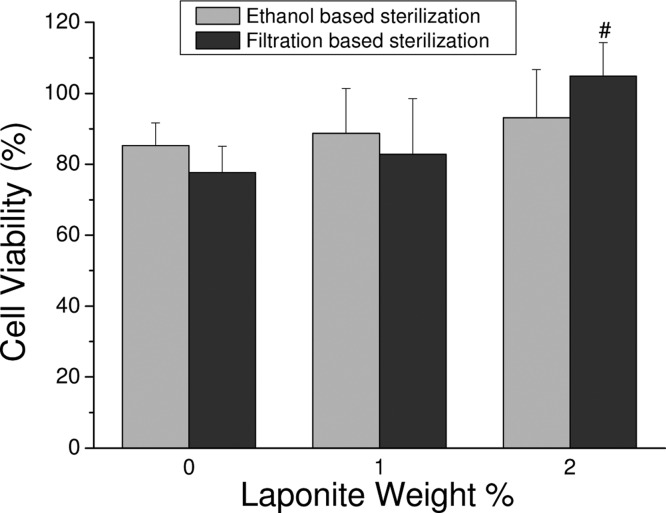
Relative cell viability of PEG-D4 hydrogels with up to 2 wt % Laponite. (left) Ethanol-based sterilization. (right) Filtration-based sterilization. #p < 0.05 when compared to 0 wt % Laponite normalized to medium control.
Figure 9
Figure 9
Histological characterization of PEG-D4 hydrogels containing 0 and 2 wt % Laponite and surrounding tissues after four weeks of subcutaneous implantation. Masson’s trichrome staining images for evaluating the overall tissue section morphology and the thickness of the fibrous capsule (fc) (A, D). Immunohistochemical staining images for evaluating the infiltration cell type and density (B, C, E, F). Cell nuclei were stained by DAPI (blue), fibroblasts were stained by marker S100A4 (green). (C) and (F) are the enlarged view of the orange boxes in (B) and (E), respectively. “h”: hydrogel; “il”: infiltration layer; one-sided arrows: interface between hydrogel and tissue; two-sided arrows: the thickness of the infiltration layer.
Figure 10
Figure 10
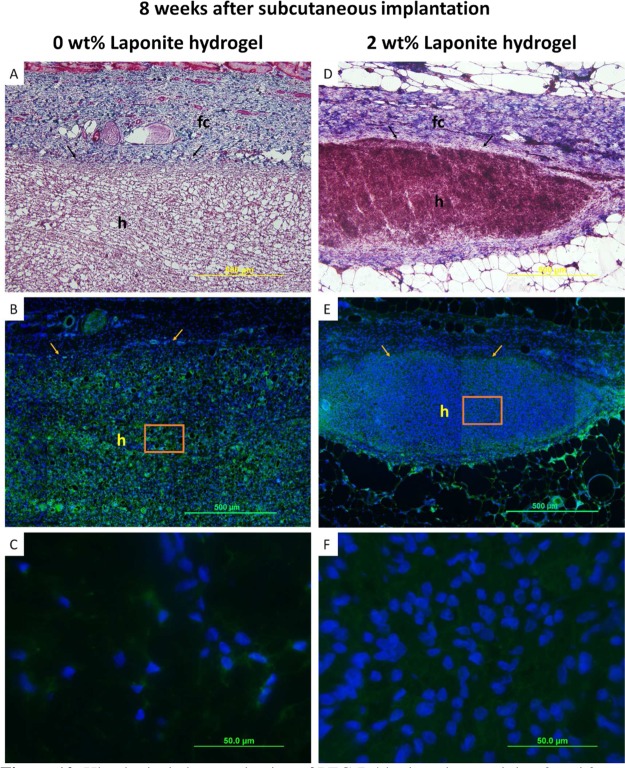
Histological characterization of PEG-D4 hydrogels containing 0 and 2 wt % Laponite and surrounding tissues after eight weeks of subcutaneous implantation. Masson’s trichrome staining images for evaluating the overall tissue section morphology and the thickness of the fibrous capsule (fc) (A, D). Immunohistochemical staining images for evaluating the infiltration cell type and density (B, C, E, F). Cell nuclei were stained by DAPI (blue), fibroblasts were stained by marker S100A4 (green). (C) and (F) are the enlarged view of the orange boxes in (B) and (E), respectively. “h”: hydrogel; arrows: interface between hydrogel and tissue.

References

    1. Ikada Y. In Wound Closure Biomaterials and Devices; Chu C. C., von Fraunhofer J. A., Greisler H. P., Eds.; CRC Press, Inc.: Boca Raton, FL, 1997; Tissue Adhesives, pp 317–346.
    1. Mehdizadeh M.; Yang J. Design Strategies and Applications of Tissue Bioadhesives. Macromol. Biosci. 2013, 13, 271–288. - PMC - PubMed
    1. Spotnitz W. D.History of Tissue Adhesive. In Surgical Adhesives and Sealants: Current Technology and Applications; Sierra D. H., Saltz R., Eds.; Technomic Publishing Co., Inc.: Lancaster, PA, 1996; pp 3–11.
    1. Eriksen J. R.; Bech J. I.; Linnemann D.; Rosenberg J. Laparoscopic Intraperitoneal Mesh Fixation with Fibrin Sealant (Tisseel) Vs. Titanium Tacks: A Randomised Controlled Experimental Study in Pigs. Hernia 2008, 12, 483–491. - PubMed
    1. Olivier ten Hallers E. J.; Jansen J. A.; Marres H. A. M.; Rakhorst G.; Verkerke G. J. Histological Assessment of Titanium and Polypropylene Fiber Mesh Implantation with and without Fibrin Tissue Glue. J. Biomed. Mater. Res., Part A 2006, 80A, 372–380. - PubMed

Publication types