. 2015 Sep;23(5):776-85.
doi: 10.1109/TNSRE.2014.2356722. Epub 2014 Sep 12.

Mechanisms of Gait Asymmetry Due to Push-Off Deficiency in Unilateral Amputees

Mechanisms of Gait Asymmetry Due to Push-Off Deficiency in Unilateral Amputees

Peter Gabriel Adamczyk et al. IEEE Trans Neural Syst Rehabil Eng. 2015 Sep.

Abstract

Unilateral lower-limb amputees exhibit asymmetry in many gait features, such as ground force, step time, step length, and joint mechanics. Although these asymmetries result from weak prosthetic-side push-off, there is no proven mechanistic explanation of how that impairment propagates to the rest of the body. We used a simple dynamic walking model to explore possible consequences of a unilateral impairment similar to that of a transtibial amputee. The model compensates for reduced push-off work from one leg by performing more work elsewhere, for example during the middle of stance by either or both legs. The model predicts several gait abnormalities, including slower forward velocity of the body center-of-mass during intact-side stance, greater energy dissipation in the intact side, and more positive work overall. We tested these predictions with data from unilateral transtibial amputees (N = 11) and nonamputee control subjects (N = 10) walking on an instrumented treadmill. We observed several predicted asymmetries, including forward velocity during stance phases and energy dissipation from the two limbs, as well as greater work overall. Secondary adaptations, such as to reduce discomfort, may exacerbate asymmetry, but these simple principles suggest that some asymmetry may be unavoidable in cases of unilateral limb loss.


Figures
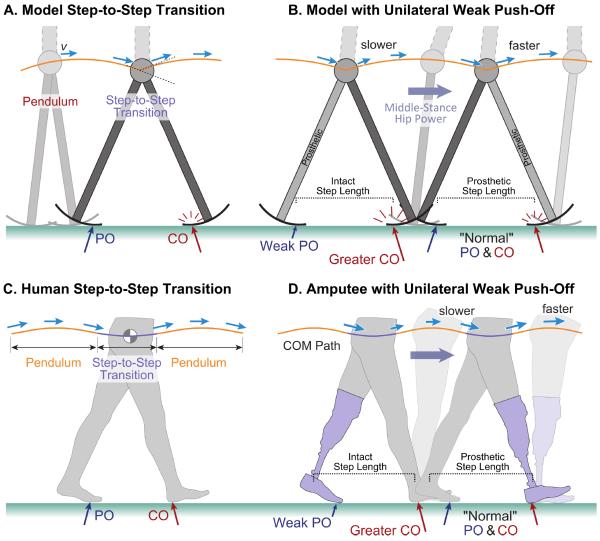
Fig. 1
Fig. 1
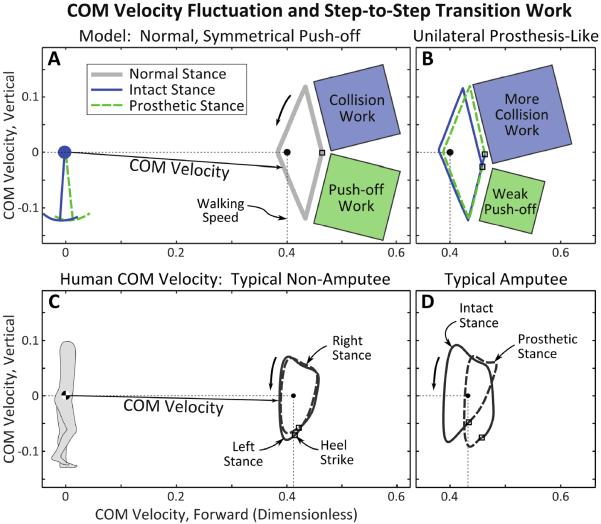
Conceptual model of walking and compensations for push-off asymmetry. (A) A symmetrical model experiences sharp changes in COM (body center-of-mass) velocity (small arrows) in the step-to-step transition. Impulsive push-off (PO) from the trailing leg and impulsive collision (CO) of the leading leg redirect the COM velocity from forward-and-down to forward-and-up (dotted lines), performing positive and negative work, respectively, on the COM. (B) In the asymmetric model, weak push-off from one leg (Prosthetic, lighter shading) results in greater collision and lower speed during the ensuing (Intact) stance phase. The model can compensate by adding work through the stance hip to accelerate. Despite this acceleration, speed during middle-stance is slower on average during Intact stance than during Prosthetic stance. (C) In humans, step-to-step transition is not perfectly impulsive but COM velocity experiences similar fluctuations. (D) Unilateral amputees have weak push-off, which is expected to lead to greater collision, slower middle-stance speed, and greater compensatory work on the intact leg. Step length asymmetry is also possible, defined here between contact points for the model (B) and between ankles for humans (D).
Fig. 2
Fig. 2
Velocity trajectories for the body center of mass for model and human. Plot of vertical vs. forward COM velocity, termed a COM hodograph, traces a counter-clockwise path; it is the path traced by the tip of the COM velocity vector (A,C). Heel strike is marked with a square in each diagram. (A) In the normal symmetric model, push-off and collision impulses perform positive and negative work, respectively (relative amounts denoted by shaded boxes), to redirect the COM velocity. The stance phase acts like an inverted pendulum and completes the path with no energy change. (B) An asymmetric model produces less push-off from the prosthetic side, resulting in a larger collision loss on the intact side. The loss requires more work elsewhere in the stride, and more total work overall, to maintain the same walking speed. The asymmetric collision also causes COM speed to be slower during intact-side stance phase than prosthetic-side stance. For human (C) non-amputees and (D) amputees, COM hodographs also trace a counter clockwise path, but with a more rounded profile due to forces being less impulsive. In amputees, the forward velocities of the two stance phases are different, with the intact side stance occurring at lower speed than prosthetic side stance.
Fig. 3
Fig. 3
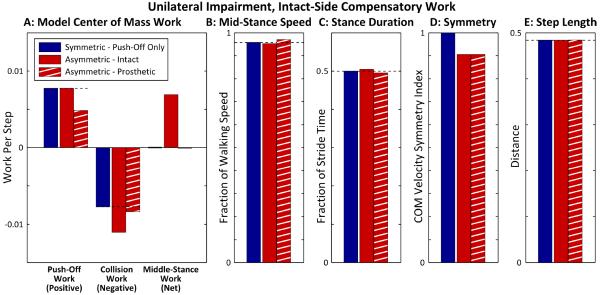
Model predictions for COM work and gait parameters. Two models are compared: A normal, symmetric model powered by push-off (left-most bars, in blue for either leg); and an asymmetric model with weak push-off in one (prosthetic-side) leg, powered by intact-side hip work (middle bars in red for strong leg, right-most bars in hatched red for prosthetic leg). (A) Positive push-off work, negative collision work, and net middle-stance work are shown for the symmetric model, and for the asymmetric model with unilaterally reduced push-off. Reduced push-off results in greater intact-side collision work, compensated for here by positive hip work during intact-side stance. (B) Greater collision produces slower forward speed at mid-stance during intact-side stance, and compensatory work produces faster speed during prosthetic-side stance. (C) Similarly, stance duration is longer on the intact side than the prosthetic side. (D) A symmetry index that quantifies the degree of match between COM velocities on the two sides (Fig. 2) summarizes the greater asymmetry due to reduced push-off. (E) Step length has very slight asymmetry, which depends on compensation strategy. With intact-side hip work, steps are slightly longer with the model's prosthetic leg; with prosthetic-side or bilateral hip work, prosthetic-side steps are shorter (see Supplementary Material).
Fig. 4
Fig. 4
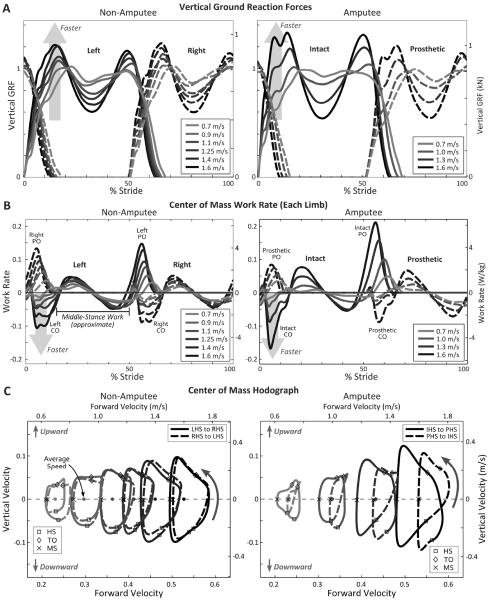
Examples of ground reaction forces, center of mass (COM) work rate, and COM hodographs for non amputee and amputee (left and right columns, respectively). Data shown are from a representative subject from each group. (A) Vertical ground reaction forces (GRF) show asymmetries between groups. Higher speeds increase peak forces in both amputees and non amputees, but the peaks are higher on the intact side of amputees. (B) COM work rate, defined as the dot product of GRF and COM velocity, shows negative collision (CO) work at beginning of stance and positive push-off (PO) work at end of stance. Push-off and collision intervals are separated by an interval of middle-stance work. Total work over a stride is the sum of all three intervals. At all speeds, push-off was lower on the prosthetic side of amputees, and collision was much greater on the intact side compared to non amputees. (C) COM hodographs show symmetry of COM velocities in non-amputees, and asymmetry in amputees. Asymmetry is especially pronounced in forward speed during prosthetic-side vs. intact-side stance. HS: Heel-strike; TO: Toe-off; MS: Mid-stance; L: Left; R: Right; P: Prosthetic; I: Intact.
Fig. 5
Fig. 5
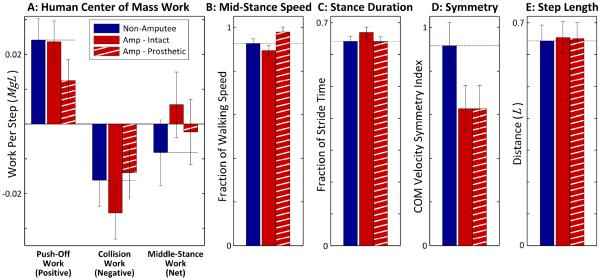
Experimental measurements of COM work and gait parameters in non-amputees and amputees (PMM ± SD, dimensionless). Non-amputee results are shown for one leg (left most bars, in blue), whereas amputee results are shown for both the intact and prosthetic side (middle bars in red and right-most bars in hatched red, respectively). (A) Positive push-off work, negative collision work, and net middle-stance work are shown. Amputees exhibited reduced prosthetic-side push-off work, increased intact-side collision work, and greater (more positive) total work during the middle-stance period. (B) In terms of mid stance speed, amputees also exhibited slower forward speed at mid-stance on the intact side, and faster speed on the prosthetic side. (C) Stance duration was longer on the intact side than the prosthetic side. (D) The COM velocity symmetry index showed lower symmetry in amputees than in non-amputees. (E) Step length was not statistically different among leg types, though absolute step length asymmetry was frequently higher in amputees (see supplementary material).

References

    1. Cheung C, Wall JC, Zelin S. A microcomputer-based system for measuring temporal asymmetry in amputee gait. Prosthet. Orthot. Int. 1983;7(1):131–140. - PubMed
    1. Dingwell JB, Davis BL, Frazder DM. Use of an instrumented treadmill for real-time gait symmetry evaluation and feedback in normal and trans-tibial amputee subjects. Prosthet. Orthot. Int. 1996;20(2):101–110. - PubMed
    1. Isakov E, Keren O, Benjuya N. Trans–tibial amputee gait: Time–distance parameters and EMG activity. Prosthet. Orthot. Int. 2000;24(3):216–220. - PubMed
    1. Nolan L, Lees A. The functional demands on the intact limb during walking for active trans-femoral and trans-tibial amputees. Prosthet. Orthot. Int. 2000;24(2):117–125. - PubMed
    1. Nolan L, Wit A, Dudziñski K, Lees A, Lake M, Wychowañski M. Adjustments in gait symmetry with walking speed in transfemoral and trans-tibial amputees. Gait Posture. 2003;17(2):142–151. - PubMed

Publication types