


Impact of clinical and therapeutic factors on incident cardiovascular and cerebrovascular events in a population-based cohort of HIV-infected and non-HIV-infected adults
- PMID: 25223811
- PMCID: PMC6649542
- DOI: 10.1002/clc.22311
Impact of clinical and therapeutic factors on incident cardiovascular and cerebrovascular events in a population-based cohort of HIV-infected and non-HIV-infected adults
Abstract
Background: Cardiovascular and cerebrovascular (CVD) events/diseases are a common cause of non-acquired immunodeficiency syndrome (AIDS)-related mortality in the aging human immunodeficiency virus (HIV)-infected population. The incidence rate and clinical correlates of CVD in people living with HIV/AIDS compared to the general population warrants further investigation.
Hypothesis: HIV/AIDS is associated with increased risk CVD compared to general population.
Methods: CVD events in a matched cohort of HIV-infected and non-HIV-infected adults, ≥18 years old, served through the South Carolina Medicaid program during 1994 to 2011 were examined using time-dependent proportional hazards regression and marginal structural modeling.
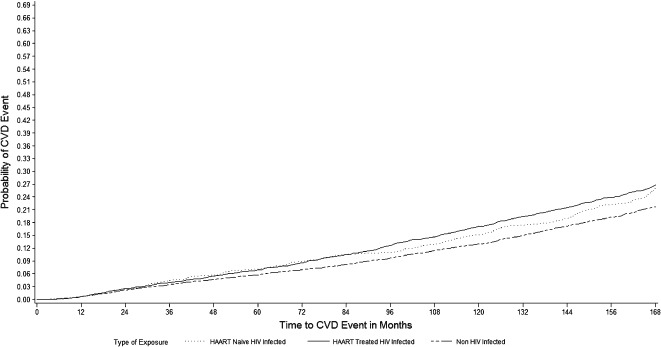
Results: A retrospective cohort of 13,632 adults was followed longitudinally for an average of 51 months. The adjusted hazard ratio (aHR) of incident CVD events was higher among HIV-infected individuals exposed to combination antiretroviral therapy (cART) (aHR = 1.15) compared to the non-HIV-infected group, but did not differ from the subgroup of cART-naïve HIV-infected adults. A higher aHR of incident CVD was associated with comorbid hypertension (aHR = 2.18), diabetes (aHR = 1.38), obesity (aHR = 1.30), tobacco use (aHR = 1.47), and hepatitis C coinfection (aHR = 1.32), and older age (aHR = 1.26), but with a lower risk among females (aHR = 0.86). A higher risk of incident CVD events was also apparent in HIV-infected individuals with exposure to both protease inhibitors (adjusted risk ratio [aRR] = 1.99) and non-nucleoside reverse transcriptase inhibitors (aRR = 2.19) compared to those with no exposure. Sustained viral load suppression was associated with a lower risk of incident CVD events (aRR = 0.74).
Conclusions: After adjusting for traditional risk factors and sociodemographic differences, there is higher risk of incident cardiovascular events among HIV-infected individuals exposed to combined antiretroviral medications compared to the general population.
© 2014 Wiley Periodicals, Inc.
Figures
References
-
- Bozzette SA, Ake CF, Tam HK, et al. Long‐term survival and serious cardiovascular events in HIV‐infected patients treated with highly active antiretroviral therapy. J Acquir Immune Defic Syndr. 2008;47:338–341. - PubMed
-
- Klein D, Hurley LB, Quesenberry CP Jr, et al.. Do protease inhibitors increase the risk for coronary heart disease in patients with HIV‐1 infection? J Acquir Immune Defic Syndr. 2002;30:471–477. - PubMed
Publication types
MeSH terms
Substances
LinkOut - more resources
Full Text Sources
Other Literature Sources
Medical
