


The clinical candidate VT-1161 is a highly potent inhibitor of Candida albicans CYP51 but fails to bind the human enzyme
- PMID: 25224009
- PMCID: PMC4249504
- DOI: 10.1128/AAC.03707-14
The clinical candidate VT-1161 is a highly potent inhibitor of Candida albicans CYP51 but fails to bind the human enzyme
Abstract
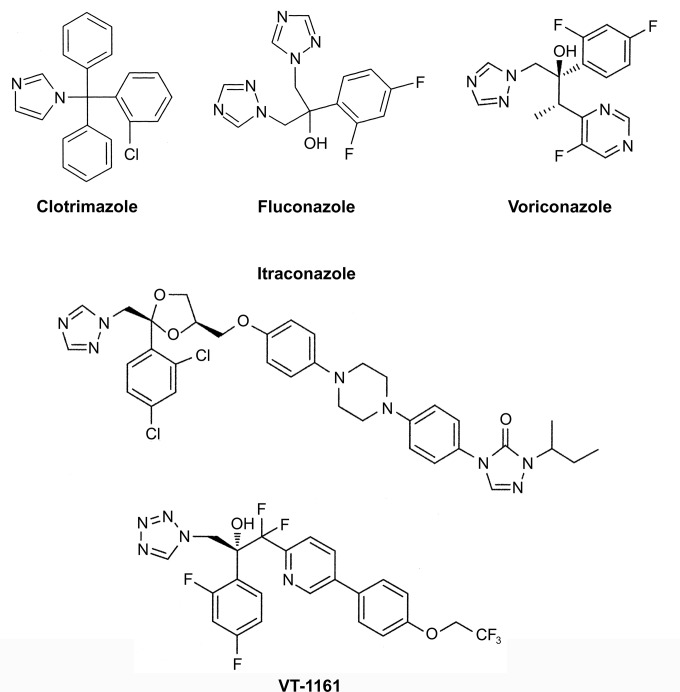
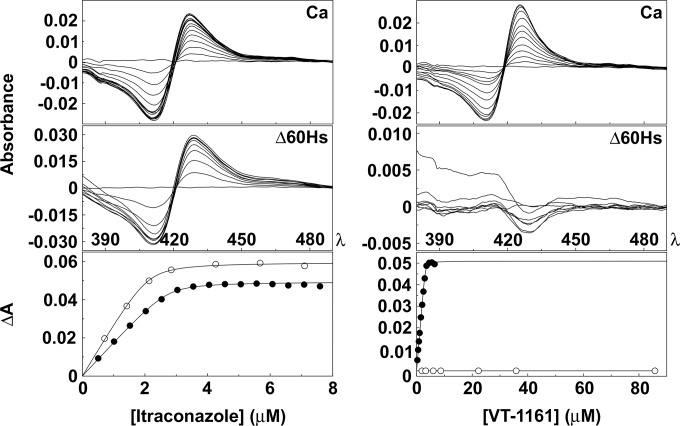
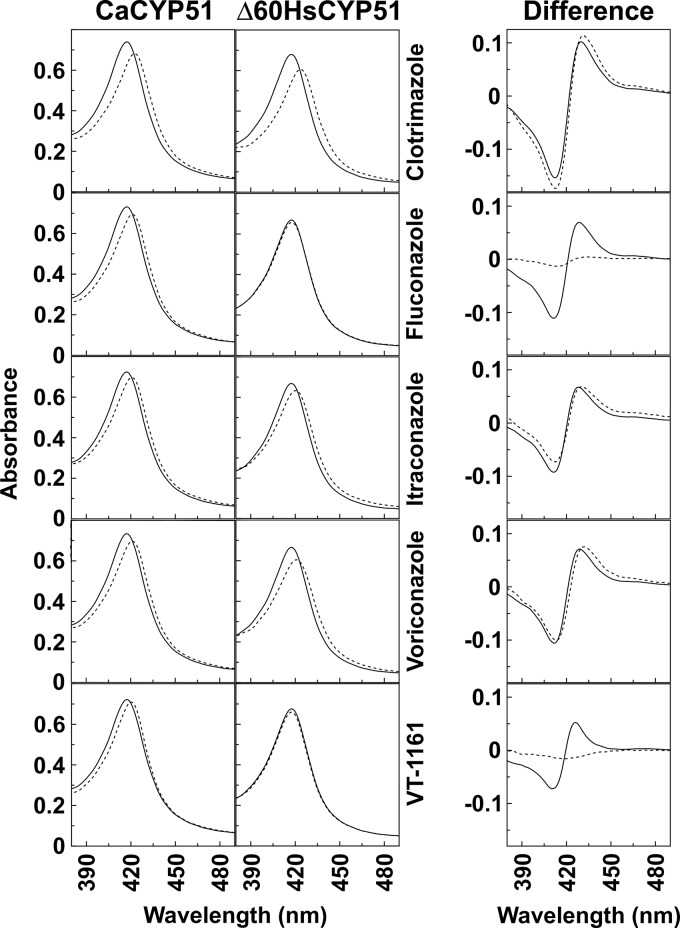
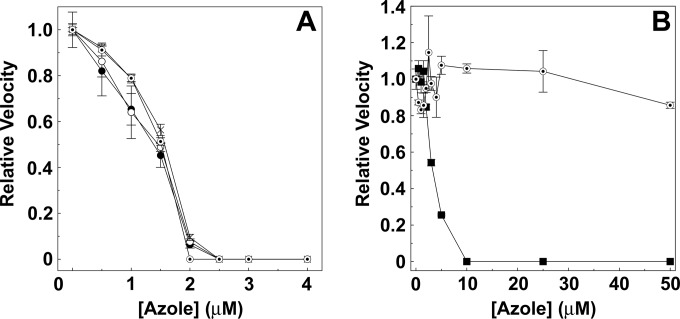
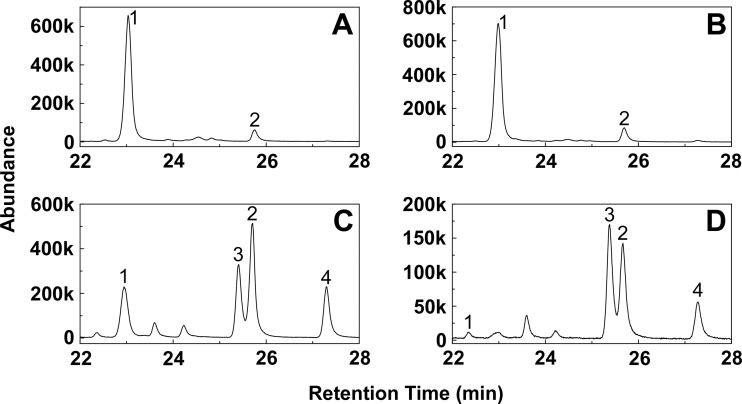
The binding and cytochrome P45051 (CYP51) inhibition properties of a novel antifungal compound, VT-1161, against purified recombinant Candida albicans CYP51 (ERG11) and Homo sapiens CYP51 were compared with those of clotrimazole, fluconazole, itraconazole, and voriconazole. VT-1161 produced a type II binding spectrum with Candida albicans CYP51, characteristic of heme iron coordination. The binding affinity of VT-1161 for Candida albicans CYP51 was high (dissociation constant [Kd], ≤ 39 nM) and similar to that of the pharmaceutical azole antifungals (Kd, ≤ 50 nM). In stark contrast, VT-1161 at concentrations up to 86 μM did not perturb the spectrum of recombinant human CYP51, whereas all the pharmaceutical azoles bound to human CYP51. In reconstitution assays, VT-1161 inhibited Candida albicans CYP51 activity in a tight-binding fashion with a potency similar to that of the pharmaceutical azoles but failed to inhibit the human enzyme at the highest concentration tested (50 μM). In addition, VT-1161 (MIC = 0.002 μg ml(-1)) had a more pronounced fungal sterol disruption profile (increased levels of methylated sterols and decreased levels of ergosterol) than the known CYP51 inhibitor voriconazole (MIC = 0.004 μg ml(-1)). Furthermore, VT-1161 weakly inhibited human CYP2C9, CYP2C19, and CYP3A4, suggesting a low drug-drug interaction potential. In summary, VT-1161 potently inhibited Candida albicans CYP51 and culture growth but did not inhibit human CYP51, demonstrating a >2,000-fold selectivity. This degree of potency and selectivity strongly supports the potential utility of VT-1161 in the treatment of Candida infections.
Copyright © 2014, American Society for Microbiology. All Rights Reserved.
Figures
References
-
- Shafaati M, Mast N, Beck O, Nayef R, Heo GY, Bjorkhem-Bergman L, Lutjohann D, Bjorkhem I, Pkuleva IA. 2010. The antifungal drug voriconazole is an efficient inhibitor of brain cholesterol 24S-hydroxylase in vitro and in vivo. J. Lipid Res. 51:318–323. 10.1194/jlr.M900174-JLR200. - DOI - PMC - PubMed
Publication types
MeSH terms
Substances
LinkOut - more resources
Full Text Sources
Other Literature Sources
