


Increased bone resorption during tenofovir plus lopinavir/ritonavir therapy in Chinese individuals with HIV
- PMID: 25224293
- PMCID: PMC4334679
- DOI: 10.1007/s00198-014-2874-3
Increased bone resorption during tenofovir plus lopinavir/ritonavir therapy in Chinese individuals with HIV
Abstract
We sought to evaluate the effects of antiretroviral therapy on skeletal metabolism in Chinese individuals with human immunodeficiency virus. Patients switched to tenofovir/lamivudine + lopinavir/ritonavir after treatment failure had an increase in bone resorption marker levels by nearly 60%, which is greater than the magnitude previously described in non-Chinese populations.
Introduction: Few studies have evaluated the effects of antiretroviral therapy on skeletal metabolism in Asian populations infected with human immunodeficiency virus (HIV).
Methods: We performed a secondary analysis of bone turnover markers (BTM) at baseline and 2 years in stored plasma samples collected from 2/2009 to 1/2013 as part of a multi-center trial. Two groups were compared: (1) treatment-naïve patients initiated on zidovudine (AZT)/lamivudine (3TC) plus nevirapine (NVP) and (2) patients who failed first-line therapy and were switched to tenofovir (TDF)/3TC plus lopinavir/ritonavir (LPVr). Tests included the bone resorption marker, C-terminal cross-linking telopeptide of type-1 collagen (CTX), and the bone formation marker procollagen type 1 N-terminal propeptide (P1NP).
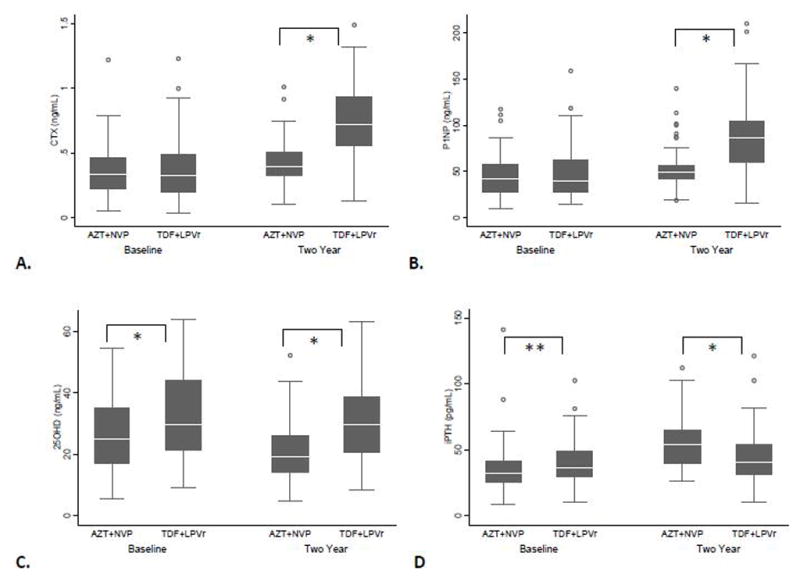
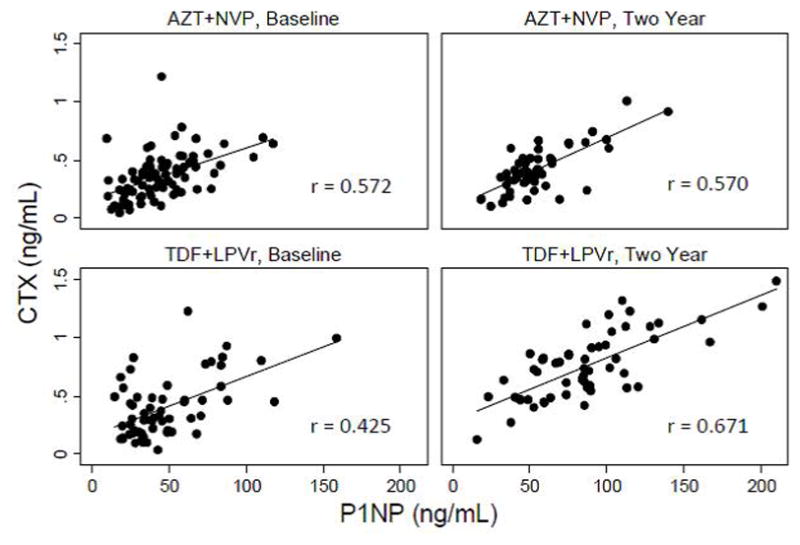
Results: In the TDF/3TC + LPVr group, samples were available from 59 patients at baseline and 56 patients at 2 years. Of these, 36 patients had samples available from both time points. In the AZT/3TC + NVP group, plasma samples were analyzed from 82 participants at baseline and of those, 61 had samples at 2 years. Median change over 2 years was greater in the TDF/3TC + LPVr group for both CTX (+0.24 ng/mL, interquartile ranges (IQR) 0.10-0.43 vs. +0.09 ng/mL, IQR -0.03 to 0.18, p = 0.001) and P1NP (+25.5 ng/mL, IQR 2.4-51.3 vs. +7.11 ng/mL, IQR -4.3 to 21.6, p = 0.012). Differences remained after adjusting for potential confounders in the multivariable analysis.
Conclusions: Switching to TDF/3TC + LPVr after treatment failure resulted in greater increases in BTMs than initiation with AZT/3TC + NVP in Chinese patients with HIV. Following this change, bone resorption marker levels increased by nearly 60 %, which is greater than the 25-35% increase from baseline described previously in non-Chinese populations. Further studies are warranted to elucidate these findings.
Conflict of interest statement
Figures
References
-
- Mondy K, Yarasheski K, Powderly WG, et al. Longitudinal evolution of bone mineral density and bone markers in human immunodeficiency virus-infected individuals. Clin Infect Dis. 2003;36(4):482–901. - PubMed
-
- Piso RJ, Rothen M, Rothen JP, Stahl M. Markers of bone turnover are elevated in patients with antiretroviral treatment independent of the substance used. J Acquir Immune Defic Syndr. 2011;56(4):320–4. - PubMed
-
- Van Vonderen MG, Mallon P, Murray B, et al. Changes in bone biomarkers in antiretroviral naïve HIV-infected men randomized to nevirapine/lopinavir/ritonavir or zidovudine/lamivudine/lopinavir/ritonavir help explain limited loss of bone mineral density over first 12 months after antiretroviral therapy initiation. 18th Conference on Retroviruses and Opportunistic Infections; Feb 27–Mar2, 2011; Boston, MA..
-
- Squires KE, Gulick R, Tebas P, et al. A comparison of stavudine plus lamivudine versus zidovudine plus lamivudine in combination with indinavir in antiretroviral naive individuals with HIV infection: selection of thymidine analog regimen therapy (START I) AIDS. 2000;14(11):1591–600. - PubMed
Publication types
MeSH terms
Substances
Grants and funding
LinkOut - more resources
Full Text Sources
Other Literature Sources
Medical
