


Buildup of spatial information over time and across eye-movements
- PMID: 25224817
- PMCID: PMC4378607
- DOI: 10.1016/j.bbr.2014.09.013
Buildup of spatial information over time and across eye-movements
Abstract
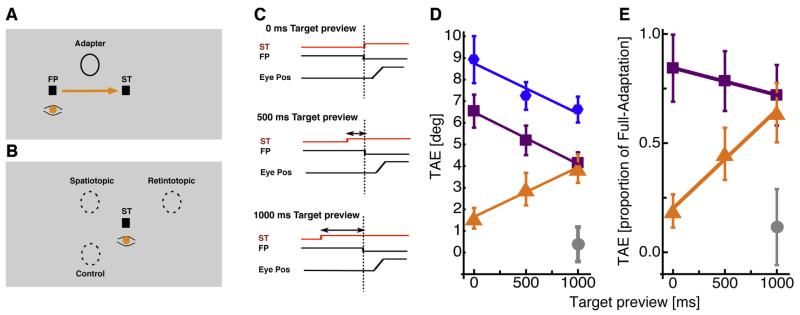
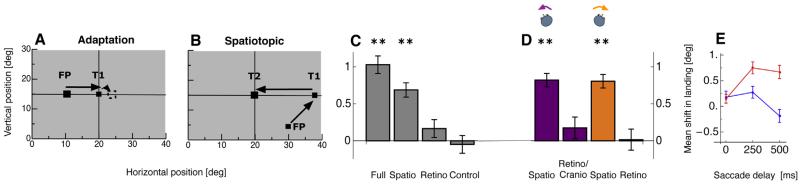
To interact rapidly and effectively with our environment, our brain needs access to a neural representation of the spatial layout of the external world. However, the construction of such a map poses major challenges, as the images on our retinae depend on where the eyes are looking, and shift each time we move our eyes, head and body to explore the world. Research from many laboratories including our own suggests that the visual system does compute spatial maps that are anchored to real-world coordinates. However, the construction of these maps takes time (up to 500ms) and also attentional resources. We discuss research investigating how retinotopic reference frames are transformed into spatiotopic reference-frames, and how this transformation takes time to complete. These results have implications for theories about visual space coordinates and particularly for the current debate about the existence of spatiotopic representations.
Keywords: Saccade; Spatial stability; Spatiotopic representation.
Copyright © 2014 Elsevier B.V. All rights reserved.
Figures
References
-
- Sherrington CS. Observations on the sensual role of the proprioceptive nerve supply of the extrinsic ocular muscles. Brain. 1918;41:332–43.
-
- Helmholtz HV. Handbuch der physiologischen Optik. Voss; Hamburg, Germany: 1867.
-
- Duhamel JR, Colby CL, Goldberg ME. The updating of the representation of visual space in parietal cortex by intended eye movements? Science. 1992;255(5040):90–2. - PubMed
-
- Sommer MA, Wurtz RH. A pathway in primate brain for internal monitoring of movements. Science. 2002;296:1480–2. - PubMed
Publication types
MeSH terms
Grants and funding
LinkOut - more resources
Full Text Sources
Other Literature Sources
