


Early or late IL-10 blockade enhances Th1 and Th17 effector responses and promotes fungal clearance in mice with cryptococcal lung infection
- PMID: 25225664
- PMCID: PMC4193595
- DOI: 10.4049/jimmunol.1400650
Early or late IL-10 blockade enhances Th1 and Th17 effector responses and promotes fungal clearance in mice with cryptococcal lung infection
Abstract
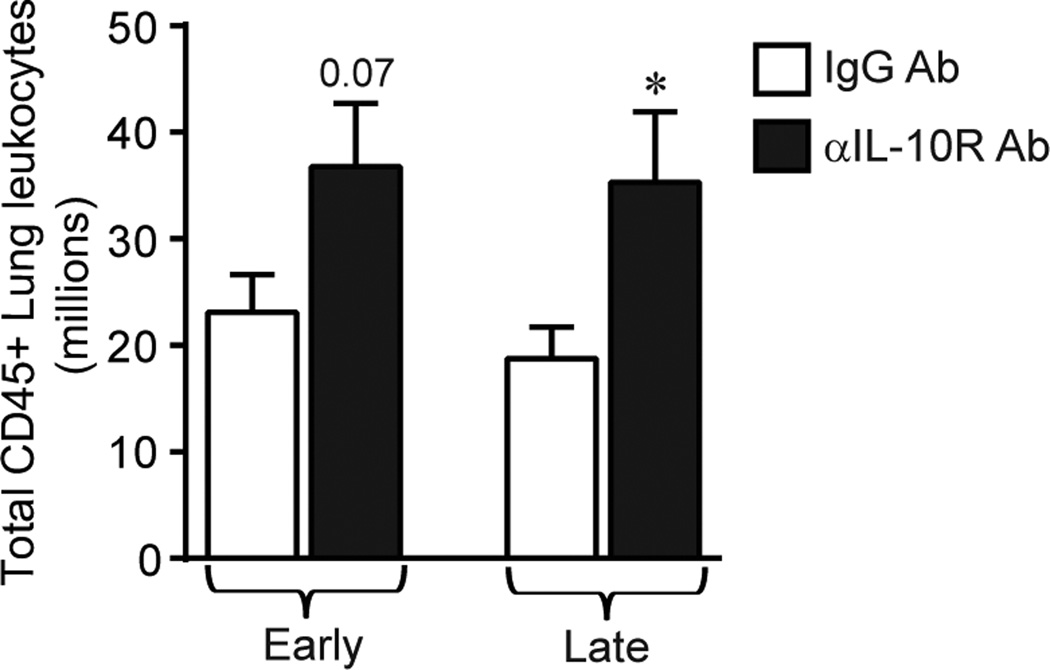
The potent immunoregulatory properties of IL-10 can counteract protective immune responses and, thereby, promote persistent infections, as evidenced by studies of cryptococcal lung infection in IL-10-deficient mice. To further investigate how IL-10 impairs fungal clearance, the current study used an established murine model of C57BL/6J mice infected with Cryptococcus neoformans strain 52D. Our results demonstrate that fungal persistence is associated with an early and sustained expression of IL-10 by lung leukocytes. To examine whether IL-10-mediated immune modulation occurs during the early or late phase of infection, assessments of fungal burden and immunophenotyping were performed on mice treated with anti-IL-10R-blocking Ab at 3, 6, and 9 d postinfection (dpi) (early phase) or at 15, 18, and 21 dpi (late phase). We found that both early and late IL-10 blockade significantly improved fungal clearance within the lung compared with isotype control treatment when assessed 35 dpi. Immunophenotyping identified that IL-10 blockade enhanced several critical effector mechanisms, including increased accumulation of CD4(+) T cells and B cells, but not CD8(+) T cells; specific increases in the total numbers of Th1 and Th17 cells; and increased accumulation and activation of CD11b(+) dendritic cells and exudate macrophages. Importantly, IL-10 blockade effectively abrogated dissemination of C. neoformans to the brain. Collectively, this study identifies early and late cellular and molecular mechanisms through which IL-10 impairs fungal clearance and highlights the therapeutic potential of IL-10 blockade in the treatment of fungal lung infections.
Copyright © 2014 by The American Association of Immunologists, Inc.
Figures




References
-
- Li SS, Mody CH. Cryptococcus. Proc Am Thorac Soc. 2010;7:186–196. - PubMed
-
- Park BJ, Wannemuehler KA, Marston BJ, Govender N, Pappas PG, Chiller TM. Estimation of the current global burden of cryptococcal meningitis among persons living with HIV/AIDS. AIDS. 2009;23:525–530. - PubMed
-
- Bozzette SA, Larsen RA, Chiu J, Leal MA, Jacobsen J, Rothman P, Robinson P, Gilbert G, McCutchan JA, Tilles J, et al. A placebo-controlled trial of maintenance therapy with fluconazole after treatment of cryptococcal meningitis in the acquired immunodeficiency syndrome. California Collaborative Treatment Group. N Engl J Med. 1991;324:580–584. - PubMed
-
- Olszewski MA, Zhang Y, Huffnagle GB. Mechanisms of cryptococcal virulence and persistence. Future Microbiol. 2010;5:1269–1288. - PubMed
Publication types
MeSH terms
Substances
Grants and funding
LinkOut - more resources
Full Text Sources
Other Literature Sources
Research Materials
