


Three-dimensional enhanced lipidomics analysis combining UPLC, differential ion mobility spectrometry, and mass spectrometric separation strategies
- PMID: 25225680
- PMCID: PMC4617145
- DOI: 10.1194/jlr.D051581
Three-dimensional enhanced lipidomics analysis combining UPLC, differential ion mobility spectrometry, and mass spectrometric separation strategies
Abstract
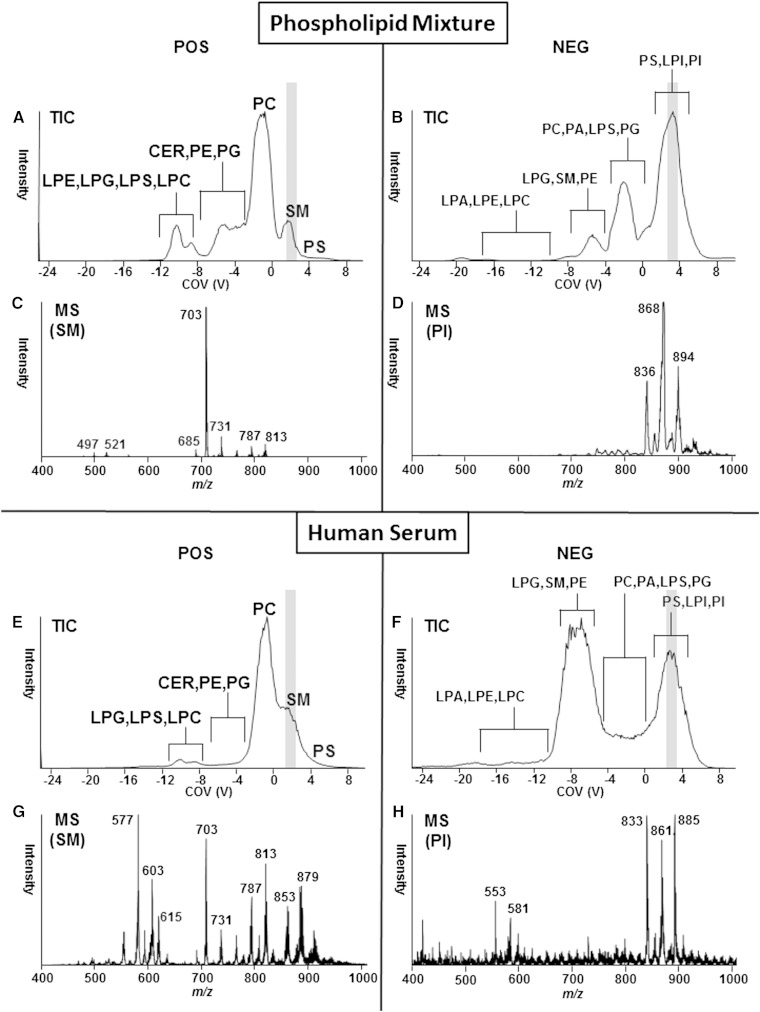
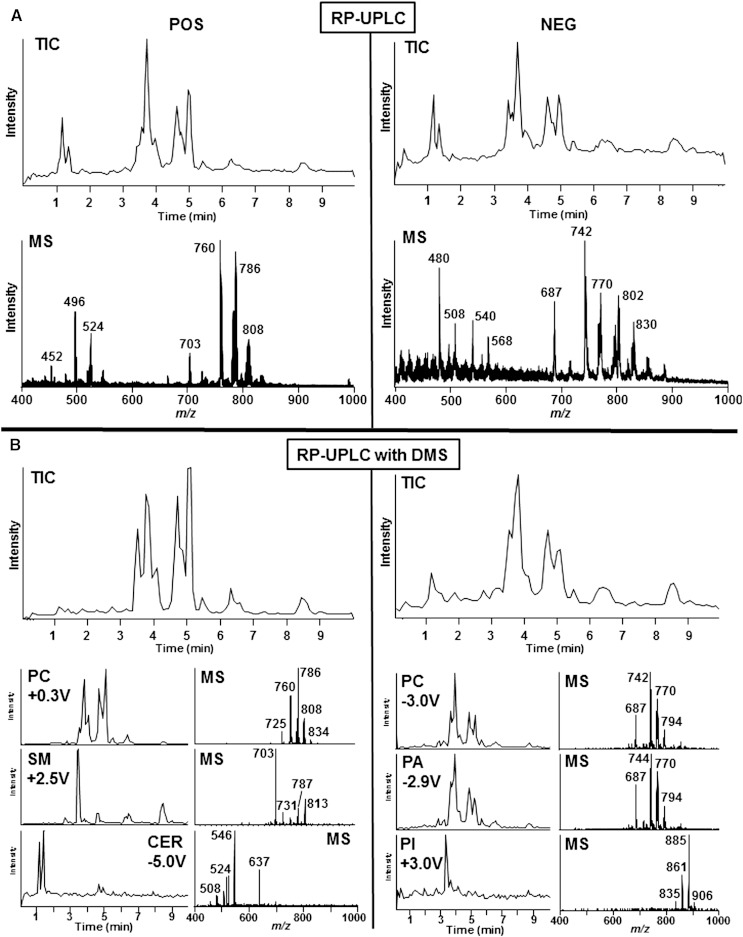
Phospholipids serve as central structural components in cellular membranes and as potent mediators in numerous signaling pathways. There are six main classes of naturally occurring phospholipids distinguished by their distinct polar head groups that contain many unique molecular species with distinct fatty acid composition. Phospholipid molecular species are often expressed as isobaric species that are denoted by the phospholipid class and the total number of carbon atoms and double bonds contained in the esterified fatty acyl groups (e.g., phosphatidylcholine 34:2). Techniques to separate these molecules exist, and each has positive and negative attributes. Hydrophilic interaction liquid chromatography uses polar bonded silica to separate lipids by polar head group but not by specific molecular species. Reversed phase (RP) chromatography can separate by fatty acyl chain composition but not by polar head group. Herein we describe a new strategy called differential ion mobility spectrometry (DMS), which separates phospholipid classes by their polar head group. Combining DMS with current LC methods enhances phospholipid separation by increasing resolution, specificity, and signal-to-noise ratio. Additional application of specialized information-dependent acquisition methodologies along with RP chromatography allows full isobaric resolution, identification, and compositional characterization of specific phospholipids at the molecular level.
Keywords: glycerophospholipids; lipid metabolism; lipid profiling.
Copyright © 2014 by the American Society for Biochemistry and Molecular Biology, Inc.
Figures



References
-
- Loizides-Mangold U. 2013. On the future of mass-spectrometry-based lipidomics. FEBS J. 280: 2817–2829. - PubMed
-
- Wenk M. R. 2005. The emerging field of lipidomics. Nat. Rev. Drug Discov. 4: 594–610. - PubMed
-
- Dennis E. A., Brown H. A., Deems R. A., Glass C. K., Merrill A. H., Murphy R. C., Raetz R. H., Shaw W., Subramaniam S., Russel D. W., et al. 2005. The LIPID MAPS approach to lipidomics. In Functional Lipidomics. L. Feng and G. Prestwich, editors. CRC Press/Taylor & Francis Group, Boca Raton, FL. 1–15.
-
- Fenn J. B., Mann M., Meng C. K., Wong S. F., Whitehouse C. M. 1989. Electrospray ionization for mass spectrometry of large biomolecules. Science. 246: 64–71. - PubMed
-
- Yost R. A., Enke C. G. 1979. Triple quadrupole mass spectrometry for direct mixture analysis and structure elucidation. Anal. Chem. 51: 1251–1264. - PubMed
Publication types
MeSH terms
Substances
Grants and funding
LinkOut - more resources
Full Text Sources
Other Literature Sources
