Review
. 2014 Nov;47(4):285-363.
doi: 10.1017/S0033583514000092. Epub 2014 Sep 16.

Frustration in biomolecules

Affiliations
Review

Frustration in biomolecules

Diego U Ferreiro et al. Q Rev Biophys. 2014 Nov.

Abstract

Biomolecules are the prime information processing elements of living matter. Most of these inanimate systems are polymers that compute their own structures and dynamics using as input seemingly random character strings of their sequence, following which they coalesce and perform integrated cellular functions. In large computational systems with finite interaction-codes, the appearance of conflicting goals is inevitable. Simple conflicting forces can lead to quite complex structures and behaviors, leading to the concept of frustration in condensed matter. We present here some basic ideas about frustration in biomolecules and how the frustration concept leads to a better appreciation of many aspects of the architecture of biomolecules, and especially how biomolecular structure connects to function by means of localized frustration. These ideas are simultaneously both seductively simple and perilously subtle to grasp completely. The energy landscape theory of protein folding provides a framework for quantifying frustration in large systems and has been implemented at many levels of description. We first review the notion of frustration from the areas of abstract logic and its uses in simple condensed matter systems. We discuss then how the frustration concept applies specifically to heteropolymers, testing folding landscape theory in computer simulations of protein models and in experimentally accessible systems. Studying the aspects of frustration averaged over many proteins provides ways to infer energy functions useful for reliable structure prediction. We discuss how frustration affects folding mechanisms. We review here how the biological functions of proteins are related to subtle local physical frustration effects and how frustration influences the appearance of metastable states, the nature of binding processes, catalysis and allosteric transitions. In this review, we also emphasize that frustration, far from being always a bad thing, is an essential feature of biomolecules that allows dynamics to be harnessed for function. In this way, we hope to illustrate how Frustration is a fundamental concept in molecular biology.


Figures

Figure 1
Figure 1
Frustration is a general feeling and a deep concept. This cartoon presents part of the problem: a group of people that cannot be seated optimally in a single row. The upper panel shows a social graph that takes into account the interactions among people. The lower panel shows the irritation of the character that tries to calculate the arrangement for he and his seven friends, finding out that there will always be unsatisfied agents. Reproduced with permission from http://xkcd.com/173
Figure 2
Figure 2
Frustration entered the physics lexicon in the study of magnets. The arrows represent spins that can be in any two states: up or down. Favorable antiferromagnetic interactions between spins are represented by squiggly lines. The potentially frustrating problem is: what is the lowest energy arrangement of the up and down spins that can be reached dynamically? On the left, the particles are arranged on a rectangular lattice. How would you set the spins such that all local interactions are satisfied? What happens if the particles are arranged on a triangular lattice, as shown on the right? There is no way to arrange the spins so that every component interaction can be minimized. The triangle is “frustrated”
Figure 3
Figure 3
Frustration leads to barriers in the energy landscape. The arrows represent spins that can be in any two states on a rectangular lattice. Favorable ferromagnetic interactions are represented by straight lines, antiferromagnetic interactions by squiggly lines. In this case most of the bonds are ferromagnetic so at low temperature most of the spins will be parallel. Two choices of spin assignments are shown. These have similar energies, are relatively stable, but they are globally dissimilar. At left most spins are down, at right most spins are up. In both cases the same number of interactions remain locally unsatisfied (red dots). There are two ways of arranging the “misaligned” spins. To rearrange from one to the other a very complicated set of spin changes must be made. This rearrangement is entropically disfavored at high temperature and energetically disfavored at low temperature. Many large scale moves must be made for the system to find out which arrangement or set of arrangements are most stable. Although there is a ground state it can be hard to find because of the very slow dynamics that emerges.
Figure 4
Figure 4
Patterns can be encoded within magnets. The magnet is composed of different patterns of binary spins arranged on a rectangular lattice. Configurations are sorted by similarity to each other in a natural reaction coordinate measuring their overlap. The energy of each configuration is given as a function of the local interactions. In this case only two patterns are encoded, allowing two globally different ground states. Configurations close to any one of them are fairly low in energy. If there are not too many interferences between the patterns, the existence of one pattern only contributes a small random energy that doesn’t destabilize the other energy minimum much. If the magnet starts in a configuration resembling one of the individual patterns, at low temperature the spins will rearrange and recollect the complete encoded pattern. These patterns remain retrievable even if many bonds of the lattice (but not too many!) become modified. The memory patterns are thus stored globally, not just locally. There is a finite capacity in the maximum number of storable patterns, as too many of them make the system behave like a random spin glass and robust recollection of the associated input memories becomes impossible.
Figure 5
Figure 5
Specific folding becomes possible as sequence complexity increases. Two-dimensional lattice polymers and its associated energy landscapes are shown. The leftmost is an homopolymer. Many configurational states with nearly similar energy can be formed, for example by shifting the “strands”. The energy landscape is very rugged with local minima and many barriers. If the temperature is higher than a typical barrier, the polymer will be fluid; at lower temperature the system becomes trapped in many configurationally disparate states and the dynamics gets glassy. At the center a two-letter heteropolymer. The shifting of strands is more difficult as the register can be partially determined by the sequence composition. The energy landscape is still rugged but an overall shape appears. The barriers between any two low energy configurations are high as energetically favorable contacts must be broken up in order to move. At rightmost a polymer with three types of monomers. The energy of the configurations can be better specified by the sequence and the energy landscape becomes funneled shaped. Adventitious trapping in high energy states is reduced and folding to the ground state is robust to both sequence and environmental perturbations. Redrawn with permission from (Wolynes 1997a)
Figure 6
Figure 6
Frustration in the lattice polymer world. Different degrees of frustration lead to distinct kinetic and thermodynamic behaviors. Here the 27-mer polymers fold into 3×3×3 cubic lattices. If two monomers are adjacent in space there is an attractive interaction between them. This interaction is strong (−3 energy units, green) if the monomers are of the same type and weak (−1 energy units, red) if they are of different types. The most compact configurations are cube-like and have 28 contacts. The structures of the ground state of two sequences are shown at the top. At left an unfrustrated sequence where all interactions are optimal is in the lowest energy state. At right a sequence for which it is impossible to optimize all interactions in any structure, making it necessary to compromise and have weak contacts in the ground energy state. Q measures the similarity to the ground state as the number of native contacts, E is the pair-wise added energy. For the unfrustrated sequences, most of the configurations with energy just above the ground state are very similar to the ground state configuration. For frustrated sequences however there are configurations with energy just above the ground state that are very different from the ground state configuration. When the system gets trapped in one of these low energy states, it takes a long time to completely reconfigure before it can try to fold again, as schematized. The middle panel sketches the results from various folding simulations in the lattice world (Onuchic et al. 1997). At top the kinetics measured as the number of MC steps required to reach the native structure. Below the thermodynamics of the same systems. Even at its fastest folding temperature the frustrated sequence is not thermodynamically stable in the folded state but takes up other configurations. The unfrustrated sequences fold fast even at temperatures where the folded state wins out thermodynamically over the panoply of other possibilities. When there is a single ground state (as is true when there is little frustration) the global minimum of the lattice polymer can be accessed fairly quickly at low temperature. For the typical frustrated sequence there are several near degenerate low energy states so the folding becomes thermodynamically reliable only at very low temperature. This degeneracy leads to kinetic trapping and the folding time course becomes non-exponential.
Figure 7
Figure 7
The global effects of frustration can be quantified with energy landscape theory. A frustrated heteropolymer will have the energy distribution drawn from a random energy landscape, a Gaussian with some mean Ē and a standard derivation ΔE. The energy of the lowest energy states Eg can be estimated given the size of the configuration space and the variance of the energy distribution. A large protein whose energy is just Eg will have quite a few kinetic traps of nearly the same stability. Therefore, if a protein is to fold robustly, its ground state energy must be substantially below Eg. If the energy of the completely folded state Ef is substantially below this estimate we can predict that frustration effects will be minimal for this sequence (Bryngelson et al. 1987). The condition that Ef is below Eg is known as the gap condition for folding. Comparing Ef and Eg and requiring them to be well separated (δE) provides one way of quantitatively stating the Principle of Minimal Frustration.
Figure 8
Figure 8
Quantifying frustration in lattice world. Different degrees of frustration lead to distinct kinetic and thermodynamic behaviors. Folding simulations in enumerable systems have confirmed the criteria for achieving non-degenerate ground states and robust rapid folding. The configurational space of a two-letter polymer folding on a 3×3×3 lattice can be exhaustively analyzed, so that the ground state energy Ef can always be found, the energy distribution all other compact structures can be computed explicitly and the relevant parameters of the energy landscape calculated. Each dot in the figure corresponds to a different sequence. The ratio of the energy gap δE = EfEg to the roughness Ē/ΔE2 define the relevant temperatures Tf and Tg. The average folding time at constant temperature for each sequence is shown. At the same time gap/rough correlates with the cooperativity of the thermodynamic folding transition as measured by its width. For a lattice world heteropolymer to behave in a protein-like way it must conform the minimal frustration principle requirement of having a sufficiently large Tf /Tg ratio as measured by the Z-score statistics. Seeing that this principle works in the controlled world of lattice proteins with known force laws gives us confidence in applying the minimal frustration principle to proteins in the real world, where the force laws are still uncertain. (Redrawn with permission from (Mélin et al. 1999)
Figure 9
Figure 9
Reliable energy functions can be learned applying Energy Landscape Theory. The correlation between structure and energy envisioned in the minimal frustration principle gives a strategy for learning energetics from protein structural databases. Machine learning algorithms find energy functions that make the landscape of natural proteins as funnel-like as possible. The more funneled potentials should have higher Tf /Tg. The parameter of a coarse-grained potential energy function are optimized self-consistently to find the ones most likely to fold properly. In this way optimal protein folding codes are found (Goldstein et al. 1992b). On the right a representation of a realistic protein folding landscape of a globular domain. There are a large number of configurations at the top of the funnel that are nearly random coils, with few nonlocal contacts. As contacts are made the energy on the average decreases. Nonspecific contacts can be sufficiently favorable, a collapsed but fluid set of configurations becomes thermodynamically relevant and indeed may be a separate phase. At left a sketch of the histograms of the energies of the configurations before and after training the energy function. The folded configurations are well separated from these disordered configurations by a stability gap from the molten globule.
Figure 10
Figure 10
Proteins live in water. Amino acid chains interact strongly with their environment, that modulates the intrachain forces and conditions the global protein dynamics (Frauenfelder et al. 2009). Accurate and reliable force fields must include the solvent, at least implicitly. A sketch of a globular domain is shown on top, where the protein is partitioned in layers, conceptualizing different interaction modes. An implementation of these ideas was realized with a transferable associative memory hamiltonian energy function (Papoian et al. 2004). The different layers were calculated and projected on a real protein structure (Lysozyme). The backbone chain is shown as a continuous trace, the lines correspond to interactions between amino acids. At left only the direct interactions are drawn (brown), next to only the water-mediated interactions (blue). At right an overlay of the molecular surface of the buried (brown) or exposed (transparent blue) residues is shown.
Figure 11
Figure 11
Protein structure predictions. Energy landscape theory provides a mathematical framework to learn energy functions. The associative memory, water mediated, structure and energy model (AWSEM) is a coarse-grained protein force field optimized with energy landscape theory (Davtyan et al. 2012). AWSEM contains physically motivated terms, such as hydrogen bonding, as well as a bioinformatically based local structure biasing term, which efficiently takes into account many-body effects modulated by the local sequence composition. With appropriate memories taken from local or global alignments, AWSEM can be used to perform de novo protein structure prediction. The figure shows structural alignments of the best ranking predictions for sequences of different sizes in which no a priori homology information is used. The predicted structures are shown in blue, and the actual experimental structure in green. The regions where the structures are highly similar as judged quantitatively via structural similarity of the contact maps are colored red for the predicted and orange for the actual structure (Sippl et al. 2012). Regions that are not accurate are shown in blue or green. While not perfect, the predictions are reasonably robust and quite good for moderate size proteins. The same model and energy function can also be used to predict the native interfaces of protein complexes (Zheng et al. 2012) thus it amounts to a flexible docking algorithm.
Figure 12
Figure 12
Proteins can be locally frustrated. A sketch of a globular domain is shown on top, with the protein partitioned in regions conceptualizing local frustration patterns. An implementation of this idea can be quantified with a local Frustration Index, calculated on real protein structures with the AMW force field (Papoian et al. 2003a). Below the schematic, the results obtained with the prototypical protein Lysozyme. The backbone is shown as a continuous trace. The protein is networked by a connected set of minimally frustrated contacts (green) while there are two patches of highly frustrated contacts (red). Neutral interactions are now drawn. Direct interactions are shown with continuous lines, and water-mediated interactions with dotted lines. The surfaces of the amino acids are overlaid, according to their frustration index calculated at the single-residue level. Local frustration patterns were calculated with the frustratometer.tk server (Jenik et al. 2012)
Figure 13
Figure 13
Local frustration patterns in globular proteins. Examples of frustratograms of natural proteins. The structural coordinates from protein models were taken the protein data bank (pdb)(Berman et al. 2000. The chain backbone is shown as a continuous trace and interactions between residues are represented by thin lines. Minimally frustrated contacts are green, highly frustrated contacts are red, and water-mediated interactions are shown with dotted lines. Two complementary ways of localized frustration are shown for each protein. At right the patterns are calculated with the mutational frustration definition: how favorable is a native interaction relative to the interactions other residues would form in those locations? At left the patterns are calculated with the configurational frustration definition: how favorable is the native interaction relative to the interactions these residues would form in other compact structures? A statistical survey was performed with a non-redundant sample of the pdb (Ferreiro et al. 2007a). The pair distribution functions between the centers of mass of the contacts are shown below for the minimally frustrated (green), neutral (gray), or highly frustrated (red) groups. Neutral interactions follow the distribution of all contacts (black); highly frustrated interactions cluster at short distances; and minimally frustrated interactions form a tight network that percolates the structure.
Figure 14
Figure 14
Is it possible to re-encode a protein structure with a reduced alphabet? Once a single overall topology is specified, successful design using oligo-letter codes becomes feasible. When the overall frustration of the starting sequence is low, competing structures are automatically destabilized by the landscape topography. The local frustration patterns of SH3 proteins with simplified sequences is shown. A natural protein is shown at the far right (pdb: 1RLQ), and next to it simplified sequences threaded on same backbone. The 5 letter code is the sequence that Riddle et al. found by selecting functional SH3 domains (Riddle et al. 1997). This sequence contains 95% of its amino acids reduced to a 5 letter alphabet of IKEA and G. The number of highly frustrated interactions increases from 3% to 7%, maintaining the minimally frustrated core of interactions. Further reduction of this same sequence did not produce folded SH3 proteins. A specific structure cannot be encoded in a homopolymer. Energy landscape theory shows that increasing the alphabet allows for the possibility of decreasing the ruggedness while still maintaining the stability gap. Bigger alphabets allow for robust encoding of various specific folds.
Figure 15
Figure 15
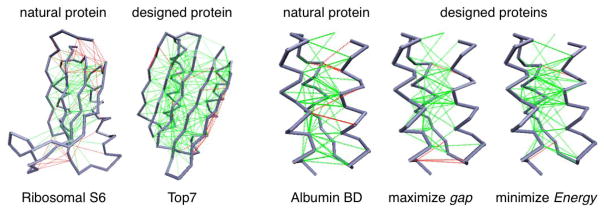
Are humans too good protein designers ? Although it is still challenging for routine technological applications, protein design has had some success. Top7 is a protein with a novel fold, designed by taking a trace of a target topology and evaluating sequences that minimize the energy in that configuration. The resulting protein is unusually unfrustrated, much less than natural proteins of similar size and secondary structure such as Ribosomal S6. Folding simulations show that S6 folds smoothly in a two-state manner in contrast with Top7 that populates intermediates, even on a perfectly funneled surface (Truong et al. 2013). The high stability of the fold is consistent with the original design, but competing low free energy structures appear because the sequence was not explicitly designed to avoid them. Energy landscape principles inspired the development of an automated procedure to design sequences by crafting a global funneled landscape to design out a vast number of misfolded configurations (Onuchic et al. 1997). Sequences are searched to either simply minimize the energy in the native state or to maximize the energy gap between folded and misfolded forms. An example of a natural Albumin binding domain and two redesigned sequences is shown. The small differences in frustration level impact the quality of folding (Truong et al. 2013). Unlike the nicely funneled landscape of the natural sequence, landscapes of the designed proteins display complicating features, indeed related to the gap-criterion used for design. Redrawn with permission from (Truong et al. 2013).
Figure 16
Figure 16
Symmetry provides an efficient way for minimal frustration. In a symmetric structure the same set of interactions is used multiple times. If a strong interaction is found it will appear more often in a symmetric molecule than in the asymmetric case, broadening the energy distribution as sketched in the figure. For folding biomolecules the energetic threshold is set by the ground state energy of random heteropolymers, Eg/N.
Figure 17
Figure 17
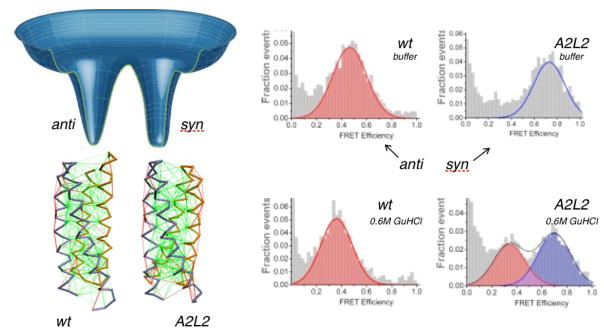
Symmetric structures tend to be low in energy. ROP dimer folds as a 4-helix bundle of paired coiled coils. An alternate non-native pairing of the helices would form a structure that uses similar contact interactions and would be energetically comparable. The energy landscape appears as a dual-funnel pictured on top. The wild type (wt) protein folds in anti topology and the A2L2 mutant in a syn topology, as found by crystallography. In these structures the backbone of one monomer is colored blue and the other orange. The local frustration patterns are displayed as green lines for the minimally frustrated interactions and red lines for the highly frustrated ones. Both forms are energetically competitive. Structure based simulations predicted that the syn topology folds much faster than the native form i.e. the anti form is more topologically frustrated. The prediction that there was a structural change based on preserving basic energy landscape theory was confirmed by single molecule FRET experiments. At right, the FRET histograms for wild type protein and the A2L2 mutant obtained in native buffer (top) and in slightly denaturing conditions (bottom). The peaks at efficiencies of 0.45 and 0.75 correspond to the anti and syn conformations respectively. While the wild type protein remains stable in one form, the A2L2 mutant occupies a mixed ensemble of states at 0.6 M GuHCl. Because of the near symmetry of a macromolecule, mutations can cause a conformational switch to a nearly degenerate, yet distinct, topology or lead to a mixture of both topologies. (Redrawn with permission from Levy et al. 2005, Gambin et al. 2009)
Figure 18
Figure 18
The energy landscape of repeat-proteins have internal symmetries. The repeating sequence encodes similar structural elements that interact with nearest neighbors, depicted by many folding elements that merge upon interaction and comprise an overall funneled landscape (Ferreiro et al. 2007b). High energy unfolded configurations are on top and the fully folded state at the bottom. In between, intermediate ensembles of partially folded states can become populated at equilibrium (red shadow). Asymmetries in the local energy distribution mold the landscape roughness that define the kinetic routes. The thick blue lines depict the preferred folding routes of the 12-ankyrin repeat protein D34, for which the intermediate ensemble is polarized towards the C-terminal repeats of the molecule (Werbeck et al. 2008). The crystal structure of D34 is pictured at the bottom, colored according to its local frustration pattern. Highly frustrated regions are located at the ends, and in a central region between repeats 5 and 6. These breaks occur where the experiments suggest the intermediate’s folding boundary is. The collective influence of local interactions along the one dimensional scaffold allows sites to thermodynamically modulate each other even at considerable distance. Small perturbations, such as mutation or ligand binding, may change the interactions in or between the modules causing large effects that can be experimentally dissected. (Redrawn with permission from (Ferreiro et al. 2008c)
Figure 19
Figure 19
Anomalous ϕ-values often involve frustrated sites. In a minimally frustrated landscape there is a relation between the energetic contribution of residues in the native state with the energetic contribution to the transition state ensembles along the primary folding routes. These can be experimentally measured by analyzing the change in stability and folding speed upon single-site mutation by ϕ-value analysis. Consistent with the notion of widespread minimal frustration, more than 1000 reliable measurements (Naganathan et al. 2010) lie in the range 0 < ϕ < 1 as expected on a perfectly funneled landscape. The figure shows the frustratograms for proteins in which deviations have been confidently measured, with the anomalous residues highlighted in orange. CI2 mutant A16G (ϕ = 1.12); FKBP12 mutant F36A (ϕ = −0.1); fynSH3 mutants F26I (ϕ = −0.4) A39V (ϕ = 2.34) A39F (ϕ = −0.16); srcSH3 mutant I34A (ϕ = 2.01).
Figure 20
Figure 20
Non-native intermediates highlight frustrated sites. Functional constraints for specific binding constrain the polypeptide sequences and can give rise to energetic conflicts with the rest of the polymer. Im7 is an example in which smooth folding is compromised by function, leading to local frustration. In the top panel is shown the average structure of the native protein where highly frustrated interactions are marked with red lines. Traps with non-native structure give rise to a folding intermediate, which is observed both in experiment and simulations. The intermediate is stabilized by favorable non-native interactions formed by residues that, in the native form, cluster on the surface and form a locally frustrated region. Minimally frustrated contacts present in the native structure (green) are distinguished from those that are nonnative (blue). A distinct nonnative cluster can be observed involving interactions between helix IV and the helix IDII region. Native (red) and nonnative (orange) frustrated contacts surround the core. Random mutagenesis identified sites where substitutions increase the thermodynamic stability (purple). Many of the residues identified as forming non-native contacts during the early stages of folding of Im7 lie in regions that have a functional role: they are involved in the recognition and inactivation of colicin toxins forming the interaction interface with them. The observation of clusters of frustrated interactions in the native states points the way to a general mutational strategy to reduce the ruggedness of real protein folding landscapes.
Figure 21
Figure 21
Frustration can affect proteins’ internal friction. Search in a rough energy landscape is affected by the population of local traps. When there are many traps these can be thought of as a source of friction on the diffusive folding. The structurally similar Spectrin repeats were shown to fold with very different rates (Wensley et al. 2010). The frustratograms of a natural protein that include these repeats is shown. R16 and R17 have a central cluster of highly frustrated residues and fold three orders of magnitude slower than does R15, which is more uniformly minimally frustrated. This central cluster of frustrated residues is involved in the main crossing from an initial transition state for folding to a later exit transition state for folding (Borgia et al. 2012). The frictional effect can be revealed by the viscosity dependence of the folding reactions, which can be studied by varying the solvent conditions and keeping the relative stabilities unchanged. For R15 the folding rate scales inversely to the solvent viscosity while for the frustrated systems R16 and R17 the folding rates are independent of solvent viscosity (Wensley et al. 2010).
Figure 22
Figure 22
Frustration guides protein-protein association. The structural coordinates of natural protein complexes were taken the pdb, and local frustration was calculated on the unbound monomers. The configurational frustration pattern of one ligand is shown together with the surface of the other. Minimally frustrated contacts are green, highly frustrated contacts in red, water-mediated interactions with dotted lines. A statistical survey was performed with a non-redundant sample of 85 complexes (Ferreiro et al. 2007a). The pair distribution functions between the centers of mass of the contacts and the Cα of either binding or non-binding surface residues is shown. Whereas many of the highly frustrated interactions are close to the binding residues as defined in the co-crystal structures, there are additional patches of frustrated interactions on the protein surfaces, suggesting there may be other functional reasons to retain these conflicting residues.
Figure 23
Figure 23
Local frustration in allosteric domains. Proteins can change their structural forms responding to signals in their environment; some have been crystallized in two different conformations. Examples of structural alignment of experimentally determined conformations is shown above, colored according to the structural deviation (blue low, red high). The frustratograms for the individual conformations are shown at the sides, with the minimally frustrated interactions in green lines, the highly frustrated interactions in red lines. At far right a quantification of the local frustration projected on the linear sequence of the protein, minimally frustrated interactions (green) or highly frustrated interactions (red) in the vicinity of each residue, in either forms (solid or dashed). The structural deviation between both states is quantified by a local Qi score. Clusters of high local frustration colocate with residues whose local environment shifts between the two structures. Redrawn with permission from (Ferreiro et al. 2011)
Figure 24
Figure 24
Frustration in prototypic allosteric proteins. Haemoglobin is a tetrameric protein in which near rigid-body rotation allows symmetrical packing of subunits to occur. In this multimeric protein the interface between the subunits is not frustrated in either form. Highly frustrated interactions do occur internally in each subunit near the heme binding site. This is a classical example of a Wyman-Monod view of symmetry leading to near degeneracy, for which allostery does not depend on frustration. Below, the case of adenylate kinase, a protein that undergoes a large-scale conformational transition upon binding substrates. Steered molecular dynamics identified locations where “hinge” motions are believed to occur, shown here with blue arrows (Henzler-Wildman et al. 2007). An extensive minimally frustrated network of contacts rigidifes the molecule in the closed form, and highly frustrated regions co-locate with the hinges. Motion of adenylate kinase along the low-frequency normal modes contributing to the closure accumulates stress in some regions (Miyashita et al. 2003). A high-stress region can “crack” or locally unfold releasing the strain and catalyzing the motion. This region is highly frustrated in both forms. The presence of interactions that conflict with folding an enzyme is a general theme in the realization of effective catalysts. Redrawn with permission from (Ferreiro et al. 2011)
Figure 25
Figure 25
Local frustration in metastable proteins. Hemagglutinin (HA) is a viral protein that undergoes a dramatic conformational change in response to an environmental pH change. The figure shows the local frustration patterns of the HA molecule crystallized in different conditions. The protein is a trimer that protrudes from the membrane of coated viruses, rearranging so that parts of it move by as much as 100 Å, labeled here A, B, C and colored on a monomer to ease visualization. Several regions of high frustration are identified at pH7 (red lines). The local frustration of these region changes upon rearrangement and is diminished overall in the structure at pH 5. The regions involved in the major conformational change are already destabilized in the pre-fusion state and are more likely to “crack”. There is also a region of high local frustration of the fusion peptide (FP, orange) in the pH 7 structure that conflicts with the core of the HA trimer. This peptide interacts with the membrane of the host endosome upon triggering by pH.
Figure 26
Figure 26
Frustration in Serpin strand swapping. Metastable proteins can undergo large conformational changes upon backbone connectivity changes. When a protease cleaves the α1-antitrypsin molecule in the RCL loop (top left, purple and orange) the whole molecule rearranges and this part of the polypeptide is found as a β-strand inserted in the central β-sheet (top right, orange). The local frustration patterns shows that the RCL is “strained” in the pre-cleavage form, where local destabilization promotes conformational change. Accommodating the new β-strand requires sub-optimal interactions among residues in the β-sheet region of the protein, which is also locally frustrated. Some serpins can spontaneously undergo a conformational rearrangement without RCL cleavage. The structure of antithrombin III (AT-III) strand-swapped dimer is shown at the bottom, with one monomer colored cyan and the other gray. In a classic domain-swap fashion, the polypeptides exchange part of the β-sheet with one another. The strand that gets swapped corresponds to the RCL region that can get cleaved. Regions of high local frustration in the dimer correspond with the regions that undergo rearrangements, the base of the swapped β-strand in addition to the α-helix that is dislodge from the face of the β-sheet for strand insertion.
Figure 27
Figure 27
Local frustration in enzymes. Catalytic sites are stringent, usually bringing together in space residues that would otherwise adopt different interactions. Examples of local frustration patterns in prototypic enzymes is shown. Orange spheres mark the catalytic residues annotated in the Catalytic Site Atlas (Porter et al. 2004). The catalytic residues are typically involved in highly frustrated interactions. Additionally the catalytic sites are often surrounded by a dense minimally frustrated network of interactions. It is apparent that large enzymes also contain other surface patches of highly frustrated interactions that could mark other functional sites, such as the binding of an allosteric effector. These general aspects of frustration in enzymes appear to hold irrespective of enzyme class or catalytic mechanism, as classified by the E.C. numbers.
Figure 28
Figure 28
Slow conformational dynamics and local frustration. Catalytic mechanisms require motion. The dynamics of the protease Thrombin change upon ligand binding. In particular the active site loops display motions over several orders of magnitude - from picoseconds to milliseconds time scales. The ensembles of structures can be visualized with experimentally calibrated molecular dynamics. An ensemble of the representative structures of this protein is shown at top left, with dynamic loops identified with different colors. The local frustration pattern of the lowest-energy structure from the ensemble is shown on the right. Minimally frustrated contacts are shown in green, highly frustrated ones in red, thin lines for water-mediated contacts. Below, a quantitative comparison of the order parameters S2 reflecting nanosecond time scale motions Sns2 (gray) and longer time scale motions SAMD2 (red, black), with the local frustration distribution (cyan, blue). The average per residue fraction of highly frustrated contacts in the three lowest-energy structures is shown with error bars corresponding to 1 s.d. The results from the inhibitor-bound ensemble are shown in the lower panel, the structural ensemble of the free protein in the top panel. Redrawn with permission from Fuglestad et al. 2013.
Figure 29
Figure 29
Frustration and the initiation of aggregation. Self-recognition of short sequences in two copies of the same protein sequence can lead to native-like interactions, resembling the first steps in the formation of an amyloid. The folding of tandem copies of TitinI27 or SH3 were simulated using AWSEM (Zheng et al. 2013). Besides native-like structures, misfolded structures with a significant amount of self-recognition interactions were found. The different levels of frustration in the tertiary contacts is illustrated in two representative structures for I27 dimer (left), SH3 dimer (right), with the backbone of the sub-domains in blue and yellow. The swapped contacts formed at the interface of SH3-SH3 are minimally frustrated, as expected from the principle of minimal frustration. The self-recognition contacts formed at the domain interface of I27–I27 are also minimally frustrated, indicating that these contacts are stronger than random contacts. Below, comparisons of the stability (energy per residue) among various structures and ensembles of thermally sampled structures of I27 (left) and SH3 (right). The stability for the native monomeric structure in shown by a green vertical line, the strongest non-native hexapeptide pairing in magenta. Misfolded configurations are typically less stable than the native structure, indicating that misfolding by inappropriate pairing of strands will be unlikely in folding of the monomers for both I27 and SH3. Blue bars show the distribution of the stability of all of the self-recognition hexapeptide pairs, calculated with the AWSEM-Amylometer based on the energies of a β-sheet formed from the hexapeptide (Zheng et al. 2013). If the stability of the strongest self hexapeptides pair is competitive with the native structure, as in the case of I27–I27, the particular self-pair is responsible for the misfolding of the fused protein and can trigger further aggregation. For SH3-SH3, the fused protein folds as well as the monomer, because all self hexapeptides pairings are weaker than the most stable nonnative hexapeptides pairing in the monomer. At low temperature, folding to the native state is robust, but the amyloid-like structures can act as kinetic traps. At higher temperature their disordered parts give them an entropic stability advantage. They can act in the initial states for further aggregation. Frustration can be manifested more strongly in partially disordered ensembles and may not always be apparent in the final crystallographic structure. These examples show that looking at pair-level frustration as in typical frustratograms may not reveal all situations where energetic frustration can show up. Redrawn with permission from Zheng et al. 2013.
Figure 30
Figure 30
Frustration in a monomer can encourage aggregation. Insulin crystallizes in either the (A) T-state (PDB code 2P2X), exemplified by the loss helical structure in the N-terminal residues of the B-chain helix (colored orange) as compared to (B) the R-state (PDB code 1ZEH), which is stabilized by the Pro(B28) D Asp mutation and by binding of phenol or cresol molecules to pocket formed between the N-terminal residues of the B-chain helix and the the C-terminal residues of the B-chain (purple). Such structural maleability is typically indicative of frustration, and indeed insulin is highly frustrated. Insulin can, on occasion cause an amyloid disease and Weiss and colleagues managed to crystallize the fibrillar form (C) (Weiss 2013). Interestingly, the molecular interactions observed in the crystal structure showed the participation of the A-chains (cyan in all structures), the most frustrated part of the insulin structure. The fibrillar form, however, appears to remain frustrated.

References

    1. Adams Margaret Joan, et al. Structure of rhombohedral 2 zinc insulin crystals. Nature. 1969;224(5218):491–495.
    1. Aksel Tural, Barrick Doug. Analysis of repeat-protein folding using nearest-neighbor statistical mechanical models. Methods Enzymol. 2009;455:95–125. doi: 10.1016/S0076-6879(08)04204-3. - DOI - PMC - PubMed
    1. Anderson PW. Antiferromagnetism. Theory of Superexchange Interaction. Phys Rev. 1950;79(2):350–356. doi: 10.1103/PhysRev.79.350. url: http://link.aps.org/doi/10.1103/PhysRev.79.350. - DOI
    1. André Ingemar, et al. Emergence of symmetry in homooligomeric biological assemblies. Proc Natl Acad Sci U S A. 2008;105(42):16148–52. doi: 10.1073/pnas.0807576105. - DOI - PMC - PubMed
    1. Anfinsen CB. Principles that govern the folding of protein chains. Science. 1973;181(4096):223–30. - PubMed

Publication types