Review
. 2014:60:11-26.
doi: 10.1159/000357332. Epub 2014 Sep 9.

Sedentary behavior as a mediator of type 2 diabetes

Affiliations
Review

Sedentary behavior as a mediator of type 2 diabetes

Marc T Hamilton et al. Med Sport Sci. 2014.

Abstract

Over the past 5 years, the fastest growing new area of physical activity research centered around the concept that the large amount of time people spend sitting inactive may have significant physiological consequences hazardous to human health, including risk for type 2 diabetes and poor metabolism of lipids and glucose. Meta-analysis (10 studies) suggests there is a 112% greater relative risk associated with a large duration of sedentary behavior for type 2 diabetes. Meta-analysis also indicates significantly greater odds for metabolic syndrome. We also summarize results for 7 studies using objective measures of total sedentary time and focusing on cardiometabolic risks in persons at high risk for type 2 diabetes or already diagnosed with type 2 diabetes. The underlying hypothesis introduced in 2004 by the inactivity physiology paradigm has been that frequent and abundant contractile activity by certain types of skeletal muscle can have a potent influence on key physiological processes, even when the intensity is below that achieved through exercise. We explain some of the mechanisms for why the metabolism in slow-twitch oxidative skeletal muscle is key for understanding the healthy responses to low-intensity physical activity (LIPA). Findings from objective measures from inclinometry indicated that the quartile range for weekly sedentary time is ∼29 h/week. The total daily time that people sit, stand, and accumulate nonexercise steps is independent of traditionally recommended moderate-vigorous physical activity. The large amount of sedentary time associated with risk for disease can only be reduced significantly with safe and nonfatiguing LIPA, especially in the most at-risk proportion of the population. Importantly, experimental studies are starting to indicate that it will be especially insightful to understand the acute dose-response effects of LIPA in order to understand why reducing sedentary time can improve lipid and glucose metabolism for the prevention and treatment of chronic disorders related to type 2 diabetes.


Figures
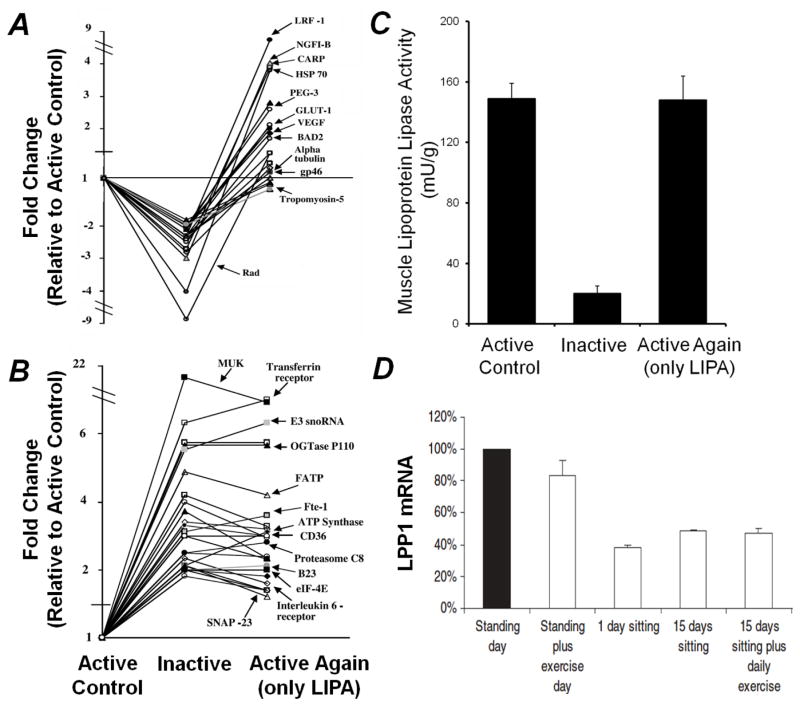
Figure 1
Figure 1
Rapid responses in skeletal muscle during altered contractile activity. A) Expression of genes suppressed by 12 hours of inactivity but restoration with 4 hours of exclusively very low-intensity physical activity (intermittent walking at 0.3 mph and standing). B) Expression of genes that are resistant to quickly being restored after prolonged inactivity (12 hours). There was also a smaller cluster of genes whose elevated gene expression during 12 hours of inactivity did return to active control levels after 4 hours of low-intensity physical activity (data not shown). A and B are adapted from reference . C) Suppression of muscle LPL activity by 12 hours of inactivity and complete restoration by 4 hours of low-intensity physical activity. Adapted from reference . D) Lipid phosphate phosphatase-1 (LPP1) gene expression in response to prolonged sitting and exercise in human skeletal muscle. Exercise did not impact LPP1 expression while the removal of daily standing/ambulation suppresses its expression thus providing evidence that the expression of some genes may be more responsive to the balance between muscle inactivity and high duration low intensity physical activity than more intense exercise. Adapted from reference .
Figure 2
Figure 2
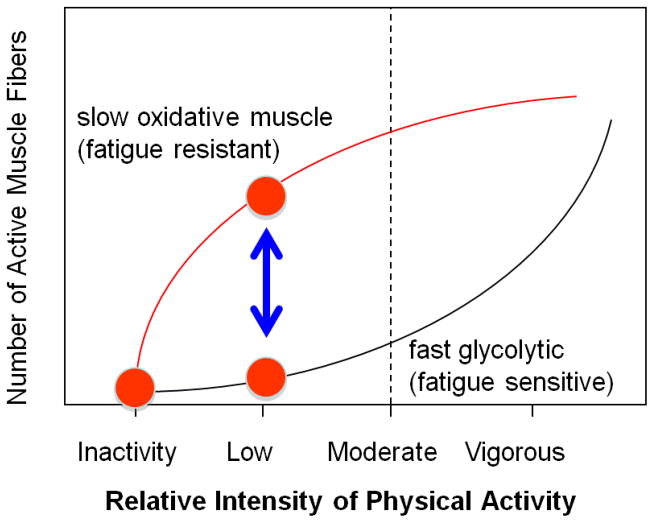
Activation of skeletal muscle recruitment over the physical activity continuum is fiber type dependent. Activity at the lower end of the physical activity continuum primarily activates slow oxidative muscle fibers that are fatigue resistant and rich in enzymes and other proteins favoring high rates of metabolism of glucose and lipids. In contrast, fast glycolytic muscle fibers are rarely recruited during low intensity physical activity. Both types of muscle are activated at maximal intensity, yet for only brief duration before extreme fatigue. There is an exponential risk of injury and fatigue as intensity is increased. Adapted from reference .
Figure 3
Figure 3
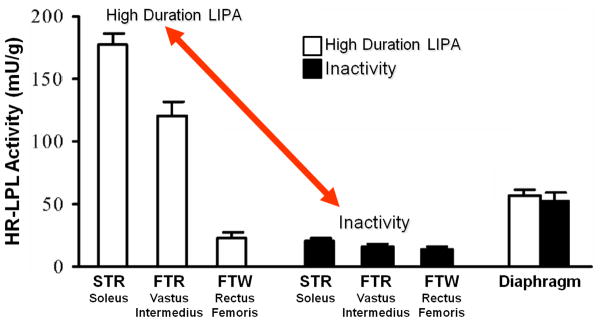
LPL activity in different muscle fiber types after 12 hours of inactivity compared with low-intensity activity. LPL activity was assessed in the slow twitch red (STR) soleus muscle, the fast twitch red (FTR) vastus intermedius, the fast twitch white (FTW) rectus femoris, and the diaphragm (which is a mixed skeletal muscle with continual activity and served as a control for systemic responses). Figure adapted from reference (59).
Figure 4
Figure 4
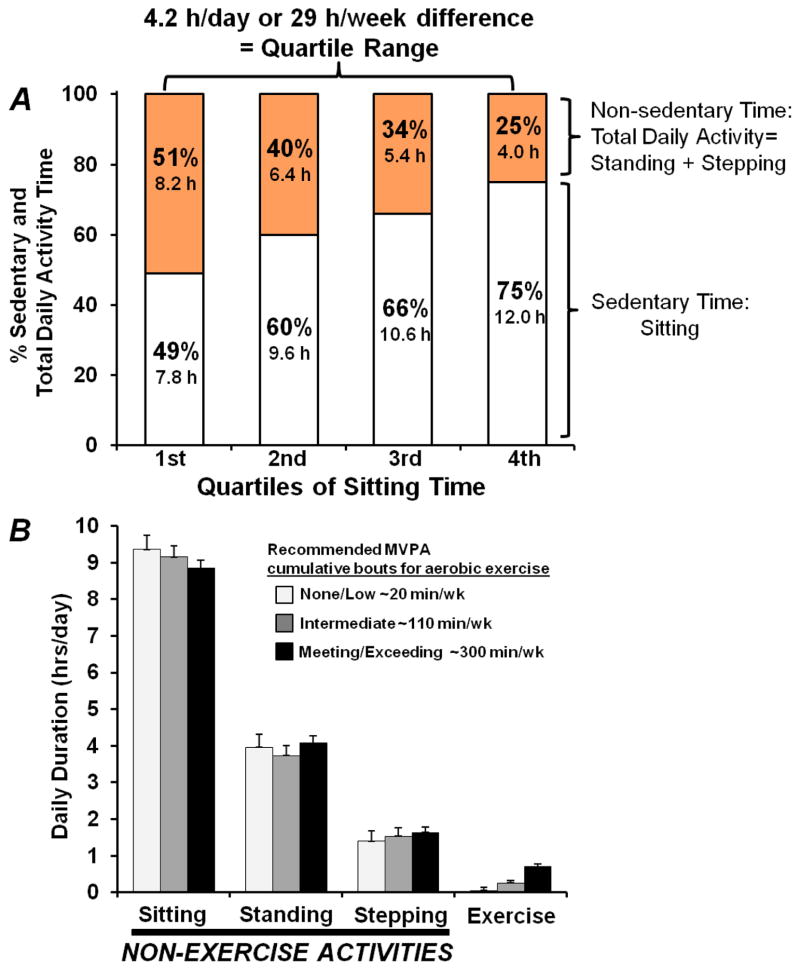
Time spent in sedentary and non-sedentary activities. A) Quartiles of daily sedentary (sitting) time assessed with activPal inclinometer in addition to non-exercise behaviors (standing and incidental stepping). There was a 29 hour/week difference in the average sedentary time and total time in all physical activity between the average of the 1st and 4th quartiles of 92 women 40–75 yrs (Zderic, unpublished observations). Thus from a public health standpoint, there is potential for large reductions in type 2 diabetes by targeting safe and feasible strategies to move the most sedentary people into the range of the least sedentary (i.e. most time of total non-sedentary activity). Sedentary behavioral differences on par with this large magnitude of time have revealed strong associations with type 2 diabetes (and metabolic syndrome) risk (see Table 1), as well as the underlying clinical biomarkers precipitating disease (e.g. hyperinsulinemia and plasma triglycerides) in persons at high risk for diabetes or already diagnosed with disease. B) Comparison of the amount of total daily sitting, standing, and stepping in 3 groups of women with large differences in the amount of time spent exercising. Notice that exercisers were not less sedentary over the whole day, even for individuals exercising up to a duration of ~300 min/week. Values are expressed as means with SEM bars. Figure 4B adapted from reference (12).

References

    1. Colberg SR, Sigal RJ, Fernhall B, Regensteiner JG, Blissmer BJ, Rubin RR, Chasan-Taber L, Albright AL, Braun B American College of Sports Medicine; American Diabetes Association. Exercise and type 2 diabetes: the American College of Sports Medicine and the American Diabetes Association: joint position statement. Diabetes Care. 2010;33(12):e147–67. - PMC - PubMed
    1. 2008 Physical Activity Guidelines for Americans. US Department of Health and Human Services; 2008. www.health.gov/paguidelines/
    1. Edwardson CL, Gorely T, Davies MJ, Gray LJ, Khunti K, Wilmot EG, Yates T, Biddle SJ. Association of sedentary behaviour with metabolic syndrome: a meta-analysis. PLoS One. 2012;7(4) - PMC - PubMed
    1. Hamilton MT, Hamilton DG, Zderic TW. Exercise physiology versus inactivity physiology: an essential concept for understanding lipoprotein lipase regulation. Exerc Sport Sci Rev. 2004;32(4):161–6. - PMC - PubMed
    1. Hamilton MT, Hamilton DG, Zderic TW. Role of low energy expenditure and sitting in obesity, metabolic syndrome, type 2 diabetes, and cardiovascular disease. Diabetes. 2007;56(11):2655–67. - PubMed

Publication types