


Population attributable risks of hypertension and diabetes for cardiovascular disease and stroke in the northern Manhattan study
- PMID: 25227406
- PMCID: PMC4323833
- DOI: 10.1161/JAHA.114.001106
Population attributable risks of hypertension and diabetes for cardiovascular disease and stroke in the northern Manhattan study
Abstract
Background: Understanding the population-level risk factor contribution to disease incidence is critical for effective allocation of resources for prevention. There are little data on the contribution of cardiovascular disease (CVD) risk factors in multiethnic elderly populations.
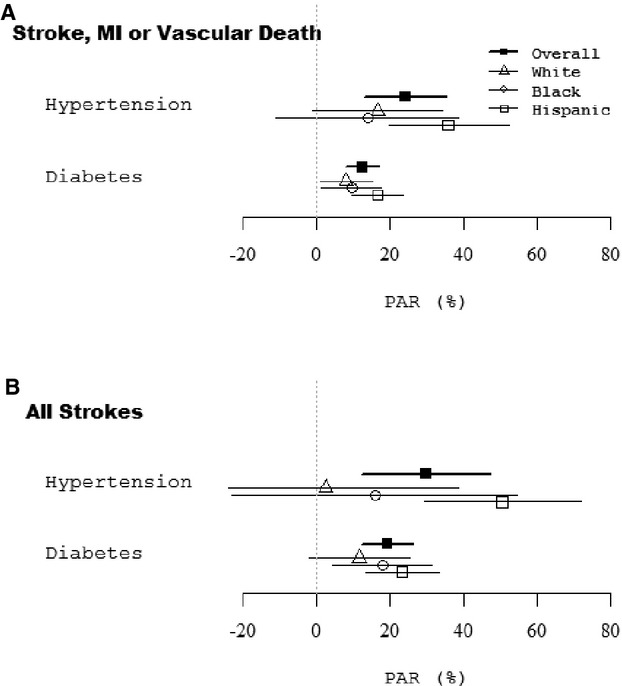
Methods and results: The Northern Manhattan Study (n=3298) is a population-based prospective cohort study of CVD outcomes in a multiethnic urban population. Multivariable Cox's models were used to calculate hazard ratios, population attributable risk (PAR), and 95% confidence intervals (CIs) for (1) combined vascular event (VE) endpoint of stroke/myocardial infarction/vascular death (n=835) and (2) stroke (n=347). The PAR resulting from hypertension (HTN) was 24.3% (95% CI, 13.2 to 35.4) for VE and 29.9% (95% CI, 12.5 to 47.4) for stroke; PAR resulting from diabetes was 12.7% (95% CI, 8.2 to 17.2) for VE and 19.5% (95% CI, 12.4 to 26.5) for stroke. The PAR resulting from HTN and diabetes for stroke differed by race-ethnicity and age (P for differences <0.05). PAR for stroke reslting from HTN was greater among Hispanics (50.6%; 95% CI, 29.2 to 71.9) than non-Hispanic whites (2.6%; 95% CI, -33.2 to 38.6) and in those <80 years of age (35.6%; 95% CI, 18.9 to 52.3) than in those ≥80 (-0.3%; 95% CI, -34.2 to 33.6). Similarly, the PAR for stroke resulting from diabetes was 23.6% among those <80 years of age (95% CI, 15.7 to 31.5) and 2.3% among those ≥80 (95% CI, -8.2 to 12.7; P for difference=0.001). The PAR for VE did not differ by age/sex/race-ethnicity.
Conclusions: HTN and diabetes have important effects on the burden of stroke, particularly among those younger than age 80 and Hispanics. Public health campaigns targeted at specific risk factors in specific populations can lead to a greater reduction in CVD.
Keywords: Aging; attributable risk; diabetes; hypertension; stroke; vascular death.
© 2014 The Authors. Published on behalf of the American Heart Association, Inc., by Wiley Blackwell.
Figures
References
-
- Go AS, Mozaffarian D, Roger VL, Benjamin EJ, Berry JD, Borden WB, Bravata DM, Dai S, Ford ES, Fox CS, Franco S, Fullerton HJ, Gillespie C, Hailpern SM, Heit JA, Howard VJ, Huffman MD, Kissela BM, Kittner SJ, Lackland DT, Lichtman JH, Lisabeth LD, Magid D, Marcus GM, Marelli A, Matchar DB, McGuire DK, Mohler ER, Moy CS, Mussolino ME, Nichol G, Paynter NP, Schreiner PJ, Sorlie PD, Stein J, Turan TN, Virani SS, Wong ND, Woo D, Turner MB. Executive summary: heart disease and stroke statistics—2013 update: a report from the American Heart Association. Circulation. 2013; 127:143-152. - PubMed
-
- Lackland DT, Roccella EJ, Deutsch AF, Fornage M, George MG, Howard G, Kissela BM, Kittner SJ, Lichtman JH, Lisabeth LD, Schwamm LH, Smith EE, Towfighi A. Factors influencing the decline in stroke mortality: a statement from the American Heart Association/American Stroke Association. Stroke. 2014; 45:315-353. - PMC - PubMed
-
- Hunt KJ, Resendez RG, Williams K, Haffner SM, Stern MP, Hazuda HP. All‐cause and cardiovascular mortality among Mexican‐American and non‐Hispanic White older participants in the San Antonio Heart Study‐ evidence against the “Hispanic paradox”. Am J Epidemiol. 2003; 158:1048-1057. - PubMed
Publication types
MeSH terms
Grants and funding
LinkOut - more resources
Full Text Sources
Other Literature Sources
Medical
